Today we’d like to introduce you to Bonnie Reddick.
Bonnie, please share your story with us. How did you get to where you are today?
I am a product of Southeast San Diego. My father was a postal worker, and my mother worked in the middle school cafeteria. I have five siblings. I am the only child who graduated from college, earning a B.A., M.A. and Ph.D. I have always been a life-long learner. I am a ferocious reader and a broad, critical, thinker. In high school, most of the girls in my neighborhood had at least one child, and they typically did not graduate. Young women, like me, were not expected to go to college. I was lucky enough to have an awesome High School English teacher, Patricia Oyeshiku, who told me that I was college material. Because she believed in me, I believed that I could go to college and be successful.
My path to my undergraduate degree can be best described as a lot of stops and starts, riddled with trauma, the death of my mother and my husband, raising two children alone, and having to work a full-time job. It took me forever, but I never gave up. I eventually earned my B.A. in Africana Studies, and I immediately enrolled in an M.A. program in English. I did not have definitive goals at the time. Education, however, was my sanctuary from sorrow and depression. Again, an awesome professor saw something in me that I could not imagine for myself, Dr. Bill Piland, asked me to apply for an internship program that taught the participants to teach at the local community college. I completed the program, and I began teaching at City College.
Later, my mentor and professor, Dr. Shirley N. Weber, asked me to teach a freshman writing class at SDSU, and I’ve been teaching ever since. That was almost 20 years ago. My life’s journey illuminates the impact one caring, nurturing teacher can have on one’s life. Each of these educators saw something in me that I didn’t see in myself. In addition to teaching our students content, a liberatory educator will help his/her students see their purpose in the world. He/she will help students become broad, deep, critical thinkers and doers.
We’re always bombarded by how great it is to pursue your passion, etc – but we’ve spoken with enough people to know that it’s not always easy. Overall, would you say things have been easy for you?
My journey has not been a smooth one. I started my college career at San Diego City College. I performed horribly my first year. Not because I was incapable, but because I was so upset that I was at a community college. I was accepted into UCLA, but my father would not help me pay for the dorms, so I had to stay home. My second year at City College, I took 3-4 Black Studies classes. The curriculum affirmed and motivated me. The professors were inspiring and nurturing. I excelled. I eventually transferred to SDSU. I dropped out of college, got married young, started a family, endured domestic violence, got divorced, and had to get a full-time job to take care of my kids.
I took classes here and there, but life happens. I married the love of my life, Christopher Reddick. My mother died a slow and painful death from cancer. Eighteen months later, my husband was killed by a drunk driver. Earning an undergraduate degree was not a priority. I eventually returned to school and finished. I often tell young women, “the race is not given to the swift nor the strong. It’s given to the one who can endure to the end”. Life happens. Inevitably, we will fall, at least once, but we have to get back up. That is the story of my life. All that I’ve been through has molded my character in a way that best supports my students. I am a nurturer and cheerleader. I have high expectations, but I will help my students meet them. We don’t know what life has in store for us, but whatever it is, we cannot give up!
So let’s switch gears a bit and go into San Diego State University story. Tell us more about your work.
In the Fall of 2019, I was given the opportunity to lead the SDSU Black Resource Center (BRC). I am charged with being meaningful and intentional in supporting Black students, faculty, staff and community in educational and social programming. More importantly, the BRC is a safe space for Black students, who only comprise 4% of SDSU’s total population, to socialize, study, bond and learn. In addition, I partner with the Charles Bell Scholar, Dr. Tonika Green, in supporting our Henrietta Goodwin Scholars (HGS), first-year Black students.
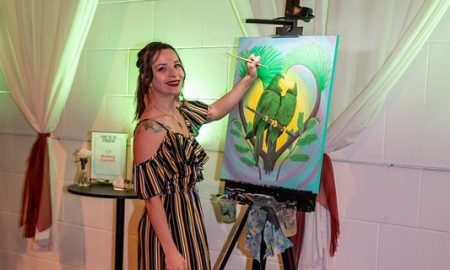
The first half of the year, my staff delivered over 90 programs. We offered academic support in Writing, Chemistry and Astronomy. We provided mental wellness support with “Talk it Out Tuesdays” and “Wellness Wednesdays”, partnering with a licensed professional to work with our students. Ayesha Kosaka lead “Paint Talks”, where students could utilize painting and conversation to respond to the world around them in a structured, creative, and supportive way. We celebrated our Alumni during Homecoming Weekend, ourselves during Kwanzaa, and the Center for our Second Year Anniversary. Our mantra is #TeamWorkMakesTheDreamWork. We need everyone on our team to contribute, and no one does it alone. We have a very supportive and loving staff, and we have produced meaningful and amazing programming.
What do you feel are the biggest barriers today to female leadership, in your industry or generally?
In my role at the BRC, my community really supports my leadership. They appreciate my efforts, and they know I care about them. As a Black female, however, outside of my immediate community, I have experienced intersectional racism and sexism. I am a confident, straight forward communicator. I am a critical thinker who is introspective, and I ask questions. Some folks interpret my style as difficult or aggressive. In meetings, I have observed white women saying the same thing that I’ve said, but their voices are soft and probing. They are not critiqued, while I’m perceived as angry. Universally, people communicate differently. I have found, however, when they want to silence or isolate Black women, they characterize us as difficult and angry.
Contact Info:
- Address: 136 West Douglas
- Phone: 6192613686
- Email: breddick@sdsu.edu
Image Credit:
Phylicia Reddick-Harvey
Mahima
SDSU
Suggest a story: SDVoyager is built on recommendations from the community; it’s how we uncover hidden gems, so if you or someone you know deserves recognition please let us know here.