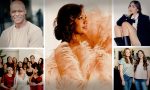
Today we’d like to introduce you to Rachel Ehlin-Smith.
Hi Rachel, we’re thrilled to have a chance to learn your story today. So, before we get into specifics, maybe you can briefly walk us through how you got to where you are today?
I started weaving 14 years ago, shortly after the premature birth of my son, Skye. It was an intense and transformative time in my life, and on the suggestion of my sister, I found myself at a Japanese weaving studio in New York called Saori. The first time I threw the shuttle, I felt something shift—it was like love at first sight. I was instantly hooked.
When I returned to San Diego, I searched for a place to continue weaving and found the Craft Center at UCSD. That’s where I really learned the foundations of weaving: how to calculate a warp, dress a loom, and weave. From there, I signed up for every weaving class I could find, eventually getting my own loom.
It took time to find my own voice in weaving and to develop the materials and techniques that feel uniquely mine. I’ve always been drawn to natural materials and subtle, earthy palettes. I love working with silk, alpaca, horsehair, dried plants, and even crystallization techniques. I like to push the boundaries of what weaving can be, often manipulating or altering the piece after it’s come off the loom.
About five years ago, I bought an alpaca and named her Poppy—after my dad, who we call Pop—because I wanted to experience the full cycle of making: from caring for the animal to weaving with its fiber.
Weaving has opened up so many doors for me. It’s brought incredible people into my life and led to creative collaborations and opportunities I never could have imagined when I started. It’s more than just a medium—it’s been a passion and a way of connecting with the world.
Over time, my work has become more sculptural and conceptual. I’ve started thinking about weaving not just as a craft, but as a language. I often draw inspiration from the natural world, domestic spaces, and the quiet intelligence of the materials themselves. I’m interested in that in-between space where something functional begins to transform, where a rug or a bouquet becomes a sculpture.
The slowness of weaving has also taught me a lot about presence and patience. There’s something deeply meditative about the rhythm of the loom. It helps me listen to myself and to the materials. Through that, I’ve found a deeper sense of purpose and connection, not only in my work but in my life.
Along the way, my practice has led to some truly meaningful moments. I’ve worked with the Mingei International Museum, had my pieces featured on the set of Grace & Frankie, and shown my work in multiple solo exhibitions. I created all of the woven pieces for the rooms at the newly renovated Jacumba Hot Springs Hotel a project that I’m extremely proud to have been a part of.
I’ve also had the joy of collaborating with Sakura Bloom, weaving and dyeing fabric for their beautiful baby carriers. It’s been such a fun and fulfilling experience. I love babies, so the idea of creating something that holds and supports them while also being beautiful and artful feels really special. Especially since I took up weaving shortly after the birth of my son.
My work has also been featured in multiple international publications and has even been forecasted in global color and trend reports something that still surprises and delights me.
Most recently, I launched a new project called Everwoven Flowers. It’s a collection of handwoven bridal bouquets made from silk thread, horsehair, and dried flowers each meant to last a lifetime. Every piece is a sculptural heirloom, blending symbolism and sentiment with texture and movement. The bouquets can be customized to include flowers that hold specific meaning for the bride—whether tied to birth months, memories, or emotional resonance. Each arrangement is designed to be displayed after the wedding, either hung on the wall or placed on a riser like a piece of art.
With Everwoven Flowers, I wanted to create something that honored tradition while also reimagining it. I wanted to offer an alternative to the ephemeral floral bouquet. Something that is tactile and intentional. In a way, it’s the culmination of everything I’ve been exploring in my practice over the years: slow making, natural materials, emotional storytelling, and the deep desire to make things that matter.
Can you talk to us a bit about the challenges and lessons you’ve learned along the way. Looking back would you say it’s been easy or smooth in retrospect?
One of my biggest challenges has been finding time and space for my creative work while raising a child. First as a new mom, and then as a single mom after splitting up with my son’s father. Balancing motherhood with studio time, applying for shows, sourcing materials, and simply making ends meet has required a huge amount of time and patience. Carving out quiet time to actually make the work especially when you’re the primary caregiver has often felt like an uphill climb.
Another ongoing challenge has been trying to distinguish myself in the world of weaving. Fiber art is having a beautiful renaissance, and while that’s exciting, it can also feel overwhelming. I’ve had to push myself to experiment, take risks, and trust the quieter, weirder parts of my creative voice in order to find what truly feels like mine.
Right now, my biggest challenge is launching a new business Everwoven Flowers which brings together everything I’ve learned as an artist, but also requires a completely different mindset. I truly believe in this project with my whole heart, and for some reason, I thought it would take off right out of the gate. When it didn’t, I had to pause and recalibrate. I’m trying to be slow and intentional with each step. I’m trying to build a strong foundation and make the right moves, but I also get distracted. Life pulls me in so many directions, and I’m still learning how to refocus and keep showing up for it. It’s humbling, but also deeply motivating, because I know I’m creating something uniquely different for the bridal market. Something that doesn’t quite exist yet.
As you know, we’re big fans of you and your work. For our readers who might not be as familiar what can you tell them about what you do?
I use traditional weaving techniques as a foundation, but I’m always looking for ways to expand and challenge the form. I work primarily with natural materials like silk, alpaca, horsehair and dried plants. I often incorporate unexpected elements like crystal growth, beeswax, and resin. I’m especially drawn to processes of heat manipulation and material alchemy. I like to see how far I can push a fiber, or how it transforms. I like to say it’s art, science, magic.
My palette tends to stay within soft, neutral ranges creams, muted earth tones, the occasional black. There’s something about subtlety that draws me in. I want the work to feel quiet but insistent.
A lot of my pieces begin with everyday objects, things that are familiar or domestic, like a rug, a dustpan and broom, or a bouquet and then I like to reimagine them as sculptural woven forms. Taking something utilitarian and turning it into a piece that invites reflection or reverence feels like an act of quiet rebellion.
There’s an ethereal, romantic quality to much of my work, something delicate and emotional that lives within the materials and the gestures that form them. I want the viewer to feel a sense of softness, intimacy, and suspended time. The work often exists in that liminal space between beauty and decay.
What sort of changes are you expecting over the next 5-10 years?
Right now, I find myself in a bit of unfamiliar territory—trying to understand and navigate the bridal industry. It’s not a world I’ve been part of before, and honestly, I’m still learning. I come from the fine art and craft world, so entering this space feels both exciting and disorienting. The bridal market has its own language and trends and I’m trying to understand how my work fits into it. Or maybe even how it might reshape it in some small way.
What I do know is that there’s space for something different. I believe more and more people are seeking objects and experiences that feel intentional, meaningful, and handmade. That’s where I see Everwoven Flowers finding its place and offering a deeply personal, tactile alternative to the traditional bouquet. A sculptural heirloom that holds meaning well beyond the wedding day.
My outlook isn’t based on data or market projections, but it’s based on intuition and a willingness to learn as I go. I’m trying to stay curious and connected to what feels authentic to me, and trust that the right people will resonate with my work
Pricing:
- $450
- $25,000
Contact Info:
- Website: https://www.everwovenflowers.com
- Instagram: mrblueskye or everwovenflowers