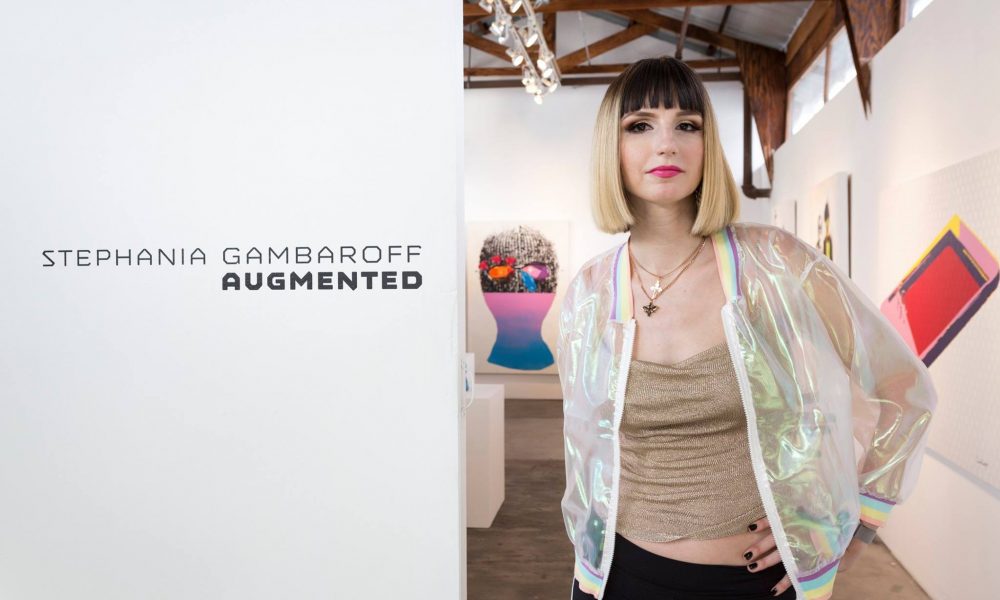
Today we’d like to introduce you to Stephania Gambaroff.
Stephania, please kick things off for us by telling us about yourself and your journey so far.
There is a time in the life of any human being when you become something. You become an X-er. It means X chooses you and you pursue X. You can’t live without it, it is an obsession, a pain, your biggest strength and alas your biggest weakness. I was born in Saint Petersburg, Russia. An only child of avant-guard artists Nina Galitskaia and Vitali Gambarov, we travelled a lot and lived in different cities. When time came for me to choose my stand against the world I went for what I knew best – art. I worked really hard and I entered an art school in Russia and I was one of the 3 women admitted to Roerich’s sculpture department. I wore men’s clothing and learnt from the best of the best how to be a tough sculptor and polished my artistic technique. I started showing my work and got involved with Pushkinskaia 10, an exhibition ground for non-conformist art of the dissent.
One year before my five year art school program was over, on a complete whim my family moved to Montreal. That same year I entered the sculpture program of Concordia University and focused much less on technique and more on analysis and critical thinking. At the time all large American productions like Aviator, Terminal, 300, Death Race 3000 were shot in Montreal. I worked on the sets both as an artist and an actor and gained interest in film. I applied corporeality and visual language I developed in sculpture to video art. My short film PowerLines won awards in Toronto and NYC, where I moved after graduation. In NYC I lived in the LES and collaborated with Eliot Sharp, who wrote music for my video series “Let’s Degrade Into Luminous Fields” examining divided into pixels human bodies, using pixels as a terrain. I exhibited with White Box and Spanick Attack and Frère Independent.
I also wrote screen plays for the WBAI radio and designed sets for film. After 4.5 years in NYC, I moved back to Montreal, where I directed and produced experimental theater plays and founded AUNA, a non-profit dedicated to helping the unheard artist voices to find a dialog and a platform. I also met the love of my life, my now husband Dave Thomas, and after a year in Montreal we moved to So Cal and married in Vegas. Los Angeles didn’t come easy like all the other cities. Pockets of civilization connected by the black brows of highways, LA is the city where one faces their demons directly. It takes a long time to dial into the energy of the city. We lived in LA Canada far away from anything happening and I grew increasingly lonely and disturbed.
I wrote a bad screen play about school shootings and created a body of drawings about alienation or pretend-closeness. After one LA gallery took my works to Miami Basel, I got so pissed at the art world. I started learning how to code and soon got a job as a coder in a gaming start-up. We moved to Santa Monica and partied a lot. My husband and I partied our faces off. We were the cliché of work hard and party harder. I wrote code and architected software systems for the next two years working for Topline Game labs, APM Marketplace and Thought-out SF. Our loft in Soma, on the corner of Market and Mission street was smack in the middle of the Twitter lane, the landmine of hypodermic needles and human feces. In the rectangle of a window are many layers of foreground, like it’s always in San Francisco – city of many layers. This is my window and in its right corner the skimpy green of a tree twitches to the rhythm of the city. Tiny in the bottom right of the frame is Jonathan. Like a sailor he is struggling with a dirty beige sheet from someone’s bed. It must have been more than his usual because all of a sudden, the police came.
Off to the ward for now. We were on our way out and Jonathan was dithering some obscure phrase for the last 40 minutes. As I was locking the door, two officers semi-circled him. Jonathan escalated the crazy. It was his usual MO, we told two more cops at the scene. When he is high. They handled him gently, maybe they know him. He climbed into the gurney without enthusiasm but on his own. And he calmed down as paramedics tied him to the gurney with some sort of long white ribbons. Maybe it is easier to handle restrains that look like white ribbons? A sheer bag-looking thingy was placed over his head. Maybe to catch his spitting? And I was off to SFMOMA.
It was the contrast between the rich, kombucha on tap offices of the tech startups and the desperate ugly tragedies of the broken lives on the street. At the same time there were the tragedies of Minnesota, Baton Rouge and Dallas, the horrible loss of lives. Juxtaposed to the Silicon Valley billionaires’ building artificial-sun bunkers for themselves for when people come after them with pitchforks. Imagine bunkers. A bunker is shelter underground, seven stories deep with a swimming pool, a winter garden and an aquarium to grow sturgeon. Under the glow of the digital sun new kind of fishes emerge in the old form.
Because we can never truly invent the new form even when we can invent almost everything else. But my point isn’t about what we can invent or not. It is about bunkers. Outside them, there is still life. Outside them there are homeless people, and waiters with pitchforks coming for those inside. If I were an application, I was ready to go in production the next day. Having been carefully developed over many months by brilliant engineers, a stack of hottest technologies, I was about to be deployed to from a few in-house stage servers to a bunch of powerful production servers. It was time.
After a year and a half in SF, I quit my job and moved back to LA. I fell in love with LA and SD all over again. I rented an amazing studio space at Keystone Art Space, met amazing So Cal artists and got to work producing my latest body of work entitled Augmented. Augmented examines the disconnect in the era of the “lust for likes”. The isolation in interpersonal relationships due to technology and the new digital age. Tech was made to make us stronger and more powerful and it did. It also made us into split beings. Like the creature with many heads I repeated paint and sculpt. We are living inside our devices while the world is changing.
It makes me want to yell to take off the googles, turn around, and see what’s right behind you, what we’re are missing. To seduce the eye, I use bright florescent colors, and then the viewer realizes there’s a deeper message, a provocative questioning. My images range from a yellow two-headed anime-eyed creature in a wheelchair, a large blue three-headed hybrid baby, and a portrait of two-headed hybrids with prosthetics, and bodies clad with VR headsets. In march 2017 I had a solo show and presented Augment to the public. My Instagram exploded with engagement and went from 100 followers to over 3k and growing. People are responding to my message and I am so grateful.
Please tell us about your art. What do you do / make / create? How? Why? What’s the message or inspiration, what do you hope people take away from it? What should we know about your artwork?
I paint on white because I feel like painting background is a lie. I try to strip away anything superfluous exposing the ‘bare metal’. I don’t like when the background is there just for decoration. This might be because I am trained as a sculptor and I think in 3D. In 2D the background, the negative space builds the positive space, but not in my work.
“This is how humanity if going to look like in the near future”, I say when I talk about my Divergent series: portraits of two-headed hybrids with prosthetics. When the technological disconnect reaches its critical mass, we will physically have to diverge to keep up with it. 2 or 3 heads aren’t a birth defect.
I explore the physical and moral dissonances generated in the result of our actual life full blood bodies “merging” into virtuality as we lose the touch with what is real and not, as the information is more and more disembodied in the age of artificial intelligence and mass shootings.
I could have made the pieces in Blender and in VR, but I chose to use spray paint and stencil. Stencils have been used to start revolutions. Stencils is like a self-replicating algorithm. Even though I use most of my stencils only once, I am fascinated with the stencil street art for its distributed nature. Same piece can create a swarm and be all over the world. It almost reflects our communication structure look at Facebook, Instagram or twitter, infinity I paint on white because I feel like painting background is a lie. I try to strip away anything superfluous exposing the ‘bare metal’. I don’t like when the background is there just for decoration.
“This is how humanity if going to look like in the near future”, I say when I talk about my Divergent series: portraits of two-headed hybrids with prosthetics. When the technological disconnect reaches its critical mass, we will physically have to diverge to keep up with it. 2 or 3 heads won’t be a birth defect.
I explore the physical and moral dissonances generated in the result of our actual life full blood bodies “merging” into virtuality as we lose the touch with what is real and not, as the information is more and more disembodied in the age of artificial intelligence and mass shootings.
My process is almost entirely digital draw the images on my iPad Pro, then I have then transferred on stencil vying and cut to multiple layers. It is only when I spray paint that my process has something to do with the past.
And I choose cement with the plastic finish for my sculptures because it both belongs to the street and has this very specific contemporary esthetics.
I love the future. I love the idea of the future. Maybe because in my western mind future means progress and hence I am convinced in the future we will solve our problems. We will be united and not divided. And we will never die.
My work is also about the present and the future, humans wearing VR headsets, they don’t just wear VR headsets. They are experiencing different reality. We can be standing next to them, with our warm bodies, smelling good, pleasant to be with. And it maybe it won’t matter because there will be a choice. A choice of different reality. We dwell, we desire with heavy wet souls and sole glopped up in the sacrificial blood to experience something without consequences. We can surely delight in the weightlessness and the light of having no responsibility and being in a save space with wires and controllers.
The mouse is clicking in the other room and the dog is barking outside and mayday dog’s name is Roo. I put on my headset in my sunlight studio downtown and I watch the digital leaves fall from the tree in uptown Manhattan. And everything is possible.
Do you think conditions are generally improving for artists? What more can cities and communities do to improve conditions for artists?
Community is the most important thing for the artists. Even though most of us aren’t well adjusted social creatures being among other people is key for producing relevant and meaningful work. Isolation is dangerous. Cities need to foster interaction between artists and audience, artists and artists.
What’s the best way for someone to check out your work and provide support?
To support my work please follow me on Instagram @gambaroff_io. And check out my site on www.gambaroff.com My new sculptures are currently exhibited at the Hive Gallery through November. And there is a show coming up in Hollywood in March, I will announce it on IG. Stay tuned!.
As an artist, how do you define success and what quality or characteristic do you feel is essential to success as an artist.
I’m just going to just use one word. Obsession. That is what’s required. Like Charles Bukowski said, find something you like and let it kill you.
Contact Info:
- Website: www.gambaroff.com
- Email: stgambar@gambaroff.com
- Instagram: https://www.instagram.com/gambaroff_io/
- Facebook: https://www.facebook.com/stgambaroff/
- Twitter: https://twitter.com/gambaroff


Image Credit:
Photo credit Cam Sanders, Mark Harvey, Savage Glory Photography
Getting in touch: SDVoyager is built on recommendations from the community; it’s how we uncover hidden gems, so if you know someone who deserves recognition please let us know here.