Today we’d like to introduce you to Mckenzie Smith.
Mckenzie, please kick things off for us by telling us about yourself and your journey so far.
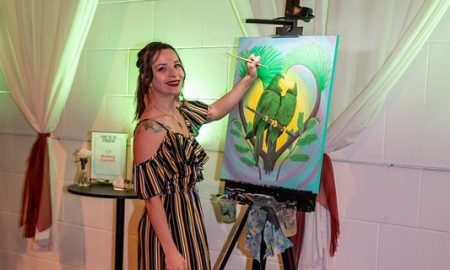
I have always been interested in art and always enjoyed creating things, thanks to my creative parents. My mom loves DIY projects and my dad enjoys woodworking and creating model cars and airplanes. I’ve drawn pictures (mainly of people) for the majority of my life, but I didn’t start to actually become good at it until my senior year of high school. I’ve never really taken an art class outside of elementary school, but for some reason thought it would be a good idea to apply to SDSU as an art major. I completed my first two years there with an emphasis in graphic design, but as I got further into the program, I realized I was less interested in graphic design and more interested in all the studio classes I was taking, so I switched my emphasis to multimedia. Now, I still get to take classes related to graphic design, but I’ve also had the opportunity to dip my toes into other areas such as painting, animation, 3D design, photography, and more. Serious painting never had much of an appeal to me as a child, but now I’ve completed 3 courses of it and have had my works selected for multiple campus installations. I love being able to focus on minute details and render realistic portraits and am looking forward to ways I can push my art in the future!
Can you give our readers some background on your art?
Most of my works are painted portraits of people, either on canvas or wood panel. I tend to focus less on conveying an explicit message and usually try to push myself to create realistic images. I love painting detailed portraits on top of simpler backgrounds, like stained wood or deep space. A lot of my works could be considered fan art since they are tributes to people I love/look up to. For example, one of my more successful paintings (“Harley”) is a portrait of my favorite music artist, Flume. It is oil and acrylic on wood panel, and the background colors of scraped pinks and purples are a nod to the cover for his second album, “Skin”.
This one was created with a lot of time and love, and I exclusively listened to his music during the creation of it. Another piece I am proud of is “Mia No. 1” and is made in sort of dual homage to both Quentin Tarantino/Pulp Fiction as well as the music genre dubstep. I initially went into the painting wanting to capture the way that dubstep makes you feel, which is how the background came to life. I blasted some dubstep and splattered and poured paint onto this giant, loose canvas to try and capture the chaos of the music. One of the songs that I was listening to said “god damn” in the drop, and I wanted to tie that into the image, which is where the idea to add Mia Wallace came in. Basically, my work tends to be a personal exploration of things that I am interested in, more like a visual diary of my thoughts and moods versus a political outlet. A lot of artists tend to create work as a response to or reflection of things happening in society, and that is great. But I prefer to take a more introspective look, and instead analyze myself and what makes me, me.
Do you think conditions are generally improving for artists? What more can cities and communities do to improve conditions for artists?
I believe that there is a huge abundance of resources available to people to push and grow their own art abilities. There are so many programs in both popular and niche subjects that can really teach you how to hone in your skills if you are willing to find them. And at least out here in California, it is a lot more acceptable to be an artist. There is a huge art community where everyone is encouraging and supportive of your work. I know so many artists through both school and outside relationships whose art overlaps and often work together, like photographers and painters or sculptors who collaborate and create immersive multimedia shows. It’s fantastic, and I love that there is so much collaboration and support in the art community. It’s less about fighting to be in the spotlight and more about working together and learning from each other in order to grow as an artist. I do think it is really difficult to become famous or make a lot of money, especially if you plan to move to one of those traditional “art cities”, like San Francisco or New York. Those places are so overfilled with artists that it can be hard to have a distinct presence and pull yourself out of the crowd.
But if you’re adamant about getting discovered and making this a career, you can always move somewhere with a budding art community or create your own community in a totally new place. I think people tend to believe that in order to become successful, they must move where the art is booming. And that can be true, but it is so hard to get popular in cities that are already packed with people who all have the same dream. Cities like San Diego are great because of how much they value the art community. It’s great to be able to drive and see every utility box uniquely painted and see giant murals on buildings all over. These city projects are awesome because they get artists to work together and get their art seen, but also bring art to places that need it most.
What’s the best way for someone to check out your work and provide support?
As of right now, I am not showing in any exhibits, but all future shows and website/print info can be found at my art Instagram: @m.smithart
Contact Info:
- Email: mcsmittylee@gmail.com
- Instagram: @m.smithart


 Image Credit:
All works are original pieces.
The “Series of Geishas” are all pieces inspired by works by Phil Couture.
Getting in touch: SDVoyager is built on recommendations from the community; it’s how we uncover hidden gems, so if you know someone who deserves recognition please let us know here.