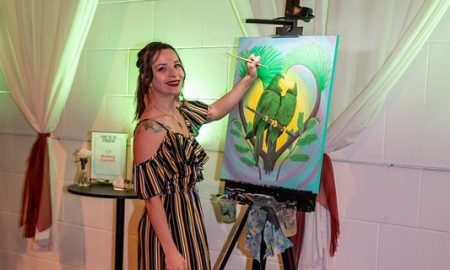
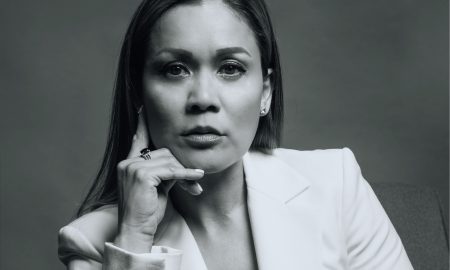
Today we’d like to introduce you to Sayamon Riddang.
Sayamon, please kick things off for us by telling us about yourself and your journey so far.
I’ve had an interest in art since high school. When I first went to college, I was an engineering student. In all my engineering classes there wasn’t much art in my curriculum, so a couple of years in I wanted to take art classes to balance out the math and science. I took sculpture, drawing, but was really interested in my Typography class. In my third year, I switched my major to graphic design. I knew that I wanted to do something that involved a combination of art and math.
After graduation, I started my career as a Graphic Designer working in multiple marketing and advertising agencies. I had worked with many creative-minded people, doing things like print ads, packaging, logos, flyers, and identity branding. I started seeing a big demand in the industry for web designers, that’s what it was called back then, and had an opportunity to take on web design projects. Designing for the web was a combination or art and math, and right there I kind of knew I wanted to move in that direction and away from traditional visual design. Even though deep down I still have a lot of appreciation for visual design.
Over a course of ten years, I’ve transitioned from a Visual Designer to a User Interface and Experience Designer A lot of times people would ask why you design something a certain way, as a visual designer you think it’s objective, there isn’t a good reasoning why someone likes your work. For me, it’s important to answer that question. So I started looking more at user experience and the research. So when clients or teams ask “Why did you design it that way?” you have an answer.
I got into software product design when I started working for local San Diego startups. When you get into product design, you start looking at the research and finding out why you’re doing this thing. That’s more important to me now: do I believe in this thing. When you work on it over time, you have to be in it every day to understand the product. And you end up understanding why the problem exists, what are possible solutions and how people use it. You can go back and revise it, make a better solution in every product iteration. I think that’s why I became more interested in product design because you can see it go from a vision to the end state of a delivered product. Whereas visual design you might design a billboard, and someone might see it and say cool, but at the end of the day the billboard gets taken down.
Everything you include in the product is a little bit of you as well. There is a saying that everything you design in a product, or something you have to use, there is a little bit of emotion attached to it. That’s because you always want to make sure that the person using it is happy. So that’s like putting your emotion into your work. A product design has more ties to it. The challenge when you’re a Product Designer is that you have to balance what the client needs, what the users need, and what industry the product is in. There is more context you need to gather.
I always liked change. Changing the environment, the industry I work in, the work itself. None of it has to be a completely different thing or objective requirements, but I’m always looking to learn something new.
Can you give our readers some background on your art?
My focus is working on digital software, designing all aspects, user researcher, the flow of the software, and the user interface. I do a lot of branding work for companies that are starting out, helping them get the brand together. More about working with people — new business owners, team of engineers and developers — to bring visions to life, especially in a tech startup environment.
As to why this? It all comes back to an ability to create something that combines of art and mathematics.
What’s the message or inspiration, what do you hope people take away from it?
Being able to adapt your knowledge. I think a lot of designers are afraid of changing their area of work “oh it’s a different medium, I’ve never done software or web”. You’re always going to be learning, and that applies to multiple different fields. You always need to evolve your knowledge and skills. You need to put in an investment, whether in time or money, you should put that investment into their career or something you’re truly passionate about.
What should we know about your artwork?
Changing how people work or live for the better, and utilizing technology to do that, but doing that in a natural way not forceful. Designing it so it’s natural enough that people don’t realize they have to use it.
In your view, what is the biggest issue artists have to deal with?
Seeing a big gap, a lot of large companies, especially in tech, are hiring people and looking for people at senior level or looking for entry level. So there is a huge gap for mid-level. Causing entry-level people, harder for them to get into the field, a lot of companies don’t have time to mentor entry-level designers.
It’s exciting to see so much opportunity and growth here now. If life becomes easier and harder in recent years, it’s easier in SD in that there is more jobs. In the past a lot of sd move out because there were no jobs or they were traditional design. But more people coming and investing.
What’s the best way for someone to check out your work and provide support?
I work with a handful of startup companies in software industry, help create a marketing website or MVP of the products, and brand identity.
If you know someone who is creating something or starting a software company, I would be interested in helping and working with the team.
Contact Info:
- Website: iamqueenbee.com
- Email: saya@iamqueenbee.com
- Other: https://www.linkedin.com/in/sayamon/


 Image Credit:
Joel Arnold
Getting in touch: SDVoyager is built on recommendations from the community; it’s how we uncover hidden gems, so if you know someone who deserves recognition please let us know here.