Today we’d like to introduce you to Haiwa Wu.
Haiwa, we’d love to hear your story and how you got to where you are today both personally and as an artist.
I drew for fun in elementary school, mostly drawing animals and Pokemon because those interested me the most. Oh, and dragons. Really, anything creature-like caught my attention. I branched out to drawing people later, something that was helped along by my mom signing me up for art classes. Sketching still lifes and figure drawing were some of the best things that happened to me, even though I wasn’t so enthusiastic about it at the time. The classes helped build technique and observation skills: some very important things in an illustrator. I’m thankful to my parents for their support in the makings of my artistic career.
I continued drawing through high school, making up characters and stories about them. After graduation, I went to art school to pursue illustration, for the main purpose of illustrating children’s books and designing characters. Now that I’m approaching the last year of my degree, my interest in future prospects has broadened, yet character design and children’s book illustration remain near and dear to me. I find a really great children’s book can have such a positive effect on people. I’d like to create something, a character, a story, that can connect with people and inspire them.
We’d love to hear more about your art. What do you do and why and what do you hope others will take away from your work?
I create a lot of character-focused art, mostly of animals/animal-like creatures. I still find them the most compelling to draw, and I like putting in the research in deciding what species to choose. My art is generally light-hearted with a touch of humor — I like to bring joy to the viewer!
By far, sketches outnumber the amount of finished illustrations I’ve made. I spend a long time in the sketching part of the creative process. I’ll draw from reference (life or photo) to get a feel for a subject or achieve greater accuracy, or I may start with loose shapes. I’ll sketch various iterations of a subject until I settle on something; many of these preliminary drawings are messy or boring and only seen by me, but they all help me find my focus. I enjoy sketching because I find it the most productive and expressive. The lines are looser, and the characters feel like they have more life. Still, it is nice seeing the impact a finished illustration gives to a character or scene.
I love drawing in a wide range of style and media. I often draw in a more simplified cartoon style, but on occasion, I veer into semi-realism or even cubist-inspired, as in a recent painting I did illustrating a scene from Kafka’s The Metamorphosis. I use both traditional and digital tools and combine them. The past few months were filled with copious amounts of painting: watercolor, ink, acrylic, and mixed media. Earlier in 2018, I started creating vector art in Adobe Illustrator; I’d like to dive back into that again this year. If I were to choose one thing though, my all-time favorite medium is graphite on paper. It feels to me the most natural way to visualize the idea in my mind. Only thing it can’t do so well is color. So if I were to choose two media… graphite and watercolor… or graphite and digital… oh no, there’s too many choices.
The stereotype of a starving artist scares away many potentially talented artists from pursuing art – any advice or thoughts about how to deal with the financial concerns an aspiring artist might be concerned about?
One piece of advice, it can be tempting to buy the cheapest materials to save money. Some things can certainly manage: copy paper and pencils work just fine for preliminary drawings, ballpoint pens make a fairly good line. But other times, the material used greatly affects the final product. Watercolor is a prime example. Cheap watercolor papers don’t hold water well, and cheap paints don’t show color well. It’s tempting to practice on lower quality paper and save the good paper for final paintings, but the two surfaces react very differently. By practicing on the higher-quality paper, the artist becomes better acquainted with its properties and can see how painting techniques will turn out in the final piece. This makes for more efficient learning. While more expensive, it’s an investment in one’s artistic career.
Do you have any events or exhibitions coming up? Where would one go to see more of your work? How can people support you and your artwork?
Apart from seeing my study room desk in person, people can check out my Instagram account (haiwawu) to stay up to date with what I’ve been drawing. As a side note, though I try, not everything is posted in chronological order, usually due to having to find time to properly scan or photograph traditional pieces. If only I had a large-format scanner in my apartment! Certain pieces I put up on my portfolio website, and there they can be seen at a higher resolution.
I have a Redbubble shop (haiwawu) that I’m gradually adding product to. It features some of my illustrations available as stickers, shirts, mugs, bags, notebooks, what have you. I’m also open to freelance work and commissions; contact me through my portfolio website or Instagram private message to discuss.
It brings me joy that people like my work. I always take time to read and reply to comments. I like to support my peers in turn, and see what wonderful friendships rise from the connection.
Contact Info:
- Website: wawuworld.carbonmade.com
- Instagram: instagram.com/haiwawu
- Other: redbubble.com/people/haiwawu


 Image Credit:
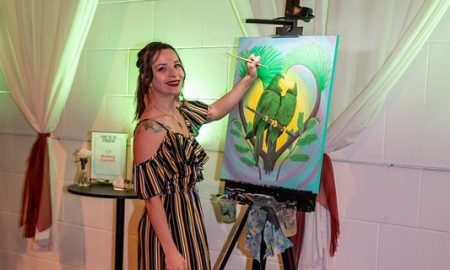
Photo taken by Erin Beccia, Embellished by Haiwa Wu.
Getting in touch: SDVoyager is built on recommendations from the community; it’s how we uncover hidden gems, so if you know someone who deserves recognition please let us know here.