Today we’d like to introduce you to Michael Howard.
Hi Michael, thanks for sharing your story with us. To start, maybe you can tell our readers some of your backstory.
Thank you for the honor and opportunity to be profiled in your magazine.
Browsing through the stories of the folks here, I am struck by how truly amazing their accounts of perseverance, inspiration, and strength shine through. And a shout-out to my friend Danny Florenzano who was recently profiled. What a profound sense of determination and grit he exhibited in his journey in becoming a filmmaker.
As for my own path, I hail originally from Paramount, CA, a south-central inner-city suburb of Los Angeles bordered by Long Beach, Norwalk and Compton.
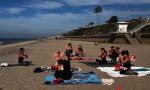
It was my first year in high school at Paramount High when I broke my neck at age 14, plunging my summer plans into chaos and my neck into a halo for three months. It happened at a local beach not far from my home. As an incoming wave rose before me, I ran toward it and dove in like I had done numerous times before. This time though, the velocity and strength of the wave’s crest crashing into the trough, or bottom region of the wave, hurdled me fast and hard to the ocean floor. My head slammed suddenly onto its uneven, hard packed sandy surface.
My vision flashed white, and time disappeared. There was no time. There was no space. Just white. I awoke and I was still on the beach’s shoreline. Waves continued to crash around me, rising over my prone, face-down body. A thought came to my mind. “I can’t move.” I tried to “feel” my body, but there was no such thing. No feeling, no body. “I’m paralyzed!” I frantically thought to myself.
Fear and panic engulfed my thoughts. “I’m going to drown right here, lying flat on my face,” I thought as kids splashed about me playing with plastic buckets and shovels, dads with beer belly’s lumbered about in the water and soccer moms preened and laughed amongst themselves. All the while, water rose over my head, depriving me of oxygen. With each wave, my face sunk deeper into the sand, creating a hollow concave bowl for the water to fill and settle around my ears.
But providence, or luck, or some other force of the universe had other plans.
“Hey, Michael, what are you doing? Why you just lying there?” I heard my friend, Rick ask.
I had travelled to the beach with my friends that day, but the injury to my head had completely wiped away that fact from my memory.
“I can’t move!” I shouted into the wet sand, sputtering water and sand about my face as I attempted to scream loud enough for him to hear.
He did what I later learned was the exact very thing you should never do to a person with a spine injury. He grabbed my wrists and dragged me higher up the bank of the beach, saving me from drowning but potentially jeopardizing my life in other ways. With all good intentions, he turned me over onto my back, so the hot sun seared my face and eyes while he hovered over me.
“What happened, man?” he asked, his thick burrowed eyebrows creased with concern.
“I dove into a wave,” I simply said.
As Rick ran to the closest lifeguard station, I began to run through the cast of my friends who might help me end my life. As a 14-year-old teenager, there was no question in my mind about one thing. I would not live a life paralyzed. No thoughts of how it could work. Or if it would work. Didn’t even cross my mind. I only thought of how I could end it. Almost comically, I imagined one of my friends pushing me in a wheelchair over the cliff of some dramatic bluff overlooking crashing waves onto the rugged, jagged rocks below.
It was about this time that I began to feel my fingers tingle. It was the same sensation as when your hand or arm fall asleep. Your limbs are numb, but you feel the needle-like prickly feeling sprinkle across your fingertips. I still couldn’t move any of my limbs, but I felt my fingers!
By the time lifeguards arrived and a crowd formed around me, I could actually feel all my limbs, but was prevented from moving them by two lifeguards holding them down, telling me not to move. But I wasn’t paralyzed!
Over the next several weeks, I lived in the hospital. The first two weeks were spent in traction, where prongs held my head in place and the weight of my body lying sedentary atop an inclined hospital bed stretched and set my vertebrae into the correct position.
Then came the halo. This was a medical contraption that kept my head upright, facing forward, unable to move. A metal band of steel circled my head, held into place by four screws that were literally bolted into my skull with the help of a liberal dose of morphine. The band of metal around my head was then attached to four alloy rods that extended to a collarbone and shoulder jacket that was cinched tightly to my chest with straps and buckles. Not the look a puberty bound teenager in his first full summer of high school wanted, but it was better than being thrown off a cliff in a wheelchair.
So it came to pass that this was the summer when I learned the valuable life lesson of priorities. Of what really matters.
And since then, I’ve come to, what many may say, is an illogical answer. Art matters. And in particular, the art of storytelling. That’s what matters.
If you think about it, everything comes back to storytelling. Love. Purpose. Meaning. Passion. Family. Friends. All of these important principals, values, and morals are attached to an origin story. Why you love your spouse. And your kids. How you found your passion. What defines you. The answers are in the stories we tell ourselves and each other. For eons, the stories we told each other was how we survived — oral traditions of agriculture, hunting, religion, healing, of how to start a fire were passed down with storytelling.
That’s why in 2023 I launched the San Diego Indie Film Network on the Roku platform. This important channel is currently the sole independent film television channel that showcases San Diego artists and filmmakers. No where else will you find a collection of diverse, rich and powerful stories in one place, all from our very own neighbors, friends and family right here in San Diego.
The channel is free — you simply need to download it to your Roku device and browse the many genres and formats of short, feature and series shows that tell important stories of life, love, meaning and purpose. That doesn’t mean it’s all roses and ice cream, though. If you like crime, action, drama, suspense and intrigue, there’s shorts and features with those elements there — whatever the story, it’s there.
I encourage everyone to download the channel and support the art of storytelling. And then, tell others about the channel. We are currently building our inventory of titles and our audience. With just a little over 30 titles, we’ve already garnished 1,700+ channel downloads, averaging about 250 downloads a month. We’re catching on, San Diegans know great content when they see it. You should join us too!
Alright, so let’s dig a little deeper into the story – has it been an easy path overall and if not, what were the challenges you’ve had to overcome?
It hasn’t been a smooth road creating the San Diego Indie Film Network by any means.
To create a Roku channel, you must learn how to code. This in itself is a journey that requires a lot of time, even more patience, and a certain level of tedious attention to detail. And I don’t have that. So I embarked on learning what I could then recruiting a friend who does have the talents needed to help. Together, the channel came together over the span of many months as he coded the ‘backend’ and I worked on loading the content on the ‘front end.’
But the biggest hurdle has been getting the word out and building the trust of the film community. Filmmakers and content creators face numerous challenges themselves and unfortunately one of them is being scammed by distributors. Their hopes of making it big and breaking through to Hollywood are exploited and used to manipulate and deceive. Scammers will say they can introduce them to famous stars, or get their films onto streaming channels. Often these promises will be accompanied with a demand for money, sometimes extravagant amounts.
My struggle has been balancing the need to pay for the bandwidth, storage, and administrative time it takes to add content to the channel with the skepticism content creators and filmmakers have rightly developed. I have landed on charging $10 fee to upload content, but even this relatively small amount is met with resistance. Once the channel reaches a certain threshold of channel downloads and average users, Roku offers an advertising program whereby an ad plays before every title. The threshold is 5,000 monthly downloads and 500 monthly average viewers. We’re not there yet, hovering around 250 monthly downloads and under 25 average users, but as we build both inventory and viewers, I am confident we will reach this threshold within a year or so.
Thanks for sharing that. So, maybe next you can tell us a bit more about your work?
What sets the San Diego Indie Film Network apart from any other streaming television channel is our dedication to showcasing San Diego based filmmakers and being the pioneer channel to do so in our television market.
As of today, the San Diego Indie Film Network is the only San Diego television channel dedicated to the indie film community.
I’m proud of the talented and diverse content creators who strive to tell powerful, impactful stories that live right here in San Diego. It’s an honor and a privilege to showcase them on the channel.
So maybe we end on discussing what matters most to you and why?
What matters to me most is the opportunity to tell impactful, powerful stories that connect us all.
This matters to me because we have a limited time to make a difference to the people around us. For the short time we are here, our mission ought to be to build up and raise each other up — an activity that, in its own right, creates a cycle of enrichment, agency, and purpose for the individual who practices it. What it also does is, connect us. Reminds us we are all essentially the same, even as our diversity and uniqueness define our individuality, we all feel the same emotions, overcome many of the same obstacles, and all strive for common goals of love, life, happiness and meaning.
Pricing:
- $10 to upload content
Contact Info:
- Website: https://sdindiefilmnetwork.com
- Facebook: https://www.facebook.com/sdindiefilmnetwork


Image Credits
Movie poster photos used with permission per section 10 and 12 of the agreement found at https://michaelhowardproductions.com/terms. Hello Cannabis by Michael Howard Nephilim by Bernard F. Kellish Minutes, Moments, Memories by Javier Fernandez Black Trump by Emanuel Hodge Don’t Let Me Sink by Vu Mai A Chateau in the Loire by Terry Ross Unsaid by Jennifer N. Linch