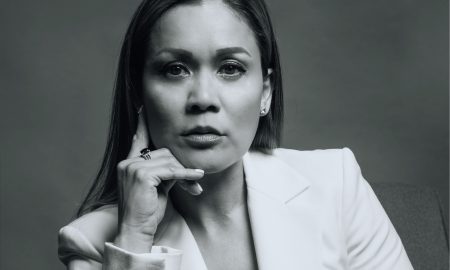
Today we’d like to introduce you to Yasmine Kasem.
So, before we jump into specific questions about what you do, why don’t you give us some details about you and your story.
I was brought up in a small city in central Indiana. My father came from a farming village in Egypt and my mom was from Wisconsin. We were one of the few Muslim families in a predominantly white Christian town. Though I didn’t begin to comprehend race, religion, and identity until I was eight years old. When 9/11 happened, I didn’t really understand what was going on. I knew something bad happened, but I couldn’t grasp the reality of the situation. I remember kids at school saying that Muslims were bad and that the US should bomb the whole middle east. These comments from my fellow 3nd-grade classmates forced me into a position of defending my religion, having to answer for and condemn acts of terrorism committed by extremists. It felt so unjust, and I was deeply angered by it. However, I learned how to act and talk to people in those situations through watching my father speak at a larger scale. Islamophobia became something I experienced and encountered frequently as a grew up. In local news papers, national news and personal interactions. As a teen, I had been writing in my local paper, responding to ignorant and bigoted articles which had really fueled my desire to reach a wider audience than my home town.
Originally, I’d wanted to be a Jazz drummer, but went for a degree in fine art because I believed that art would be a better medium to address the misconceptions of Islam, Muslim Women, and S.W.A.N.A (southwest Asia and North Africa) cultural practices I’d heard so often. I received my BFA in sculpture from Herron School of Art and Design in Indianapolis, and during my time there, I started to develop a sculptural practice to create a dialogue about misconceptions about Muslim Women. Through this method, I could have generative and transforming conversations with peers or audiences at exhibitions.
When I moved to San Diego to work on my MFA at UCSD, I continued this practice for a little but started to find issue with my work because I was making art about topics and practices in Islam that I didn’t necessarily subscribe to or perform myself. My work wasn’t representing me as an individual. Muslims often get compacted into a monolithic entity, which is what contributes to gross misconceptions. There have been strides in representing the diversity amongst Muslims, but there should be more. Realizing that, it became imperative that I make work to reflect my own experience. However, it’s been very difficult to speak about certain aspects of identity openly.
Overall, has it been relatively smooth? If not, what were some of the struggles along the way?
There’s a part of my identity that I’ve been dancing around, to avoid speaking about publicly. It’s complicated and exhausting but I kept dancing around it because I was afraid of what would happen when I stopped. However, the exhaustion from avoiding to talk about being a Queer Muslim is outweighing the fear at this point. I’ve felt like not talking about it, especially regarding my art practice has been holding me back. I feel that regardless of it being a very precarious position of being a Queer Muslim, it’s worth it to be in a state of precariousness than to give in and hide or reject one of my identities for the other. It’s difficult to maintain at times, there are so many risks especially when it comes to relationships with family and community. The loss of those relationships are still real fears I have, especially since I am not out to some family.
My current work reflects my experience as a Queer Muslim Woman. It took me a while to make art about it, and even longer to talk publicly about it, but I feel so much happier and fulfilled with what I make now. Transforming the precariousness I feel and translating those emotions into abstract sculptures and installations lets me look at my identity in different ways and find solutions to some of the issues I encounter, such as isolation and validation. Although talking about being a Queer Muslim Woman through my work publicly puts me in a vulnerable position, there’s strength and value in being vulnerable.
Sometimes it can be intimidating talking about the topics that I do. I used to feel like there was a lot of responsibility to say or make something just right or I was going to make the entire Muslim community look bad. But at the end of the day, it’s no one individuals job to represent a community. In fact, staying true to your own experience is a great way to represent and exhibit diversity within a community.
Advice I would give to young women starting out down this path is to not try to meet any expectation of what you “should” be, or the type of art you “should” make. The art world can be intimidating, and so can your peers. In my experience, putting a lot of pressure on yourself to make something that would sound good or would please a specific community or person really stifles what you’re capable of. Sometimes, the best work can be scariest to make but it can also be incredibly liberating.
Please tell us more about your work, what you are currently focused on and most proud of. What sets you apart from the competition?
I am an artist, I work predominantly in sculpture and installation. I make work about identity, presence, and tension. These days, my work is abstract in form and is coming from a more emotional and personal space. I’m also working heavily in soft materials and textiles. Although early in my practice, I was much more interested in the figure, faces, and hard materials like bronze stone and steal.
Currently, I am interested in the layers of identity and how they unravel. I’m working through this concept through material’s that I feel exhibit properties I see within myself and my identity. I’ve been working with a soft material called cotton piping and its unraveling. Within this process, I am seeking the limits and breaking points of the materials’ properties and amplifying its fragility. In the making of a piece that threatens collapse or teeters in balance, the material displays the power behind its fragility and the foreshadowing of possible change. I am also interested in the ambiguous properties materials can yield and how the same material can have many faces. I also utilize this process of material exploration through installation and space building. Creating places for the tensions to ease and the strength of fragility to be seen.
What do you feel are the biggest barriers today to female leadership, in your industry or generally?
There’s a lot to address, but I think generally, we’re not taken seriously and given the respect we deserve. Even though there has been more vocal support for women in leadership positions. There’s also a lot of need for intersectionality and action to show support, across all fields. If you support the idea of female leadership, and actual women in leadership roles, show it with actions too. Make way for intersectionality, pay equally, support events produced and organized by women and women identified with your attendance.
Contact Info:
- Email: kasem.yasminemfa@gmail.com


Suggest a story: SDVoyager is built on recommendations from the community; it’s how we uncover hidden gems, so if you or someone you know deserves recognition please let us know here.