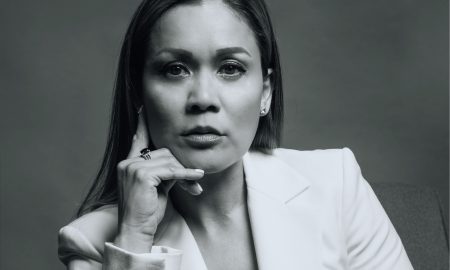
Today we’d like to introduce you to Tiange Zhou.
Hi Tiange, can you start by introducing yourself? We’d love to learn more about how you got to where you are today?
I was born into a family of artists in a smaller city in China. My father is a director and actor, and my mother is a nurse but also a semi-professional dancer. My first performance on stage was about four months after my birth. This experience I don’t remember may have been carved into my subconscious mind. This probably also destined me to live a creative life. Meanwhile, I remembered when I was little, my father always hosted salons every couple of weeks and invited his friends who were poets, writers, painters, photographers, and musicians to have to tea afternoon or if I define it ” smoke afternoon” to talk about art, philosophy, society, etc. And I was always around them since I was two years old. Those events definitely made a strong influence on my future life, a life as a creator and also an interdisciplinary collaborator, a life in which I constantly work with people from many different areas. Like most Asian kids of my generation, I started to learn the piano when I was about four years old. And from the beginning, I was not a child who only practiced the piano. Since taking piano lessons for about a month or two, I have started to create something I like.
When I was about nine years old, I solemnly announced to my parents that I would become a composer in the future because only playing other people’s works made it difficult for me to find my own voice. I am grateful to my parents for taking the idea of a child very seriously and sincerely supporting me, even if there is no musician in the family. When I was fourteen years old, my family moved to Beijing. From this point, I started to have the chance to receive professional composition training. Fortunately, at the age of 16, I was admitted into the high school of the Central Conservatory of Music High School in composition major as one of the five students admitted that year among the applicants from entire China. My very first composition teacher Prof. Du Yong was a really unique person. Instead of telling students what to do, he was often just sitting in his studio quietly and pushed the student to figure out a certain point they have been stuck “by themselves”.
It was not easy in the first place; I remembered there were some lessons. Both of us did not talk a word for at least 15 minutes. Well, probably it was not that long, but the silence was really just unbearable. Of course, after 15 minutes of silence, he would give some directional comments. But still, he encouraged the independent mind and critical thinking, which was not so common at the music school in China at that time. In the conservatory, I received the most brutal and intense French school, Russian school style training on music fundamentals. However, because of my very special composition teacher, I have space to breathe the free air and compose the works I was sincerely interested in. During my time in the conservatory high school, I often sneaked into the lectures and master classes of the conservatory college. I guess I would see my education of contemporary music was from these places when I listened to university professors or guests from other places talked about compositions from composers all over the world, including sat in a lecture Matthias Herrmann, a music theory professor from Stuttgart, Germany talked about contemporary music ideologies from Mozart’s works and listened to people talked about the music of many American composers such as David Lang and Roger Reynolds, whom I would not imagine at the moment that I will study with them ten years after in my Master’s and Ph.D.
That was the years right before the Beijing Olympic Game, in which the conservatories there started having a lot of international collaborations and academic communications with people outside of China. It was a good time for a young composer like me to absorb new and challenging ideas. In 2010, I left home and moved to New York to obtain my college education at the Manhattan School of Music. It was a completely new environment for me. And it was indeed challenging and exciting. A city with most people from all over the world really gave me a lot of good nutrition. Being able to collaborate with people and live in a diverse environment is what I have been looking forward to my entire life. During my undergraduate study, I could not count how many concerts and theatre performances I have been to and how many musicians from different parts of the world I have been working with during my study there. And almost every Saturday, I prepared two bagels with cream cheese and peanut butter and a bottle of water or coffee and visited the Metropolitan Museum for at least ten hours.
At school, it was not easy at the beginning too. I remember that my English level in the first place could not even support me enough to understand music history courses, which I ended up recording the lecture and went back to listen five times after the class. But I think it was a good challenge, and I would highly recommend everyone to live at once in their life out of the linguistic comfort zone. Because it could effectively develop the ability of empathy and also identify oneself better. My composition advisor at Manhattan School is German composer Reiko Fueling, who is distinguished from my advisor at high school. Of course, he has also been extremely supportive and encouraged students’ creativity and critical thinking. However, he has a very profound and systematic plan for me to make sure I receive a comprehensive education as a composer. Besides writing music, I was asked to hand copy the entire score of the influential repertories in contemporary music history, for example, Ligeti’s woodwind quintet, Boulez’s Le Marteau sans maître (Hammer without a Master), Morton Feldman’s King of Denmark, etc. I was also asked to analyze a lot of Bach’s works and played them on the piano while I analyzed them. I remember at the time I studied with him, I was banned from using the word ” just” because as he mentioned, there was no “just”, I had to be serious to give reasons for my choice in composition.
During 2012-2013, I got an opportunity to attend an exchange study program at the University of Music and Performing Arts at Stuttgart, Germany. It was a very interesting year. I had to admit that the culture shock at the beginning was more challenging comparing the time I moved from Beijing to New York. But it has also brought new dynamics to my music creations. I started getting opportunities to go around Europe, attend music festivals, and work with musicians all over the world outside of the school settings. Since that year, I have always pushed myself to visit a country or at least a new city every year to extend my scope and challenge my awareness of the real world. And indeed, adventures excite me. After another year in New York City, I moved to New Haven in the summer of 2014 to pursue my master’s degree in composition at Yale University.
By following the Yale School of Music tradition, I have studied with every teacher there, including Martin Bresnick, Hannah Lash, David Lang, Aaron Jay Kernis, and Christopher Theofanidis. Besides the music school education, I sat in many courses at the school of drama, school of art, school of architecture, school of management, and school of law. These experiences really deeply enriched my knowledge and my empathetic understanding of people in different fields, which provided me even more passion for working with interdisciplinary peers. Meanwhile, I got my first teaching job at Yale as a teaching fellow at Yale College Music Media Lab. And from there, I realized teaching is going to be a very significant part of my life. Now I am in my fifth year of the Ph.D. program and going to graduate next month. I could not express how fortunate to be in a group of the most challenging and exciting musicians and to learn new thoughts and ideas on a daily basis.
I am very thankful for getting opportunities to work independently with Prof. Mark Dresser, Prof. Tom Erbe, Prof. Wilfrido Terrazas, and Prof. Victoria Petrovich and sit in the seminars with Prof. Rand Steiger, Prof. Miller Puckette, Prof. Chinary Ung, Prof. Jann Pasler, Prof. Katharina Rosenberger, Prof. Sarah Hankins, and Prof. Nancy Guy. My Ph.D. advisor Prof. Roger Reynolds, is never just a great mentor for me, he is a friend, a family member, and a person who has always encouraged me to be myself, work on my best to embody my idea into a promising level, and never give up that idea for even one second. Meanwhile, I treasure my fantastic peer colleagues, who support me sincerely with their friendships, and always keep pushing me to develop and confirming my ideas with their creative and critical minds. In UCSD, beyond keep creating music, I am also lucky to be granted plenty of opportunities to teach. Until the end of 2020, I have already taught five courses independently and going to have a couple more before I graduate. I could not agree more that teaching is also learning. My students always inspire me significantly while I am teaching them at the same time. All in all, I guess I could never be who I am right now without the inspiration and support from all these great human beings I have encountered in life.
We all face challenges, but looking back, would you describe it as a relatively smooth road?
Yes, there are definitely challenges, but these also provide opportunities for me to establish myself by most of the time accepting different comments and improve from that point, or other times be strongly guard my belief no matter how the resistance would be. For instance, in some situations, when people come to my concert and expect to receive the serving of standard “orange chicken”, I have to disappoint them because I do not really enjoy serving exotically flavored post-card music. And I have issues when my music is judged by if it is “women” enough or not “women enough”. I guess I value more the fact that every human has the own identity, and it is very much depending on one’s experience and belief. From what I believe, it sounds too naive to make a conclusion of any individual with only a few keywords. Humanities are multilayered and complicated, and that is also one of the most important reasons why we are beautiful and exciting, aren’t we? If there is something that I wish to be remembered, it will be my works, or me associating with my works, but not me, as an isolated “some person”. I guess how to be a person with identities but not be overly labeled is not only a challenge for now but also something we will always need to be careful and keep working on in the next decades of life.
Thanks for sharing that. So, maybe next you can tell us a bit more about your work?
I am interested in developing large size music pieces from relatively condensed musical ideas, like planting a “seed”, or even smaller, a “cell” and making it grow into a tree or an architecture. Therefore, the structure of the work and how musical events happen during a certain amount of time is quite crucial. There is always more than one layer of compositional process in my creative works. In past years, I started spending a longer and longer time on one single work because it takes time to sculpt the shape of the work appropriately from the concrete which I have prepared by myself and many times with very specific collaborators. Instead of composing for certain instruments, I enjoy composing for performers. When I talked about the identity of myself, I value the individual musicianship and creativity of collaborative musicians and how they play their own instruments. The collaborative progress could make me learn a lot of perspectives I have never thought about before.
Meanwhile, as a person from a theatre family, it is very natural for me to imagine the performances of my works as whole immersive experiences. For me, there are no such things as “adding” on “lighting,” or “adding on” stage design, or “adding on” costume design, the so-called “multimedia elements” of performance have always been evoked in my mind at almost the same time of music creation. I sincerely wish my audiences could take all the different elements from my performances. Of course, I am open for audiences to interpret the work based upon their own choices and experiences. But if one pays attention to some details, he/she could really find some interesting metaphors that bring the experience into different dimensions.
We love surprises, fun facts and unexpected stories. Is there something you can share that might surprise us?
As with most of my crucial events in life, moving to San Diego was not planned in the first place. In fact, in my last year at Yale, I was not so sure if I would pursue a Ph.D. immediately after my master’s study. In November 2015, my piece for a percussion quartet “Beginning of Origin” was selected by a Grammy winner percussion group -Third Coast Percussion as one of the repertoires in the Chinese composer percussion piece concert at Chicago Art Institute. At the rehearsal space of the ensemble, I have encountered another composer- Prof. Lei Liang from UCSD, who has a world premiere in the same concert. Then, something very special happened in my life. By sharing the uber ride from the rehearsal space to downtown Chicago, in about 15 minutes, Prof. Liang convinced me that UCSD is “the place” for me to have a future I have been looking for for a long time. How impressive! I sincerely appreciate this very unique encounter.
Contact Info:
- Email: tiangezhoumusic@gmail.com
- Website: https://www.tiangezhoumusic.com/
- Instagram: tiangezhouphotography
- SoundCloud: https://soundcloud.com/tiange-zhou-1