Today we’d like to introduce you to Chelsea Hill.
Alright, so thank you so much for sharing your story and insight with our readers. To kick things off, can you tell us a bit about how you got started?
I was born in Metro Manila, Philippines, as a child of divorced parents. My father was an alcoholic living in the United States and my mother raised my sister and I on her own in Manila. In 2005, when my sister and I were in middle school, my mother thought that we should pursue our education in the United States. At this point, my father had been sober for some time so we ended up moving in with him in a very rural town called Bandon, Oregon. My experience coming of age in that town was full of microaggressions, fresh-off-the-boat jokes, and perpetual foreigner stereotypes. Throughout this time, my father started drinking again and he became abusive. Because of his alcoholism and inability to provide for me and my sister, we both started working service jobs to keep ourselves afloat. At the end of my senior year of high school, we ended up losing the home we were staying in. I was technically homeless and had to rely on friends to help me until I could move into my freshman dorm. I couldn’t wait to leave that town and ended up going to college over 5 hours away outside of Portland, Oregon. I received a scholarship to attend Pacific University in Forest Grove and received my Bachelor’s in Anthropology and Sociology with a minor in Gender and Sexuality Studies. After the abuse, I experienced at home and separate incidents involving assault and harassment, I wanted to learn more about ways to prevent gender-based violence. My thesis project would eventually become a sexual assault prevention training intended for college students, that was rooted in methods of bystander intervention.
After finishing my Bachelor’s, I moved to San Diego, California. After a couple of years, I decided to pursue my Master of Social Work to continue the work I had begun in my undergraduate career. Over the past few years, I have been working with survivors of violence as well as immigrants and refugees in the San Diego area. In May of 2021, I completed my Master of Social Work from Boston University and have continued my advocacy work. I recently accepted a new role as the Manager of Continuing Education and Training for an organization called the Institute on Violence, Abuse, and Trauma. Through the work of this organization, I am so grateful for the opportunity to address different types of violence at a systemic level and work towards prevention in our local communities.
Alright, so let’s dig a little deeper into the story – has it been an easy path overall, and if not, what were the challenges you’ve had to overcome?
It has definitely been a difficult journey. First were my experiences as an immigrant coming to a new country and having to assimilate. It took me many years to realize that I lost pieces of myself and my culture in that process and I am still constantly trying to reconnect with the parts I’ve lost. For example, my language. I do consider myself fluent in Tagalog conversationally, but I am constantly working to regain a lot of the vocabulary I have lost over time.
Then dealing with my father was also really difficult. My sister and I both had to grow up really fast and learn to take care of each other. My mother was all the way in the Philippines and she never fully realized how bad things were because I hid it from her out of pride. What saved me was having an amazing system of friends and community members who knew I was struggling and stepped in to help when I really needed it. That’s part of what inspired me to do the same for others.
Alright, so let’s switch gears a bit and talk business. What should we know about your work?
I am a macro social worker and essentially all that means is I am trying to make positive social change at the macro-level of our communities. My past experience includes being a domestic violence counselor, survivor advocate, case manager, and program manager.
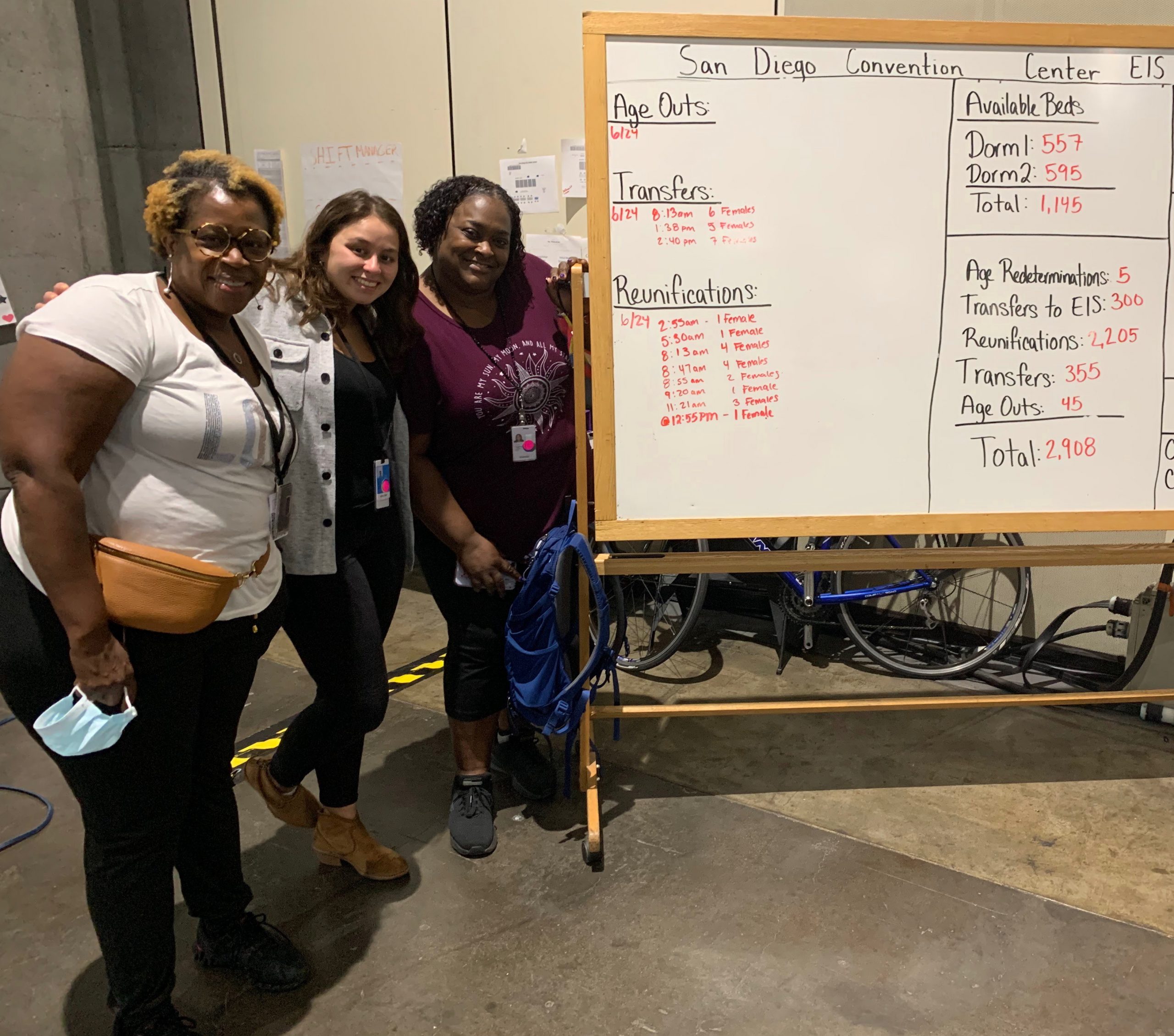
Last year, I was part of a very big project that involved collaboration among local, state, and federal governments, as well as several non-government organizations across San Diego County. Between April and July of 2021, the U.S. Federal Government converted the San Diego Convention Center into an Emergency Intake Site for unaccompanied migrant children entering the United States. This influx of immigrants occurred as Biden rolled back Trump-era anti-immigration policies and many sites were opened across several border cities, with San Diego being the largest. I had a unique opportunity to work at the site as the transportation coordinator. We provided trauma-informed care to children at the site and worked to reunite them with their family members in the United States. By the end of the project, we were able to remove over 2,000 children from ICE (Immigration and Customs Enforcement) custody and reunify them with their families.
Like I mentioned previously, I recently accepted a new role as the Manager of Continuing Education and Training for an organization called the Institute on Violence, Abuse, and Trauma. I am excited to use this role as an opportunity to continue my work in violence prevention. As an immigrant and a survivor, myself, I want to do everything I can to make our communities safer, especially for our most marginalized people.
What do you like and dislike about the city?
After living in rural Oregon for so many years and being 5 hours away from the nearest Asian grocery store, the best thing about moving to San Diego was finding a Filipino community. For Filipinos, food is a very big part of who we are and how we show love and having access to Filipino grocery stores really changed how I’ve been able to reconnect with my culture and my childhood. In addition to the food, the weather also makes me feel more at home. I love waking up to sunshine most of the year.
There isn’t much I dislike about the city; however, I do think there are many things that our community can improve. For me, this means increasing access to secure, affordable housing, and other necessary resources.
Contact Info:
- Instagram: instagram.com/itsmeshellsea