Today we’d like to introduce you to Dia Bassett.
Hi Dia, so excited to have you on the platform. So before we get into questions about your work-life, maybe you can bring our readers up to speed on your story and how you got to where you are today?
My work began as a way of listening—first to materials, then to my body, and now to the space between grief and renewal. Two years ago, when my husband died, the ground shifted beneath every definition I had of love, home, and purpose. Raising my daughter alone has been both an anchor and an expansion—an ongoing balance between strength and surrender.
Out of this turning came a changing language for me: movement stitched with fabric and flowers, gestures layered with history, and breath laced with memory. I began creating costumes and performance pieces that embody transformation—born from meditations on poisonous plants, whose dual nature mirrors the paradox of healing and harm, beauty and danger.
Through this work, I seek not only to express loss but to metabolize it—to trace the alchemy that makes life out of endings. Somewhere amidst my evolving art landscape, I rediscovered joy—strange, vibrant, and alive in the same soil as sorrow.
We all face challenges, but looking back would you describe it as a relatively smooth road?
No, not smooth—but deeply textured. My path as an artist has wound through many terrains: teaching, arts administration, and long pauses where creating had to wait. There were times when sustaining an artistic practice felt almost impossible, like as a new mom, and it often seemed the art world had closed its doors. So, I learned to build my own doorway—to create the kind of space where my work and life could coexist. At the start of the COVID pandemic, when public spaces were closed, an art exhibition I had work in was closed because the museum was shut down for over a year.
So I made my small apartment I shared with my husband and two-year old daughter into a studio space by weaving directly on the walls.
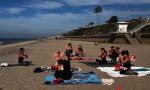
The dance studio where I took modern dance classes was also shut for over a year, and I started taking pole-dancing at a studio that was having classes outdoors.
Just after that, a California Arts Council Emerging Artist Fellowship encouraged me to keep faith in my voice, even when the direction wasn’t yet clear. But it wasn’t until this past year that my work truly transformed—after loss, after rebuilding, after beginning again. The return to making art has felt like a homecoming, uneven and imperfect, but alive with purpose.
Thanks for sharing that. So, maybe next you can tell us a bit more about your work?
I build performances that weave together sculptural costume, movement, and ritual. I create costumes and textile installations that I design and construct by hand—often from vintage garments, natural fibers, and found materials. These pieces act as both sculpture and skin, transforming with movement and embodying the tension between vulnerability and resilience. What I’m exploring now feels like a dialogue between grief and transformation—how the body can become a vessel for both. My recent work has been inspired by meditations on poisonous plants, whose dual nature reflects the complexity of healing: beauty and danger intertwined.
I have also worked for many years in arts education and administration, helping other artists realize their visions. It has taught me the value of community and collaboration, which continue to shape how I approach my own work. Working in the arts continues to inspire me and inform my own practice as I get to witness other artists and performers excel at what they do.
My current practice is raw, exploratory, and often cathartic—an unfolding process of rediscovery. I blend my background in modern dance, theatre, pole dance, sculptural installation, and textile work to create performance experiences that engage the body on multiple levels. I hand-build costumes and wearable sculptures that shift with movement, becoming a second skin through which emotion can surface.
In my meditations with poisonous plants, I often encounter visions of my own death—imagery that has become a catalyst for exploring cycles of ending and rebirth in my performances. These experiences, paired with the profound loss of my husband, have shaped my work into a kind of ritual choreography, honoring transformation in all its forms.
People say they feel drawn into the transformation—witnessing not a character, but my body moving through grief, resilience, and joy. That shared, embodied experience is what sets my work apart.
Is there something surprising that you feel even people who know you might not know about?
Most people don’t know that I lived in Italy for almost a year when I was in college. In a vow to learn Italian, I didn’t speak English in public spaces. So for the first two or three months, I was almost silent in public, until one day a stranger greeted me in Italian. I think that stranger’s voice cracked the code and helped boost my confidence trying to speak and learn Italian.
Contact Info:
- Website: https://www.diabassett.com
- Instagram: https://www.instagram.com/diewerke______artandlife/


Image Credits
Personal Photo:
(Still frame of video) Anthony Muñoz
Tim Hardy –Morning Glory dance photos
Ben Dulay–framed dried flower photo
Alejandro Arreguin Villegas–Triangles–Triangular wall weavings