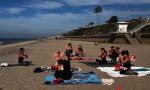
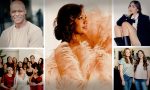
Today we’d like to introduce you to Leslie Seiters.
Hi Leslie, so excited to have you on the platform. So, before we get into questions about your work life, maybe you can bring our readers up to speed on your story and how you got to where you are today.
Art rooms have always felt like charmed spaces- in schools and studios, and theaters. After studying visual art in college, I moved to my first city, San Francisco, the place I still consider my art home. In the mid ’90s, I saw “Contraband,” directed by Sara Shelton Mann. These performances were wild and gorgeous and included singing, flying bodies, political rants, and piles of gravel. Seeing this work shifted my artmaking more firmly to dance and performance. Dancing with Jo Kreiter/Flyaway Productions, I became increasingly enamored with dance and how it can be beauty and community, and protest.
Can you talk to us a bit about the challenges and lessons you’ve learned along the way? Looking back, would you say it’s been easy or smooth in retrospect?
Engagement in art as experimental and counter-cultural is a challenge: How to tend to distributary channels or trickles that exist outside of the dominant flow of “mainstream.” How to engage in dance that practices tuning in to what is emerging especially when it seems “off-track,” divergent, or precarious. How to create art that purposely evades a commercial niche (given success and opportunity are largely tied to market-driven productivity and entrepreneurship). How to fund projects, pay collaborators, and participate in art-making communities where resources are scarce, and funding options reflect business models by default? How to be in relation to “popular” (at times including full indulgence in pop culture) while also questioning, countering, and conjuring alternatives? How to promote work that is not representational, does not abide by familiar logics, is not based on language or stories- yet contains all the above in circuitous, undercover, or inexplicable ways? When prominent social, political, and aesthetic streams flow toward commercial value, representation, and recognizable, the challenge is to continue making “other.” Dance can do things that language cannot, and Art can do something that business models cannot. This does not feel like a problem to be solved but a value system to hold, practice, and learn from.
Alright, so let’s switch gears a bit and talk business. What should we know about your work?
“Experimental” is a term I use because it locates research in the figuring out. Annually, I assign students the “Embarrassment” chapter of Anne Bogarts’ “The Director Prepares” (a dog-eared text I annually re-read and re-consider). She writes, “If your work does not sufficiently embarrass you, then very likely no one will be touched by it… The best way to avoid embarrassment is to treat the material at hand as a known entity rather than an unknown one.” Through processes of making, I practice “in-Directing,” disorienting, catching unplanned poetics, (re)claiming edges, questioning norms, making mistakes, and not-landing. Students and audiences are often familiar with dance that promotes unison, recognizable virtuosity and illustrates the lyrics or feeling of a song or a personal or social message. The direct impulse to cheer out loud as a response to witnessing any of the above is an incredible feeling. I love this about live performance- the charge of collective celebration, agreement, or inspiration. And there is a less common shared experience of leaning in because we are not quite sure what we are witnessing, the aliveness of a collective silence that holds too many questions to make a declaration- I place value on the latter because it happens less and less (And it currently feels like we need it more and more.) Colloquially, “embarrassment” accompanies a misstep and refers to something that should not have happened (and will hopefully soon be forgotten). What if bumps, accidents, and complications are signs that we are near the edges of what we know, and rather than avoid them, we consider them as guides? For me, performance is a place to be exposed in the activity of research rather than a presentation of research findings.
What matters most to you?
For me, now, connections matter most. Connection to lineage and what will come, to collaborators and audiences, to gravity, motion, and weight. Connection to dancing and making with full animal bodies. Connection to Wilder and Wider. The magic of live theater matters. The immediacy of being attentive (even simply in-attendance) with other live bodies as something unfolds over time. Dances I make do not have overtly political messaging- but not because they are not political. The focus is on what dance does, not what it means. The activism is in the how, in the radical practices of connection and collaboration, and attention to less familiar, hidden, or other ways/knowings/perspectives/logics.
A student who studied with me commented, “I think we are getting better at making coincidences happen.” At first blush, I thought this student missed the point- the premise of coincidence is its unplanned, unaccounted-for nature. Over time, her words have grown in resonance. As a teacher and artist, “making coincidences happen” does feel central. It’s like magic and miracles- not about creating illusions, but being awake to feel them (especially when we can somehow exit the “mainstream” of what awe, beauty, virtuosity, and dance “should” look like).
In the absence of a singular or overt message, I see audiences veer towards conclusions like “This isn’t about anything,” or “It’s abstract,” or “I don’t get it.” I want audiences to know that meanings are multiple and their engagement and perspective is part of the work. If the performance can create a context where audiences feel this, perhaps they can engage in the work without trying to “get it right.” If the work can cue permission and space, might audiences practice an encounter unencumbered by prescribed meanings and expectations? Might audiences connect with more of their sense experience, bodies, and capacity for multiplicity of meaning and logic? Dancing is by, with, and of human animals- for me, it is never an abstract engagement. When compositional aspects like shape, cadence, and intensity are applied to humans, meaning happens; I value dance practices that usher in possibility in how we know, relate, and create order. Doing so can influence what we notice, allow and encourage in ourselves and our surroundings.
Contact Info:
- Website: https://leslieseiters.com/
- Other: https://vimeo.com/user1360535