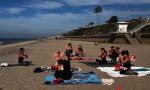
Today we’d like to introduce you to Dr. Tomas Frymann.
Hi Tomas, so excited to have you with us today. What can you tell us about your story?
I grew up in La Jolla by the ocean in a very active, connected environment where sports, nature, and close relationships were part of everyday life. From an early age, I was curious not just about performance or achievement, but about what actually makes for a good, meaningful, and enjoyable life over time — physically, psychologically, socially, and spiritually.
That curiosity gradually evolved into a deeper inquiry into life’s big questions: What is consciousness? What is the nature of self? Why do certain experiences lead people to feel more alive, compassionate, and connected? I was drawn to contemplative traditions, particularly Buddhism and Zen-influenced perspectives, which approach well-being not as something to optimize, but as something that emerges from understanding our interconnection with life itself.
After I had an experience with psychedelic mushrooms, I became particularly fascinated by the perspective of non-duality. I came to an awareness that I am to the universe as a wave is to the ocean; what I call Tomas is a temporary pattern emerging from an underlying whole we call the “universe.” I asked myself what it would be like to exist from the perspective of the whole universe itself. The notion that arose is that which I call the SuperSelf: the idea that the universe itself individuates into the experience of each unique being. It exists in multiple places, or selves, all at once, like “superposition.” While superposition describes a quantum particle in multiple places at once, SuperSelf describes the fundamental experiencer, the universe itself, existing in many positions at once. It is every single living being that exists, all at once, yet individually. Anywhere an experience is happening, that is the universe individuating itself into that being. And I recognized that that is what I fundamentally am. This concept was reified across the years for me as I entered onto my path as a psychedelic facilitator and explored the realms of Ayahuasca, Iboga, 5-MeO-DMT, and San Pedro.
I spent years studying psychology, meditation, and cross-cultural approaches to consciousness, including time practicing Vipassana meditation and learning from indigenous and contemplative traditions that emphasize relational identity rather than separateness. This path eventually led me to pursue doctoral research in the Spirituality and Psychology Lab at Columbia University, where my work focused on self-transcendence, meaning-making, and what I call Interbeing — the lived recognition that we are both distinct individuals and expressions of an interconnected whole.
My academic work has centered on developing empirical tools to study integration and identity change following profound experiences, including meditation, peak experiences, and non-ordinary states of consciousness. This resulted in the first validated measures of Psychedelic Integration and Interbeing Identity, which are now used internationally in research, clinical, and educational contexts. Alongside research, I’ve worked in hospitals, universities, hospice care, and veteran support organizations, helping facilitate and integrate transformative experiences into daily life in grounded, ethical, and psychologically healthy ways.
I later founded As We Wake, a nonprofit dedicated to connecting culture to Interbeing through research, education, community living, and creative projects. At its core, the work is about helping people live with greater clarity, responsibility, joy, and connection — drawing from psychology, contemplative wisdom, and modern science. Today, my focus sits at the intersection of research, community formation, philosophy, and community design, with the broader aim of contributing to a culture that understands well-being, identity, and consciousness in a more holistic and humane way. We just recently bought a property in Byron Bay, Australia and are expanding As We Wake abroad.
Alright, so let’s dig a little deeper into the story – has it been an easy path overall and if not, what were the challenges you’ve had to overcome?
In many ways, it actually has been a smooth road. I’ve been fortunate to experience a great deal of joy, friendship, mentorship, and meaningful connection along the way. Much of my path has been guided by genuine curiosity and a sense of alignment, which has often made my work feel less like struggle and more like a natural unfolding. I’ve consistently been supported by inspiring teachers, collaborators, and communities that made the journey feel shared rather than solitary.
That said, there have been substantial challenges. My mom died of cancer when I was 25 years old and I also walked alongside my brother in a long and challenging mental health journey. Those experiences sharpened my appreciation for resilience, compassion, and responsibility.
Professionally, working at the intersection of science, spirituality, and mental health also requires discernment and patience — learning how to communicate complex, deeply human experiences in ways that are ethical, rigorous, and accessible. Overall, the combination of joy and challenge has been formative. It’s helped me trust the process of growth, stay oriented toward connection, and hold both curiosity and care at the center of my work and life.
As you know, we’re big fans of you and your work. For our readers who might not be as familiar what can you tell them about what you do?
My work focuses on helping people experience, understand, and embody non-duality — not as an abstract philosophy, but as a lived way of relating to themselves, others, and the world. I’m interested in how shifts in identity and perception can translate into greater ease, compassion, clarity, and enjoyment of life over time.
I’m especially proud of As We Wake, the nonprofit collective I founded, which is centered entirely around non-duality and Interbeing. It’s a living ecosystem that brings together community living, creative projects, research, education, and experiential learning. The organization explores how non-dual understanding can be expressed through how we live together, collaborate, care for one another, and engage with culture.
Alongside this community work, I’m known for my scientific research on Psychedelic Integration and Interbeing Identity. I developed the first validated measures in this area, which are now used internationally across research, clinical, and educational contexts. That work reflects my commitment to bridging rigorous science with the realities of transformative human experience, without over-pathologizing or oversimplifying it.
What I’m most proud of, though, is the relational impact of the work. I place a strong emphasis on personal integrity, presence, and embodiment — recognizing that how we show up matters as much as what we teach. Maintaining the quality of my own inner state, and letting that inform how I listen, respond, and lead, has been central to the positive impact I’ve had on people and communities.
What sets my work apart is that it’s identity-centered rather than technique-centered. Non-duality isn’t something I see as a peak experience to chase, but as an orientation that can be lived, practiced, and embodied in ordinary moments. That perspective allows the work to remain grounded, ethical, and deeply human, while still engaging with cutting-edge research and cultural innovation.
Are there any apps, books, podcasts, blogs or other resources you think our readers should check out?
I tend to draw from a mix of contemplative wisdom, psychology, philosophy, and consciousness science rather than any single source. Certain books have been especially influential in helping me live well, not just think well.
On the applied spirituality side, The Four Agreements by Don Miguel Ruiz, The Power of Now and A New Earth by Eckhart Tolle, The Untethered Soul by Michael Singer, and Thich Nhat Hanh’s Living Buddha, Living Christ have all offered practical, grounded guidance for bringing awareness into everyday life. Khalil Gibran’s The Prophet and the Dalai Lama’s The Art of Happiness remain timeless companions.
In terms of non-duality and identity, books like Alan Watts’ The Book and The Way of Zen, Sam Harris’ Waking Up, Charles Eisenstein’s The More Beautiful World Our Hearts Know Is Possible, and Magnus Vinding’s You Are Them have been especially clarifying in articulating interconnectedness in ways that feel both poetic and rational.
From a scientific and psychological perspective, I often return to works by Daniel Siegel (Mindsight), Martin Seligman (Flourish), Mihaly Csikszentmihalyi (Flow), Giulio Tononi (Phi), and Carl Sagan (Cosmos) — all of which bridge rigor with wonder.
In the psychedelic space, Michael Pollan’s How to Change Your Mind and Ryan Westrum’s The Psychedelic Integration Handbook stand out for their thoughtful, responsible framing, especially around meaning-making and integration rather than novelty.
I also find fiction to be one of the most powerful spiritual teachers. Short works like Andy Weir’s The Egg, along with The Alchemist, Zen and the Art of Motorcycle Maintenance, and The Little Prince, often communicate truths about identity and purpose more directly than theory ever could.
Rather than relying heavily on apps, I tend to prioritize meditation, reflection, meaningful conversation, and time in nature. Overall, the resources that help me most are the ones that don’t just inform the mind, but gently reorient how I relate to myself, others, and life as a whole.
Contact Info:
- Website: https://www.aswewake.com
- Email: drfrymann@gmail.com,
- Instagram: @aswewake, @tfrymann
- Facebook: @aswewake