


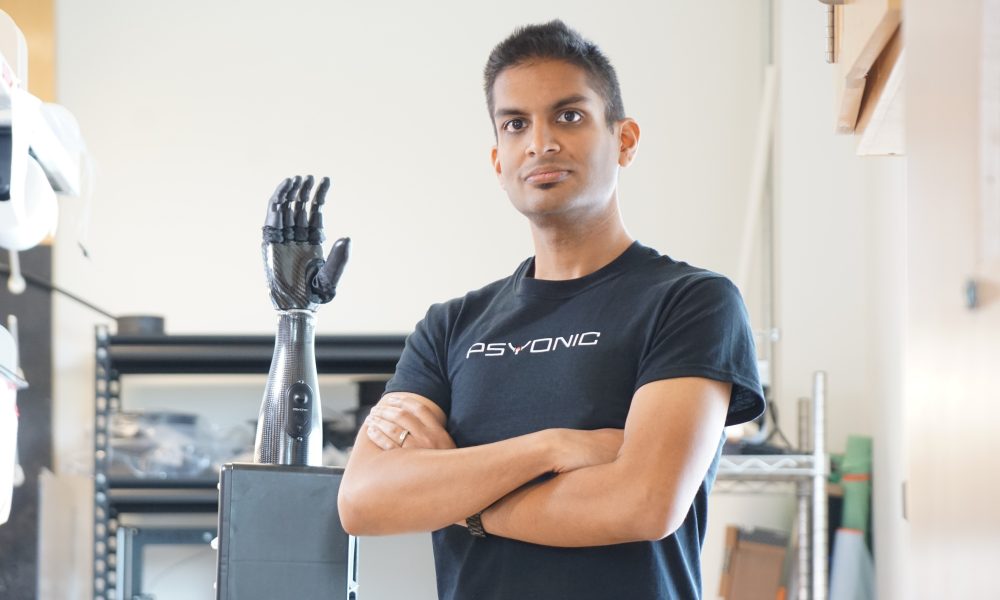
Today we’d like to introduce you to Dr. Aadeel Akhtar.
Alright, so thank you so much for sharing your story and insight with our readers. To kick things off, can you tell us a bit about how you got started?
When I was 7 years old, I met someone with a limb difference for the first time. She was my age, living in poverty in Pakistan, missing her right leg, and using a tree branch as a crutch. At the time, I wondered how we could share the same ethnic heritage but have such vastly different qualities of life. As I grew older, I realized that this was due to a lack of resources. For that reason, I founded and serve as the CEO of PSYONIC, a company whose mission is to develop advanced prostheses that are affordable for everyone. PSYONIC’s first product is the Ability Hand–a prosthetic hand that moves all five fingers, is the fastest available, is impact resistant, and gives users a feeling of touch.
While I was doing my Ph.D. at the University of Illinois at Urbana-Champaign, I got the chance to go to Ecuador and try an early design of our Ability Hand on a patient who lost his left hand 35 years prior due to war. At the time, the hand was 3 times the size of an average human hand, had wires going everywhere, plugged into breadboards, laptops, and the wall. Despite that, our patient Juan said he felt as though a part of him had come back because he was able to make a pinch with his left hand for the first time in 35 years. The only way to ensure that every person with a limb difference could feel the same way that Juan did was to commercialize the technology, and that’s when PSYONIC was born. In the US, we worked with US Army Sgt. Garrett Anderson, who used a hook on a daily basis–technology that hasn’t changed since the civil war. With our Ability Hand, he was able to pushups for the first time since his army days and could actually feel when he held his daughter’s hand.
At PSYONIC, we believe that everyone deserves the best available prosthetic devices. And we built the Ability Hand to be used by patients now as well as with future bionic technologies. By pushing the boundaries of what is possible with commercial prosthetic devices and making them more accessible than ever, we are redefining what it means to be human for individuals with limb differences all over the world.
Can you talk to us a bit about the challenges and lessons you’ve learned along the way? Looking back, would you say it’s been easy or smooth in retrospect?
As with any startup, the journey is a rollercoaster, with high highs and low lows. Financing in this space can be tough because the population size of people with limb differences is not large and, thus is an often-neglected community. Early in the company, we have gone from being nearly bankrupt to winning a large grant from the National Science Foundation and having more money in our history in a matter of weeks. There were also plenty of technical challenges too in making the fastest bionic hand and first with touch feedback on the market. Quick iteration and grit were necessary to survive both the financial and technical challenges to get where we are today.
Great, so let’s talk business. Can you tell our readers more about what you do and what you think sets you apart from others?
At PSYONIC, we are creating advanced bionic limbs that are accessible to all people with limb differences. Our first product, the Ability Hand, is an advanced bionic hand that is the fastest on the market, the first to provide touch feedback and is resilient to impacts. It is water-resistant and USB-C rechargeable. You can also charge your phone from your hand–a superhuman ability we like to give our users. Most importantly, it is also covered by Medicare in the US, expanding access from 10% of the population that could afford an advanced bionic limb to 75%.
What sort of changes are you expecting over the next 5-10 years?
In the next 5-10 years, we will be seeing a shift towards more body-integrated bionic limbs. This means that our bionic Ability Hand, and eventually Ability Leg, will be directly connected to the bones, nerves, and muscles of our users. We have a 5-year goal of making an Ability Leg that you can do a triathlon in. One of the big reasons we recently moved to San Diego is to leverage the resources of the military hospital, UCSD, Challenged Athletes Foundation, and other institutions based in San Diego and Southern California to make this bionic revolution happen. We will be turning San Diego into the bionics capital of the world. If you’d like to be a part of our mission, we recently launched an equity crowdfund raise where you can invest in PSYONIC: www.startengine.com/psyonic
Contact Info:
- Website: www.psyonic.io
- Instagram: https://www.instagram.com/psyonicinc/
- Facebook: https://www.facebook.com/psyonicinc
- Twitter: https://twitter.com/psyonicinc
- Youtube: https://www.youtube.com/psyonic
- Other: https://www.startengine.com/psyonic


Popular
-

San Diego’s Most Inspiring Stories
-

Reclaiming Boundaries: Tanya Dantus on the Transformative Power of Saying No
-

Reclaiming the Kitchen: CC Consalvo’s Mindful Approach to Everyday Health
-

Leading Through the Hard Seasons: Dr. Anita Polite‑Wilson on Resilience, Anticipation, and the Real Work of Leadership

