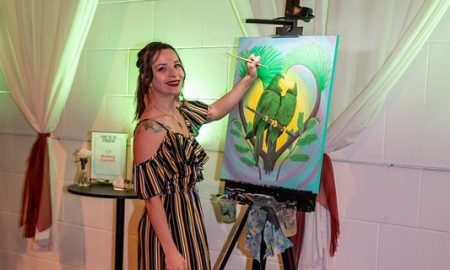
Today we’d like to introduce you to Courtney Poole.
So, before we jump into specific questions about the business, why don’t you give us some details about you and your story.
My husband Laren and I moved to Uganda in the fall of 2012 for his humanitarian career with Bridgeway Foundation. I left my job at a boutique marketing agency in San Diego that I loved, but I looked forward to treating the move as a time to discover new passions and possibly find a career that would have much deeper meaning to me.
During those first few weeks in my adopted home of Africa, I took in my new city, Kampala, wandering the streets through shops and markets, which is where I began discovering the artistry and work of the locals. They were using age-old methods to build custom products and pieces using natural, local materials. I began working with them to create decor and kitchen items for our new home and quickly started to see something beautiful emerge as my love for the coastal living of California mixed with the indigenous materials in Africa.
While working alongside these artisans to create pieces I loved, I realized that I could offer a sustainable income, challenge them to create high-quality products, and expose them to the global marketplace. Applying good design, a love for creating, business-mindedness, and relationship building – all with the goal of improving impoverished communities in Uganda – suddenly became the dream I never knew I had.
When I shared my vision with Laren, he was equally excited — and that’s when the adventure really began. We started pitching our designs to American retailers, we created our own online shop and brand, and slowly but surely, we gained the attention of Americans who shared our love for well-crafted, sustainably made goods that had a soul and story.
Today, we have our own workshop based in Kampala with a small, in-house staff, in addition to a number of contracted artisans, workshops, and cooperatives in the region that we partner with to craft all of our beautiful goods.
Has it been a smooth road?
Nothing worthwhile ever comes easy – or at least that’s what I tell myself! I’ve learned many lessons since we launched Rose & Fitzgerald in 2013:
The biggest challenge working with handmade and natural materials is accepting (and being prepared for) the things that go wrong – and believe me, if things can go wrong, they most certainly will! There are many issues that have come up along the way, and we’ve had to learn from each. For example, wood not being properly dried before products are carved, cow horn not being properly cleaned, items not being properly packed and arriving at our US facility cracked or broken; or paperwork not having proper codes, resulting in shipments sitting for weeks in US customs. In the first couple of years, these types of issues would completely overwhelm and stress me out, and I wasn’t able to think clearly in order to find a solution. What I’ve learned over the years is that all I can do is my very best, and at the end of the day, most problems can be solved one way or another with enough time and thoughtful strategy.
I’ve experienced so much grace and understanding, even from big buyers, when we’ve broken the bad news that their shipment will be arriving late, or the quantities being delivered are less than they ordered. Rather than seeing each struggle or setback as a huge failure, I now see it as an opportunity to learn and adapt; and hopefully, avoid the same mistakes from happening again in the future. We’ve come such a long way and I’m really proud of that!
So let’s switch gears a bit and go into the Rose & Fitzgerald story. Tell us more about the business.
I’m proud that we create luxurious, high-quality, and modern goods in a part of Africa not known for them. When we first launched, we were one of the only brands that I knew of that was working with Ankole horn, an extremely difficult material to properly clean, shape, and care for. And it’s been one of our best-sellers, year after year.
I’m also proud of the ways we’ve innovated our product line – for example, by introducing soapstone out of Kenya. It’s another product material that we noticed wasn’t already saturating the market, and people have responded so well to the rare and beautiful material.
Where do you see your industry going over the next 5-10 years? Any big shifts, changes, trends, etc?
I think the ethical/handmade industry is going to continue to grow in huge ways in the next 5-10 years. People are becoming more educated and interested in how and where their products are made, and how they impact people and the planet. I think it’s a trend that is here to stay.
Contact Info:
- Website: www.roseandfitzgerald.com
- Email: info@roseandfitzgerald.com
- Instagram: https://www.instagram.com/roseandfitzgerald/
- Facebook: https://www.facebook.com/roseandfitzgerald
- Twitter: https://twitter.com/roseandfitz


Getting in touch: SDVoyager is built on recommendations from the community; it’s how we uncover hidden gems, so if you know someone who deserves recognition please let us know here.