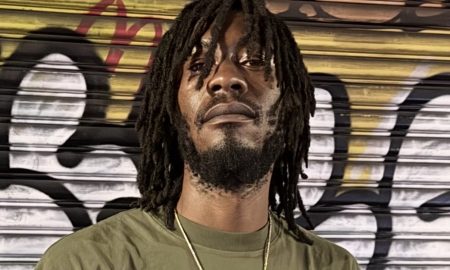
Today we’d like to introduce you to Dairrick Khalil Hodges.
So, before we jump into specific questions about the business, why don’t you give us some details about you and your story.
By the time I was 10 years old, my experiences had pretty much convinced me that I was worthless. I was already in my second year of foster care; five different placements under my belt, some random kid’s shoes on my feet, and a pain in my soul so deep that it would be over half a decade before I felt it on the surface. Suicide had claimed the life of my grandmother and greatest support just the year before and I found myself at a wall, staring hopelessness in the face without any language to describe the way it looked or felt. I fell silent.
I was completely unaware of it at the time, but that silence would set the stage for everything that I was to endure after that. Eventually, learning to break that silence would serve to shape everything that I am today. My name is Dairrick Khalil Hodges, I am an artist, an educator and social activist. As a performer, I use the stage as a platform for truth. Not only to share my stories but to hold space for youth who have walked a similar path as me to also share theirs.
To me, community is everything. So much of who we all are is rooted in and shaped by the relationships we have with the people and places around us. I was a child raised by the community; by teachers, social workers, counselors, case managers, grocery store owners, neighborhood kids. I had easily 20 placements between group and foster homes, at least 10 different schools, not including alternative educations programs. I never had a home, I just lived in a bunch of other people’s houses. It was hard for me to connect with anyone, it was difficult to accept myself as the kid who didn’t belong anywhere. I was difficult for other kids to accept me, period.
I was bullied by teachers and students in school, abused at home, and just emotionally absent everywhere else. I was a child whose walls had already closed in. Then I accidentally found myself on stage in a musical, the sounds of applause guided me toward a way out. The arts gave me an identity, community, something to focus on. It created space with bullies, suddenly negative comments would be followed by some sort of redemption. I would hear groups of kids making fun of me still, but there would always be someone among them to add, “yeah, but he can sing really good!”. That was everything for me. I sort of learned through living the importance of positive connection. Just having that one thing to hold onto was the difference between life and death for me.
I lived in this constant search for meaningful relationships. I soaked up any semblance of it that I could find. Good people were like flashlights in a blackout. I’d grow weak in my own dark space and then one of them would flash a light out of nowhere, offer me respite and then show me a path to keep moving forward. I stored these people in my soul. Eventually, darkness started to feel like a place I was no longer alone in. I could hear them in my head and feel them in my heart. I still hear and feel them to this day. In my adulthood they continue to inspire me to be that light for others, to build and strengthen the community in everything that I do. There are still so many youths today telling my story.
Young people are aggressively being denied the ability to live, love and grow wholly. With the levels of trauma impacting marginalized communities, especially those of color. As well as the continuous, seemingly deliberate replacement of outlets (both educational and recreational) that are designed to engage creativity and vulnerability, with systems designed to foster fear and shame, youth are more than ever suffering an alarming mental-emotional oppression. Our youth just simply do not feel safe in the places they live or the schools they attend; they lack the tools to identify or express their emotions in healthy ways, they feel disconnected, unsupported, overwhelmed, and alone.
With suicide now being the second leading cause of death among youth 15-24 years old, the effects of this oppression in our youth are undeniable, devastating and frankly, difficult to stomach. Somewhere along the line, we abandoned the heart and soul of young people. We made a mockery of emotion; labeled it weak, “less than”, unnecessary, called it hindrance. We put important emphasis on productivity of the body and academic mind. Advancements in technology went a long way to support this productivity, while simultaneously waging war on the human condition. Pain is an unavoidable part of the human experience, It plays such a huge part in how we live, learn and grow in this world.
When people experience pain at various levels, that they are then socially and systematically denied opportunity to process and heal, that pain creates dysfunctions that present across a spectrum of symptoms and behaviors which ail community wellness. Prolonged dysfunctional periods play a huge role in breeding what I personally call “humanities kryptonite”, more commonly known as hopelessness. Hopelessness is a killer. One that is seldom held accountable for the lives that it takes. No accountability for the grandmother it took from me, for my mom, foster brother, friend and clients I have lost along the way, for the students, I continue to lose. Or for the “me” that almost died as well.
I almost gave in. I almost never knew myself. I came very close to never discovering that the very pain that once trapped me in a paralyzing silence, would one day serve as fuel for my greatest superpowers; compassion, creativity and vulnerability. It is through the arts that I learned to train those skills. Theatre was the gift that gave me a voice. Taught me to tell a story, to feel out loud. It was the arts that saved my life.
Overall, has it been relatively smooth? If not, what were some of the struggles along the way?
The road has been rough. As mentioned I’ve had quite an uphill battle to be where I am today.
I have had to overcome obstacles of the foster system, homelessness, health and wellness, discrimination and various forms of judgment. including the way that I saw and thought about myself. I have lost both my grandmother and mother to suicide, I’ve dealt with my own depression and ideations. As well as just the general struggle of trying to become a self-sufficient adult without any guidance or familial support.
The SOULcial Workers – what should we know? What do you guys do best? What sets you apart from the competition?
I Founded The SOULcial Workers, a theatre arts organization for creative youth development. In short, we plant SEEDs, offering original productions, programs, and events dedicated to the Social Education and Emotional Development of youth in vulnerable populations. Our organization is committed to suicide prevention through restoring healthy relationships and ending the silence around the stigmatization of mental and emotional wellness. We see a world where all youth have the safety and support to explore and develop their identity. A world where all youth are provided with an equitable education, ample access to the arts; and are nurtured by compassionate, creative and connected communities.
We use theatre edutainment to teach healthy relationships. we offer tools for understanding things like shame and vulnerability, power and control and share stories to strengthen compassion and empathy. We help youth through the process of creating original theatrical productions that not only serve as a reflection to help them better understand who they are but also builds a community around the experiences they share, giving them a tangible experience of their own power to impact, empower inspire change in those around them.
We aim to create works that offer theatre to the community but also offer community to the theatre. representation is so important. The community needs to be able to see themselves in the characters and hear themselves in the stories. The theatre community sometimes lacks soul, it lacks authenticity. because of that, I think we often miss opportunities to participate in creating real change.
I believe the theatre is the space where we are supposed to engage in open dialogue, where we safely share ideas and create conversation around our collective difficulties and desires. I think it is the perfect place for us to collaboratively contribute to change, where we can not only come to understand our role in it, but those roles can actually be played out to demonstrate what the change we seek looks like in real life. people often have this idea that theatre can’t be real… I think it has to be! The SOULcial Workers intentionally hold space for youth and community to be seen and heard.
What is “success” or “successful” for you?
To me, success isn’t necessarily tied to the result of something. It isn’t a win or lose, pass or fail thing for me. Of course, accomplishment is an excellent feeling but the real success is in the journey for me. It’s in the continuing to move forward when you have every reason to stop. The decision to stand up again EVERYTIME you fall and in the people around you that you inspire to do the same.
Contact Info:
- Website: www.thesoulcialworkers.com
- Instagram: @thesoulcialworkers, @dk.music


Getting in touch: SDVoyager is built on recommendations from the community; it’s how we uncover hidden gems, so if you know someone who deserves recognition please let us know here.