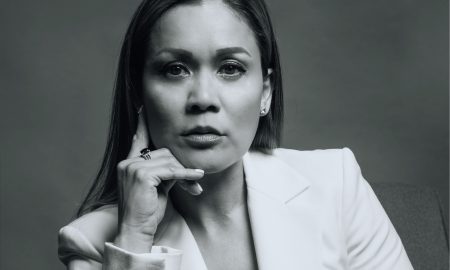
Today we’d like to introduce you to John Purlia.
John, before we jump into specific questions about your work, why don’t you give us some details about you and your story.
I began creating my art largely by accident in 2004 when I acquired my first digital camera. At the time, I was a Senior Director of Engineering at Qualcomm and decorated my office with a large assortment of odd toys — robots, wind-ups, finger puppets that looked like nuns… all of what you would expect someone in a high tech job to have. With a camera now in hand, I of course wanted to memorialize my collection by taking photos of all my toys, which I did, and every one of my photos was boring! What good was there in photographing the plastic image of a tiny hula dancer against a blank wall?
Then I had an idea… what if I give my toys a little context? So the next weekend I hauled a box of vintage record albums from the 1950’s and 60’s into work, intending to use these as backdrops for my “toy portraits.” These weren’t classic albums by any means but were odd finds I’d been collecting for years for their cover art and kitsch cheesiness — “Music For Reading,” spoken word albums, exotic music with wildly garish cover art. Just thing to spice up my toy photos!
With these first shots, which were basically a form of three-dimensional photographic collage, I quickly realized I was able to tell a narrative story in which the figures in the foreground were interacting with those appearing on the record albums in the background. And where these first photos were very simple, usually involving a single background image and a small collection of figures, my work has evolved over the years to include a much more expansive collection of toys and objects to tell much more elaborate (and, sometimes, indecipherable) stories. I now often spend several weeks, and sometimes months working on a single piece constructed from dozens of figures, multiple album covers, books, odd collected ephemera, and dozens of layered photographs.
Where I began taking quick still shots of toys and records using a point and shoot camera, my work has expanded to now include video animation and original music I compose and construct as “audible collages” much in the same way I build by art pieces from found objects — though in this case, I’m using clips from movies, TV, and vintage educational films.
My most recent solo exhibit, “Quantum Revolutions of the Telepathic Turntable” included a series of 8 interactive multimedia pieces presented on 40” screens driven by small single-board computers and custom kewpie emblazoned headphones, all controlled from small wooden boxes that contained miniature sculptural scenes made from toys, Legos, and alphabet blocks. The eight original songs I composed for the show were further pressed into my own vinyl records as the debut release from “Vinyl Nightmare Orchestra,” which I made available at an elaborately packaged double album featuring all the music and artwork created for the show.
We’re always bombarded by how great it is to pursue your passion, etc – but we’ve spoken with enough people to know that it’s not always easy. Overall, would you say things have been easy for you?
The biggest challenge I face today is confronting my own attention to detail. I am meticulous in post-production to the point that the image displayed in the gallery often looks nothing like the images that were captured by my camera. Each piece goes through hundreds of hours of digital retouching, removing dust particles (THOUSANDS of dust particles!), eliminating unwanted text from the background elements, improving colors, detail, and achieving the visual effects I see in my head. Though the quality of the work has improved (in my mind, at least), I’m not able to produce anywhere near as many new pieces as I would like. Ultimately, though, I’m very pleased with each new piece as it emerges from my studio.
We’d love to hear more about your work.
I’d like to think that I’ve been developing a style that is easily recognizable as my own, and I try to maintain consistency from piece to piece, both visually and in the narration that is reflected in what the viewer sees. It’s always satisfying to meet another artist or collector who, when I pass along a business card they look at the image printed on the face and say “Oh! You’re the toy and record guy! I dig your work!”
Has luck played a meaningful role in your life and business?
The biggest stroke of luck I’ve had was taking an engineering job at Qualcomm in 1992. Working at Qualcomm was an invigorating experience, as I was surrounded by bright, hard-working, and creative people who endeavored to change the wireless industry. Moreover, though, I was able to share in the company’s success, which ultimately provided the means by which I was able to leave the company 18 years later to pursue my creative endeavors full-time.
Contact Info:
- Address: 6751 Muirlands Drive
La Jolla, CA 92037 - Website: www.johnpurlia.com
- Email: jpurla@mac.com
- Instagram: @johnpurlia
- Facebook: https://www.facebook.com/johnpurlia
- Twitter: http://twitter.com/johnpurlia
- Other: http://www.youtube.com/user/johnpurlia


 Image Credit:
Ardee Horne (personal photo)
John Purlia (all other images)
Suggest a story: SDVoyager is built on recommendations from the community; it’s how we uncover hidden gems, so if you or someone you know deserves recognition please let us know here.