Today we’d like to introduce you to Kris Primacio.
Kris, can you briefly walk us through your story – how you started and how you got to where you are today.
When I started surfing at the age of 41, that act directly led me to where I am today, but if I dig a little deeper, how I got to where I am today began at a young age, elementary school, or thirty-years before I discovered surfing. I grew up in a small town in Washington State, and it was ingrained in me to give back to my community through volunteering. I volunteered with Special Olympics, Make-A-Wish, Boys & Girls Club, Ronald McDonald House, raised money for various organizations. As I got older, I volunteered at several different Children’s Hospitals and about six months before I started surfing, I went to Kenya for a month to volunteer at an orphanage, which turned out to be a life-changing experience.
I moved from Seattle, Washington, to Southern California in 2004. I had just gone through a divorce when I left Seattle, and although it was amicable, it left me shattered. I wasn’t moving towards something healthy in California. I was running away from the memories in Seattle. It took me several years later, but I finally found my footing in So Cal. I moved into a little apartment by the beach in 2010, and everybody around me surfed. Growing up in Seattle never led me to surf. The ocean was over 3.5 hours away from where I grew up, and we only went to the ocean to collect clams. Otherwise, I spent my time on Puget Sound, fishing, and catching Dungeness crab or swimming and wake-boarding in one of the thousands of lakes around Seattle. It never occurred to me to take up surfing, not just because the water is freezing in the Pacific Northwest, but I didn’t know anybody who surfed.
In 2011 a group of friends took me to San’Onofre and pushed me into my first wave there, and I knew I would never be the same. That monumental moment occurred five months after my Dad, my hero, informed me he had cancer. I found myself running to the ocean every single day to catch waves and try to improve my skills. I assumed it was my eagerness to learn and competitiveness not to suck and that alone was the power the sea had over me, but now I know, sitting in that lineup helped me forget about my Dad’s CT scans or that his white-blood-cell count was dropping or that the chemo wasn’t working. I am so present on my surfboard and comforted by being wholly immersed in nature. Mother Ocean became my church, my meditation, my prayer room, my blue gym, my therapy all at once. I sought refuge in the ocean and still do today.
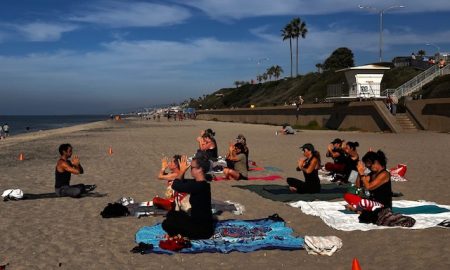
The year I started surfing, I started volunteering for a surf therapy program (Jimmy Miller Memorial Foundation – JMMF) that works with Veterans, active-duty military, and vulnerable youth. Like all surf therapy programs, they use a structured method of surfing to achieve a therapeutic benefit with unique populations. Volunteering with JMMF led me to other incredible surf therapy programs, like Best Day Foundation in LA and Orange County, Urban Surf4Kids in San Diego, and AmpSurf and A Walk on Water throughout Southern California.
As mentioned, I’ve volunteered my whole life, but being down on the beach and sharing the healing powers of the ocean is something so special. You are instantly welcomed into a group of participants (athletes), other volunteers, practitioners, and it feels like family. Watching individuals catching their first waves and cheering them on or surf instructing behind the board, it always felt like my first wave too.
By 2014, I realized how much I centered my life around surfing. I would schedule meetings around the tides and swells, 100% of my volunteer work focused solely on surf therapy programs. I would pack a surfboard and gear anytime I jumped in the car (just in case waves were breaking wherever I was going). I would miss a lot of dinner dates because there would be a late evening glass off, and I always chose surfing. At the time, I wasn’t quite sure how or what, but I remember making this proclamation out loud (to nobody in particular), that I would work in the surf industry. I knew I wanted to be around like-minded people, and I wanted to be in the ocean surfing as much as possible, but that was all I knew. I didn’t have a plan, I surfed and spent a lot of time with surfers or volunteering and teaching others how to surf.
In 2016, one month after the most significant human in my life, my beautiful father lost his battle to cancer, I was devastated. I can’t remember anything about that first month after his passing except that I was asked to run the beach sessions for JMMF while Carly Rogers, the Program Director and Co-Founder, was going on maternity leave. With great honor, I accepted the position. I was confident that taking the lead of a surf therapy program was the only prescription I needed to mend my broken heart. By the beginning of 2017, Carly decided to retire, and with her recommendation to the board, JMMF made me their Program Manager.
My desire to work in the surf industry didn’t seem that far fetched, even without a grand plan. Still, I would have never guessed that it would be on the mental health side and that the work I would end up doing would be so meaningful and would take me around the world. Becoming the Program Manager of JMMF in 2017 would bring me to South Africa that same year to meet with seven other surf therapy organizations in Cape Town for a week. We shared everything we knew; we brainstormed, there were hearty discussions, tears, and a lot of laughter, fun, and bonding amongst 16-strangers. By the end of that week, we created the International Surf Therapy Organization. We held our next five day conference a mere nine months later (July 2018) in Jeffreys Bay, Africa, and we had 15-surf therapy programs represented and 25-people in attendance. After the week was over, the board recognized we were growing and wanted someone to take the helm. By the fall of 2018, I was appointed the CEO of the International Surf Therapy Organization (ISTO).
I’ve discovered that if you want to be a part of something, you will do whatever it takes to do so. You’ll feel richer than you ever have before because you’ll value purpose, adventure, and your mental wellness over any material goods. Lastly, volunteering by nature benefits your mental health and promotes physical wellbeing and increases the quality of your life, along with the beneficiaries you come to serve. If you’re fortunate, volunteering can lead you to a dream job, even if those dreams didn’t start until you were in your forties.
Has it been a smooth road?
I don’t know anybody who’s had a ‘smooth road’ and has achieved their dreams without struggling along the way. I believe we grow and progress more because of the struggling and just like the ocean, that offers us unique surf conditions every single day, because of variables like swell size and direction, the winds, the tides, the weather patterns, the growing pains of starting a nonprofit will ebb and flow. Our struggles of starting a new nonprofit, I imagine, are similar to other nonprofits, like defining who we are and what our deliverables would be, along with ensuring we’ve got passionate and active board members in place and eventually staffing. The never-ending struggles perhaps will be what all nonprofits are up against, endlessly fundraising.
Please tell us about your organization.
The International Surf Therapy Organization (ISTO) is a collective of the world’s leading surf therapy practitioners, researchers, professors, and influencers. We’re promoting understanding (through research), sharing best practices to better our practices and advocating for excellence in surf therapy, in doing so, affording more people access to safe surf therapy programs globally. The future of surf therapy is being recognized as a prescribable evidence-based therapeutic service, accreditation at University to earn a degree in surf therapy, and universally covered by health insurance agencies.
Although surf therapy programs have operated for the past 25-years, the term surf therapy is not yet mainstream, but that is changing, surf therapy is an essential and pioneering form of mental health practice. Currently, mental health disorders impact one in four adults worldwide, yet treatment isn’t accessible to all those affected and often carries a tremendous stigma. It is essential to find new ways to package therapy, making it more accessible, fun, and friendly while retaining evidence-based and impactful approaches.
Fortunately, there is significant evidence articulating the benefits of surf therapy. In the last five years, the use of surf therapy has expanded globally. The practice combines surfing with evidence-based treatment to improve wellbeing outcomes. Between 2011 and 2017, there were eight published surf therapy papers, and between 2017-2019 that number doubled. By March of 2020, ISTO Contributors and guest editors, including professors and clinicians, are producing the first-ever academic publication for a Special Issue in the Global Journal of Community Psychology Practice dedicated to surf therapy research, which will produce 11-more published papers.
Formative research demonstrates that surf therapy is impactful for a wide range of demographics. Including Veterans, youth-at-risk, active duty military, children on the Autism spectrum, Down syndrome, blindness, people with physical disabilities, individuals struggling with PTSD, suicidal tendencies, depression, trauma, low income, imprisoned men, abused women and children, and on and on. Surf therapy is also highly cost-effective, and, given that 40% of the world’s population lives within 10 km of the coast, can be made accessible.
In a short two years, ISTO has become a backbone organization for the entire surf therapy sector. We started with eight surf therapy programs globally and are engaged with nearly 70 today. We are bringing the industry together in a way that’s never been done before. Seasoned programs are supporting new organizations, through ISTO by sharing curriculum, and best practices.
ISTO is the first and only surf therapy organization with a global reach. Currently, the surf therapy sector is made up of small, disparate organizations around the world. To consolidate and establish standards, ISTO has spent two-years mapping the industry, networking organizations, and building benchmark tools to map the impact of surf therapy. I’m incredibly proud to be a part of this groundbreaking movement.
Let’s touch on your thoughts about our city – what do you like the most and least?
San Diego is a lot like where I grew up in Seattle, only much sunnier and warmer. There are fun pockets of diversity throughout the city, including unique restaurants and young start-ups that support my belief that the future is bright. San Diego, just like Seattle, borders a massive body of water, the Pacific Ocean versus the Puget Sound, both offer idyllic views and picturesque scenery. What I like least is that San Diego is more than twice as populated over Seattle, and I’m a big fan of less is more.
Pricing:
- Sponsorship Opportunties
- SWELL LEVEL $1000+
- PARTY WAVE $3000+
- A-FRAME $5000+
- INSIDE THE WAVE $10,000+
Contact Info:
- Website: www.intlsurftherapy.org
- Phone: 310.200.5318
- Email: kris.primacio@intlsurftherapy.org
- Instagram: https://www.instagram.com/intlsurftherapyorg/
- Facebook: https://www.facebook.com/intlsurftherapyorg/
- Twitter: https://twitter.com/intlsurftherapy
- Other: https://www.linkedin.com/company/international-surf-therapy-organization/


Image Credit:
Tony Zan
Grace Muckenfuss
Phil Craig
Alessandro Masciotti
Suggest a story: SDVoyager is built on recommendations from the community; it’s how we uncover hidden gems, so if you or someone you know deserves recognition please let us know here.