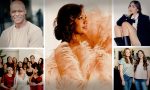
Today we’d like to introduce you to Megan Toth.
Hi Megan, thanks for sharing your story with us. To start, maybe you can tell our readers some of your backstory.
I’m a military brat, a third culture kid, and mixed race—and because of that, choosing a career was incredibly difficult for me. For decades, I struggled with identity. Art was the one constant. It always came naturally, and it always held the words I couldn’t articulate from a very young age.
In fourth grade, I was selected for an art show for my self-portrait. My art teacher told my parents I had a “real talent.” I grew up in a family where art was cherished—seen as a valuable hobby, even if not necessarily a career. My great-grandmother had a ceramics studio in her home. She won awards for her oil paintings and created hundreds, maybe thousands, of hand-painted vases, dolls, plates, and more throughout her life. My grandmother studied photography in college and loved it. My dad documented our family constantly through photos and videos, and today we treasure that archive.
In college, though, I remember an art professor lecturing us about how art “doesn’t make money.” That stuck with me. In my senior year of high school, my dad had me take multiple personality tests so I could figure out my path, but they didn’t help—because I still didn’t know who I was.
I tried computers as a career. That ended quickly after taking Cisco classes in high school. Later, after painfully failing physiology in college and dragging myself through nursing prerequisites, I applied to nursing programs. My dad saw how much I loved helping people, so nursing seemed like a natural fit to him. I was rejected by every school I applied to, and that forced a pause. I started asking myself those big questions: “Who am I? What is my purpose? Am I good enough?” I paused. I prayed. I pondered.
What happened next surprised me: missions. My first thought when I heard the word “missionary” was, honestly, “people who go to Africa and die from some unnamed disease.” But I couldn’t ignore the deep pull toward it. Counselors recommended that I get on the 2–5 year waiting list for nursing school at my community college and finish my AA in the meantime. I did that, and then I applied to Youth With a Mission (YWAM), a discipleship training school for young adults.
After another rejection letter and silence from two bases, I finally heard back from a reconciliation-focused DTS in Belfast, Northern Ireland. They welcomed me with open arms. I had no idea it was exactly where I was meant to be. I don’t believe in coincidences, and later I learned my childhood neighbor had been a missionary in Ireland, and at the time I was nannying for a Jewish family—connections that would matter later.
In Belfast we learned about the Troubles, listened to firsthand accounts, and worked closely within the Catholic community. I also met my first art therapist there. I tucked that encounter into my heart for nearly a decade. Some of the people I lived with were from conflict zones—Israel/Palestine, Lebanon, Sierra Leone, South Africa. I learned about Israel/Palestine from my Christian Arab roommate. My passion for art reignited. I painted, drew, wrote poetry, and photographed everything.
In early 2009, my YWAM team went to Rwanda and Burundi were we learned about the genocide. I worked with journalists documenting Rwanda’s annual genocide remembrance parade. While in Africa, I felt strongly that I needed to apply to a secondary YWAM program called PhotogenX—focused on documenting injustice through photography. I needed to raise $10,000, and I filled out the application on a painfully slow computer. It took eight hours because of the internet.
After my DTS, I came back home to San Diego and found a letter from my community college waiting: “The wait is over, you can now apply to the nursing program.” What do I do? I remembered Belfast. I remembered art. And I declined the nursing program.
That summer I raised enough money to join PhotogenX for another year and a half. I traveled the world with eleven other women documenting stories of injustice. Together we created a book called Act Here. Love Now. We toured it up the West Coast. I loved piecing the book together—a sign that graphic design might be the right path.
I went back to school, worked as a second shooter for a friend’s wedding photography business, and after finishing art prerequisites at community college, I landed at CSU Long Beach. I applied to their impacted graphic design program—again, rejected. My counselors suggested finishing faster with a studio art degree and a graphic design minor, so I did that.
After graduating in 2015, I felt led to return to Israel/Palestine, this time with Telos (a non-profit peacemaking organization) on a reconciliation trip. Of course I brought my camera. On a bus full of strangers, during an icebreaker game, I said aloud: “If I could live anywhere and do anything, I’d live in Israel/Palestine and do art therapy.” Years later, flipping through old journals, I realized I had written versions of that prayer over and over: “God, if art therapy is my path, show me the way.”
On my way home from that trip, I visited my grandmother and told her how vulnerable I felt for sharing my deepest desires with strangers. She told me, “You have nothing holding you back. Go live your dreams.”
So I listened. I went home and googled art therapy. In 2015, the last time I’d met an art therapist had been 2008. On the very first page—maybe early AI magic—a link popped up: University of Haifa, one-year master’s degree in Creative Arts Therapies, in English. I knew instantly I was supposed to go.
I completed my psychology prerequisites, saved money, got my visa, and returned to Israel/Palestine for my master’s in art therapy that same year! While there I documented everything and finally understood who I was: a healer, an artist, an archivist, and a peacemaker.
Since then, I’ve worked as an art therapist in a psychiatric hospital, supervised art therapists and other adjunctive therapists, and was an art therapy professor at a college. Currently I’m publishing a book that pairs my photographs with Psalms 120–134—a guide for modern-day pilgrims to experience Israel/Palestine as it is, conflict and all.
Most recently, I was part of the San Diego Artist Incubator, a cohort of 30 artists funded through city grants. It helped me understand deeper parts of myself and my brand. I’m now shifting from documentary travel photography to archiving family stories. And my art therapy practice is moving online, focusing specifically on grief—my specialty during my years in the psychiatric hospital. For more information regarding both of these endeavours please check out www.megantothphotography.com and www.onlinearttherapy.net or @megantothphoto and @online.arttherapy
Can you talk to us a bit about the challenges and lessons you’ve learned along the way. Looking back would you say it’s been easy or smooth in retrospect?
No, definitely not. My path was not linear, it was like a rollercoasater, up, down, side ways, and backwards. Lots of rejections. I’ve heard it said, be grateful for the rejections, because they lead you in the right direction.
Thanks – so what else should our readers know about your work and what you’re currently focused on?
I am an art therapist and a photographer, and I specialize in grief. A little backstory on that: I attended my first funeral as a child. My uncle died from a bad blood transfusion. He was a hemophiliac, and in the 90s hemophiliacs sometimes received blood from HIV+ donors. He was one of the unlucky ones and died shortly thereafter.
My second funeral was in 2006. My good friend’s husband, married only two years, died detonating a bomb while serving in the Middle East. After his death, and in the years that followed, several of my young married friends lost their spouses—four in total. I learned a lot about grief in my early twenties because of these tragedies.
And I continue to learn about grief. My mother unexpectedly died last year, and her death changed me. I quit my art therapy job at the psychiatric hospital because of constant burnout and because I simply couldn’t do grief work with others when I was drowning in my own. I’m proud of myself for quitting and pursuing business endeavors, especially knowing my mom would be proud of me too.
I think what sets me apart from others is a few things: traveling the world before I turned 25 helped me see life from a wide range of perspectives. Growing up around different cultures and ethnicities as a military brat shaped me as well. I’m good at connecting dots—as you may have noticed from how my story weaves together. This helps me ask people the right questions as a therapist, and it helped me as a photojournalist.
I’m proud of myself for being brave—living in other countries alone, traveling alone, and asking people hard questions. But I’m most proud of my latest endeavor. As a peacemaker, I often walk the line of empathizing with everyone without sharing my own opinions. I’m trying not to do that anymore. The photography book I’ve created is a huge leap in that direction. I believe Christians need to know more about what is actually happening in Israel/Palestine. My photography book, A Modern-Day Pilgrimage Through the Psalms of Ascent, is something I hope will open people’s eyes to what life is truly like there today—conflict and all.
We love surprises, fun facts and unexpected stories. Is there something you can share that might surprise us?
Something most people might find surprising about me is that I’m not Japanese. Most people think I am Japanese when they meet me. I grew up in Japan, this might be why they think this. But I am not Japanese.
Pricing:
- my photography book $50
- individual art thearpy session $175
Contact Info:
- Website: www.megantothphotography.com and www.onlinearttherapy.net
- Instagram: @megantothphoto, @online.arttherapy


Image Credits
Melana Preston took the image of me in black clothes sitting in the window seal, all others I took or an assistant took, can’t remember who….