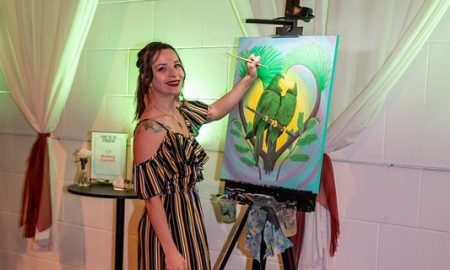
Today we’d like to introduce you to Molly Paulick.
Molly, before we jump into specific questions about your art, why don’t you give us some details about you and your story.
I’ve been painting for as long as I can remember. Fortunately, my parents were very supportive of my creative tendencies and they gave me a lot of freedom to explore different art mediums. I’ve always been an extremely tactile person, so I would paint or draw or make things out of paper, clay, sticks, and leaves. I learned how to oil paint when I was in middle school and have been hooked on painting ever since. To this day, I’ve never gotten bored with the physicality and motion of painting.
When I wasn’t painting, I was exploring the open fields, collecting rocks, dissecting plants, catching and releasing lizards, and smelling sagebrush. These memories were formative to my awareness and appreciation for the natural world around me. Not just on camping trips to designated “wilderness” spaces – but in my everyday experiences. My neighborhood in Irvine nestled up against an ecological preserve where stewards restore habitat for many native species, including the California gnatcatcher. Some of my earliest memories are hiking around that preserve with my dad. He explained why it’s essential to preserve and restore habitat for our local wildlife, especially since Irvine, and the rest of southern California, was rapidly developing at the time.
My favorite places started to turn into track home developments and shopping centers. Although that signified growth for the city of Irvine, it did mean there was a dramatic loss of the natural spaces from my childhood. This constant tension between the growth of urban development and the natural world has always informed my artistic voice.
I pursued my bachelor’s degree in Painting and Drawing from Azusa Pacific University. In college, I was exposed to even more artistic mediums like sculpture, ceramics, and graphic design. I consistently tried new things, but I always came back to painting. I loved synthesizing what I was experiencing and learning outside of the studio and visually portray it all into a piece of art or body of work. For my senior exhibition, I tapped into my earliest memories of growing up next to an ecological preserve and created my first body of work “Wilder Still.” This show explored the connection between our own bodies and the natural world around us.
Has it been a smooth road?
When I graduated from art school in 2010, I desired to continue a career in painting, but I let fear, doubt, and my crippling inner critic hold me back. Instead, I pursued a career behind the scenes, first as the Grants and Programs Coordinator at the Arts Council for Long Beach, and then as a marketing and design consultant for creative businesses. Even though I was happy with my job and painting here and there, I had a longing to pursue my art seriously; I just didn’t have the guts to do it yet.
Fast forward to the summer of 2015 when my sister, Julia, was killed by a drunk driver. Right before she died, she reminded me that anyone could do my job, but only I can produce my art, and the world needed to see it. And so, just as any earth-shattering experience does to a soul, I re-examined my life, faced the fear that had been holding me back, built some wood panels, and got to work painting. Throughout the next three years, and alongside my full-time job, I completed a whole new body of work, “Let them Illuminate the Lands.” These paintings were a direct reflection of the perspective I gained through the sudden death and subsequent grief of losing my sister, and the bravery and joy I discovered in the midst of it. I’m continuing to face my fears of being an artist and all that entails every day, but I have newfound courage to kick said fear to the curb.
Even though I’m facing my fears, that doesn’t mean they are gone. I still struggle with my inner critic almost every time I paint. He’s just not as loud anymore. It took putting one foot in front of the other to get where I am today. It started with one painting at a time, applying to my first group exhibition, then connecting with a curator for a solo exhibition, then receiving the 2019 Business of Art Scholarship through the Studio Door Gallery and participating in the Little Italy Art Walk which led to my first interview on CBS. (https://tinyurl.com/mollypaulickcbs) As cliche as it sounds, it really took one step at a time.
We’d love to hear more about your art.
The paintings I am most known for are large scale wood panel collage paintings. Beginning with a photograph snapped from the window seat of an airplane, the scene serves as a backdrop to the foliage found in the area. From there, I create layers using acrylic paint to depict the diverse elements of each landscape – from tiny roads and buildings to large-scale flora – pushing and pulling the focus for the viewer. My current work focuses on the hyper-local ecology and the history of my own neighborhood of Hillcrest, San Diego.
I first moved to San Diego about a year after my sister passed away. And as most of us know, it can be really isolating moving to a new place. Loneliness, grief, and a longing to feel known were my ever-present reality. However, I knew that to feel at home, I needed to get to know my local surroundings. I started walking all over my neighborhood with my dog. I met and became friends with my neighbors as well as paid attention to the diversity of plant life. It was in this act of paying attention and getting to really know my neighborhood, that the various plants started to find their way into my paintings. From there, I took an interest in the tropical horticultural history of San Diego. It wasn’t until I was painting these plants that I started to ask questions about the plants that existed before my neighborhood and the European horticultural influence.
I began researching and sketching our local native plants, which led to learning the history and modern experience of the indigenous people of San Diego, the Kumeyaay, and their relationship with the plants that existed long before European settlement. I wanted to figure out when the disconnection to our natural surroundings began and how in this next phase of our city, we can live in collaboration with the natural world, not in conflict with it. It turns out that San Diego is the most biologically rich county in the continental U.S., and not many people know this incredible fact!
I owe a lot of my San Diego ecological knowledge to the California Native Plant Society – San Diego chapter. Their mission is to “conserve San Diego and Imperial County native plants and their natural habitats, and to increase everyone’s understanding, appreciation, and horticultural use of native plants.” Knowing the names of the plants, the history of the ground beneath my feet, and the people of my neighborhood made me feel less alone and more at home in my adoptive city.
Through the awareness and knowledge of these plants and ecosystems, we can play a huge role in providing more habitat to our local wildlife. In this new era of people caring even more about the future of our planet, I hope my art can make people look twice at our unique plants and animals. I believe awareness leads to attention, and what we pay attention to is what we end up loving. What we end up loving, we want to care for and protect.
The best places to see and experience San Diego’s native plants are Mission Trails Regional Park, Cabrillo National Monument, Torrey Pines State Natural Reserve, Los Peñasquitos Canyon Preserve, and our local urban canyons like Florida Canyon in Balboa Park. To see home gardens that use California native plants primarily, attend the California Native Plant Society – San Diego Chapter’s Garden Tours on April 4th, 2020 (https://www.cnpssd.org/events/gardentour2020). This is the first year we are including artists in the gardens as well. I’ll be there with a few other painters and sculptors who all use our local flora and fauna as their inspiration. Lastly, the iNaturalist app is a fantastic way to get outside and learn about the specific plants you’re seeing by taking photos and uploading them to the database.
Let’s touch on your thoughts about our city – what do you like the most and least?
San Diego continues to amaze me with all its opportunities for artists. It is a city bustling with talent and ingenuity but not so overcrowded that it’s impossible to get your work seen. Not only does San Diego have established art galleries and alternative art spaces, it’s also still developing its artistic identity. For artists, that can be an exciting time to be involved in a city. People are willing to collaborate with one another as there is not a lot of pretentious behavior going on.
Artists will always be hungry for community as it can be an isolating job, but I believe San Diego has the energy and people to deepen connections. And it can happen on a microscopic scale! I recently met a few other painters, and we decided to create a ladies drawing night once a month. This has been so beneficial for not only my work but my artist’s soul. Most people are willing to say yes to something like that – it just takes a bit of corralling, organizing, and putting yourself out there.
Pricing:
- Art Prints: $28 – $165
- Original Art: $250 – $2,500
Contact Info:
- Website: www.mollypaulick.com
- Email: mollypaulick@gmail.com
- Instagram: @mollypaulickart


Suggest a story: SDVoyager is built on recommendations from the community; it’s how we uncover hidden gems, so if you or someone you know deserves recognition please let us know here.