Today we’d like to introduce you to Sharon Cooley.
Sharon, let’s start with your story. We’d love to hear how you got started and how the journey has been so far
In 1996 when I was 35 years young, I got my career corporate job working at Qualcomm. It was a great corporate job with great benefits. I took advantage of their continue education benefits. Qualcomm would pay for my schooling as long as it was a certified class. So in the Spring of 2004, I enrolled at UCSD and got my Photography of Arts Degree.
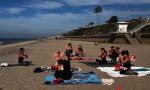
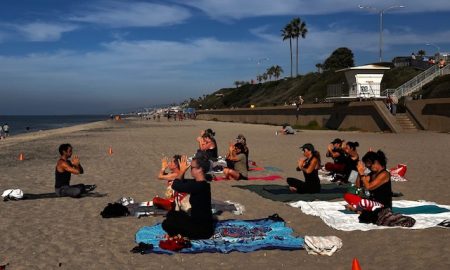
My first class was a Black and White photography. I finally learned how to use all the dials on my 35mm camera. Little did I know that my class project of taking Black and White family portraits was going to lead me to my career dream of being a family portrait being a Photographer. I captured a couple of my co-worker’s family portraits for my school project. Word got out at work that I was a Black and White family portrait photographer. A few weeks later, I found myself busy every weekend, capturing family portraits on the beach or at local parks. I lived in the Ocean Beach Point Loma area, so I took my clients to all the local secluded beaches where I could capture these fun Southern California Beach Casual Family Portraits.
Most of my clients had little children and they enjoyed the idea of capturing their family portraits on the beach. I captured special moments like their children playing together. Then they were playing with their children and wonderful natural and casual portraits of the whole family. I remember way back when I was young and I wanted these fun family portraits taken of my family and me. The cost of hiring a photographer was so expensive. So I never hired a photographer because of the sitting session fee they were charging was way too much for me to even think of hiring a photographer. I decided if I was going to be a people person photographer that I would have reasonable rates for anyone to hire me.
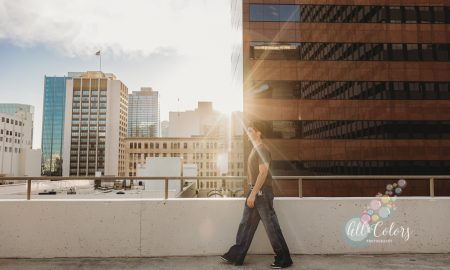
September 2007, I left my corporate job and started my photography business. I went into business on my own. I was the Photographer of my business, the accountant of my business and marketing of my business. I had no partners. My weekends were booked capturing Family Portraits but I knew that family portraits alone wasn’t going to help me make ends meet. So I expanded my photography portfolio to start shooting Architectural Photography. I started shooting for Builders (San Diego local Contractors). I knew the Owners of Vanberg Construction. Over a happy hour conversation, I purposed to Jeff and Bob, who were cousins that started Vanberg Construction. I purpose to them that I could start shooting their home projects from start to finish. They ONLY hired a photographer to shoot their finished project but never hired a photographer to shoot all three stages of their project, which is the Before images so you can see how the home looked before the remodel the home. Then I captured the Rough Framing stage to capture all the framing and electrical and plumbing before it got covered with drywall. Then I came back and captured the final finish work. They loved how I captured all three stages from the same place so they can see the transitional changes.
Vanberg Construction invited me to a Business Networking Group to share my Photography Services that I offered them. There were all different trade of the building business at this networking business. There were other Contractors, Customer Cabinet Makers, Tile setters, Electricians, Plumbers and Interior Designers. The next thing you know… I started servicing six different Contractors capturing the three phases of all their home projects. The contractors were not the only ones that purchased their project images. Their sub-contractor, like the Custom Cabinet Makers, would buy the finish images of the cabinets that they built into the home if the homeowner hired an Interior Designer to decorate their newly finished project. I would sell the contractor and interior design both the finish images.
During the week, I was busy capturing my Contractor Remold or New Build home projects and on the weekend, I was busy capturing family portraits. My families started having babies, so there was a need for me to learn how to capture newborn and baby portraits. I found that the new parents did not want to take their baby and themselves to a studio to capture their newborn’s images. So I decided to become an ON LOCATION PHOTOGRAPHER. I brought my little studio setup to their home and captured their newborn images at the comforts of their own home. My clients loved my work and the idea of me coming to them. Word of mouth made my newborn portrait photography grow. I am also a Landscape photographer. I won 3rd place in the OB Street Fair photo competition. It had to be an image captured with film, not digital. To enter the contest, you had to provide a Film Negative to prove that the image was captured with film. You also had to submit an 8×10 print of your image and it had to be any landscape of Point Loma or Ocean Beach.
With 63 votes, went to Sharon Coley for her black and white photo depicting a misting evening on the shore, looking up at the darkness of the pier. With a gloomy sky hovering above, just as the streetlamp begins to flicker on. She used a slow exposure to create an eerie feeling.
“I’ve never taken [photography] up as a profession, “said Cooley, a former resident of Ocean Beach who now lives in San Carlos.
Cooley has been experimenting with photography as a hobby since she was 16 years old and is now in her 40’s. She recently took a black and white photography class at the University of California, San Diego and had since been working to perfect her landscape images. In the meantime, friends have been asking her to do black and white portraits of their families. “My goal is to become a little bit more than an amateur,” Cooley said.
She found the photo contest a perfect way to enhance her skills and get feedback on her work. Along with an award-winning photo of the Ocean Beach Pier, Cooley has photographed the Imperial Beach Pier and the Children’s Pool in La Jolla. ‘I’ve been trying to shoot every monument in San Diego,” she said, “The OB Peir is my favorite.”
Cooley has never entered a photography competition. Now she plans to put more of her work on public display. She hopes to enter an art gallery sometime and is currently working on a website. “I’m glad I had the chance to enter this contest,” she said, “I’m just excited that I placed. I don’t care that I didn’t win. So I submitted my very first Black and White landscape image I captured on my old Canon AE! 35mm camera. I also develop my own black and white film at home and then exposed the images myself.
Story behind the 3rd place image. For all the young millennials out there that don’t know how BW images were developed back in the days. I put a little blurb of what it took to develop a picture. So you and others will understand how cool it was to have my image that I created from capturing it to developing the BW film all the way to enlarging the print. I built in my backyard a 10×10 Darkroom to develop my own film and enlarge my own prints in my backyard.
Kodak film chemicals. Step 1: Prepare for lights out. You’re going to need complete darkness to load the film into the tank. If you set up your darkroom correctly, it should be extremely hard, if not impossible, to tell whether your eyes are open or closed. I use a bathroom with no windows and block off the seams of the door with tape, but you can also manipulate the film in a dark bag like the one mentioned in the tools list. Before you hit the switch, arrange the pieces of your tank where you can easily find them without knocking them onto the floor. Once the film is out of its canister, you won’t be able to turn the light back on, and searching around the floor in pitch-black darkness isn’t fun. Once you turn out the lights, sit with your eyes closed for a few minutes before re-opening them into the darkness. You might see dim light sources you couldn’t before your eyes adjusted. If you do, then block off those sources to prevent even faint light from filtering in.
Step 2: Load the film into the tank. Film loaded onto a developing reel. One of the trickiest parts of the process is learning how to get the film onto the reel without being able to see it. It’s a good idea to practice loading a ruined roll of film in the light.
Step 3: Mix the chemicals. Now for the fun part! Be sure to mix the chemicals according to the instructions that come with them. Powdered chemicals really Develop the film. Rinsing the fix. After the fix, it’s time to wash the negatives. Running tap water (no need for distilled H2O at this point in the process) through the tank for five minutes should do the trick, but I’ve also just filled and emptied the tank a few times while swishing the water around inside. It works out fine—and uses a lot less water. At this point, you can use a wetting agent like Photo Flo to prevent water spots from appearing on the negatives.
Step 5: Dry the negatives. The last step in the dev process is hanging the negatives up to dry. Making the Enlargement.
1. Set timer to the number of seconds determined from the test strip.
2. If the exposure times become too short, approximately 10 – 15 seconds, it may be necessary to stop down the aperture further. If the exposure times become too long, over 60 seconds, it may be necessary to open the aperture an additional stop(s).
3. So as to ensure correct exposure/density and contrast in the highlight, mid-tone and shadow areas of the negative, it may be necessary to change the filter to either lower or raise the contrast.
4. Once the exposure time and aperture combination, as well as the proper filter, have been determined, note the exposure time, aperture, and filter number on the back of the paper in pencil and on the Printing Record.
5. Place a full sheet (8” x 10”) of paper with the emulsion up in the sizing slot of the adjustable easel and close the easel and press timer button for exposure.
6. Utilize any secondary printing controls, such as dodging, during the exposure, and/or burning, after the initial print exposure.
7. Remove paper and process.
Photography will always be one of my favorite pass time hobby that I will continue to do as long as I can hold a camera in my hand. I’m sharing my story not to gain more business but to let you and the readers know that if you are passionate about something. Then just do it. Whether it to do it as a hobby or make a career business out of it, just do it because you are passionate about it. Learn all that you can. Then once you think you can make money from what you do. Then start out little. Why little? Well… I say test the waters. For example like me becoming a family photographer takes experience and understanding of the individual clients you will be dealing with, This kind of business is never the same, so I had to test the waters to see if I can really do what I was planning to do and that is be a family portrait photographer when I shot my first two toddler children family portrait I never experience how difficult it is to get toddlers to pay attention. I spent an hour trying to capture two of the children looking at me and posed the way I set them up to pose. I didn’t get a single shot of the two girls looking at me.
I was so focus in trying to get the girls to look at me that I did not set my subjects in a pose that looks like a normal family pose for a picture. It was a disaster, to say the least. Clients weren’t happy with any of the pictures. I felt bad about the whole situation because I did not have any control of my sitting session. Any normal person probably would have stop being a family portrait photographer. ME! I did the opposite. I read up on books of how to get children’s attention and I researched what the latest cartoons and kids TV shows were so I can converse with the kids at their level. I also plan to not pose the family so much and pre-set them in a setting that was more natural. Then I would let them interact as if I wasn’t there and that is when I started capturing their moments. Natural happenings and true natural laughs. Natural tickles and truly happy, laughing smiles.
I called my clients that were disappointed and offer them a free portrait session. My second session with the family was a success. The children were laughing and smiling without me asking them to. Why? Because I knew how to get their attention and because I knew what cartoons were out there, I was able to talk about a cartoon character that made them laugh. Needless to say, the sitting session was a success and the parent and toddlers had a fun adventures photo session with me.
I was 16 years old when I got into photography. I used to envy the high school photographers and wished that I had a cool 35mm camera like them. I got a job working under the table (Because I wasn’t old enough to legally work) for my best friend’s father, who owned a Chinese Laundry Mat. My best friend and I folded all the Hotel Sheets that her father’s laundry laundered. I saved up enough money to purchase my first 35mm camera which was an Olympic OM1.
When I was capturing the image of the OB Pier, the one that got 3rd place was when I met my photography mentor and good friend of mine, George Barnes. He’s an old school photographer. He just shoots for a hobby but he saw something in me and just took it upon himself to mentored me. I learned a lot from him. When I met George was the same year that digital photography was at its infant stage. So I learned alongside with George on how to use Photoshop to help enhance your images. The one thing that stuck to mind with me is George said, “Photoshop should be used to enhance your photos, not fix them.” Meaning if you captured the image with the correct settings, you don’t have to fix your image in photoshop to correct that. You can just enhance your image.
Being a people person and having energy to play with children is just one of the secrets of retaining clients. If they love your energy and your playfulness with their children and capturing fun, loving photos of their family is what makes a great family photographer. Have a good business plan if you decided to make a career out of photography.
– Website to show off your work
– Reasonable Sitting Session Rates
– Good customer service – Showing up to photoshoot on-time, giving your customer a great experience working with you and getting their product to them in a timely matter will give you 5-star customer service.
– Have all the camera equipment needed
– Prepare to study all the photo applications to help enhance your photography (Photoshop and Lightroom)
I continue to capture People Portraits and Landscape images as a hobby. Well… I hope you’ve enjoyed my journey of becoming a professional photographer. Sharon Cooley, Photographer
Overall, has it been relatively smooth? If not, what were some of the struggles along the way?
Running your own business as a Photographer can be exhausting. Because you are the Photographer, The Sales Person, Marketing to create your own website and your own accountant. All these roles runs your business. Being able to manage all these roles take commitment. Commitment to create the best photography experience with your client. Commitment to your timelines of meeting them and then providing them their product in a timely matter. Being able to have all the equipment to properly do your job. Lights, backdrops, cameras, flashes and all the props needed for studio shooting. If you are an organized person, you get structure your time to manage your business and live a balanced life.
We’d love to hear more about your work.
Sharon Cooley Photography specialize in On Location Photography Beach Park or at the privacy of your own home. Southern California Casual Style Photography. Capturing special moments of Family, Children, Babies and Newborns are my specialty. I get all my clients from referral. I think that’s a good enough answer on what sets me apart from others.
Any shoutouts? Who else deserves credit in this story – who has played a meaningful role?
Thanks to the two gentlemen below. The two of them helped mentor me through my journey of becoming of a professional photographer.
Mentor: George Barnes https://georgebarnesphotography.zenfolio.com
Mentor: Kerry Snyder https://www.kerrysniderphotography.com
Contact Info:
- Website: www.SharonCooleyPhotography.com
- Phone: 619 394-3213
- Email: scooleygirl@mac.com


Suggest a story: SDVoyager is built on recommendations from the community; it’s how we uncover hidden gems, so if you or someone you know deserves recognition please let us know here.