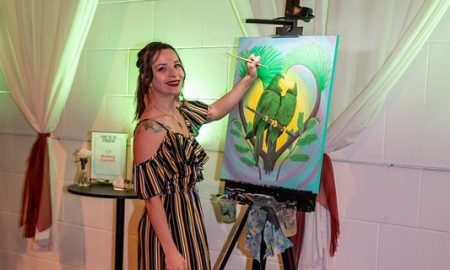
Today we’d like to introduce you to Susan Scharpf.
Every artist has a unique story. Can you briefly walk us through yours?
I have an MFA as a set designer and worked as a scenic and mural artist for many years. I’ve also sewn my whole life and as most artists, and certainly, as a scenic artist, have dabbled in lots of other media. Nine years ago we adopted our first child, and I quit my job as the Charge Artist at SDSU to stay home with him. At the time, we were living in Pacific Beach, and I really wanted a surfboard inspired quilt for him. But, I couldn’t find anything I liked, so I made one from Indonesian batiks and Hawaiian prints. It was my own design, and I figured out how to do it on my own. It was so bold and colorful and unique, and people kept asking me about it. So, I decided to do crib quilt versions of it and other kids items. I was busy with my son, and then a few years later, we adopted our second son, so making quilts took a back seat. But, three years ago, I decided it was time to get back to it, and I applied to be a member of the Spanish Arts Village in Balboa Park. I was accepted and became the only quilt artist in the village. The need to stock the studio with things to sell meant I had to start producing much more than I had been, and that was a great challenge. I had to start learning marketing and merchandising, which isn’t the easiest thing for an artist! I don’t like the business side so much…I just want to create! But, it’s been a wonderful learning opportunity that has allowed me to really become skilled and know how to better realize my designs and my crazy ideas. I still use the batiks because I have a very bold colorful style. All the stitching is completely freehanded on my machine. I love coming up with new ideas and creating things that haven’t been done before.
Please tell us about your art.
I am a quilt artist. In some ways, I hate to say that because it always conjures up images of traditional quilting, and that I do is far from that. I love traditional quilting, but I am much more of a freestyle kind of girl. I never use patterns, unless a design calls for it, then I create my own. And that is rare. Mostly I have an idea in my head, and I jump in head first and start building it. Since most art is static, I am always looking for ways to capture motion and light and energy. Through the use of the bold Indonesian batiks, the layering of bold, vibrant prints and colors and the addition of all the threadwork, I am able to create a quilted art piece that gives the audience so many things to discover. I love the unexpected, and I love to have a little of that (or a lot) in every piece. Maybe it’s the stitching that requires a closer look to see all the shapes and designs and sometimes even messages. Maybe it’s the fact that I use a contrasting thread on a solid batik on the backs of my pieces, which allows you to see a simpler, more graphic line drawing version of the colorful quilt top design on the back as well. I also try to use strong imagery and in particular, strong female imagery. The Phoenix, mermaids, strong, bold women, lions, bears and other animals, surf and ocean-inspired images all make their way into my quilts on a regular basis. I want people to look at my pieces and think “no fear.”
What do you think about the conditions for artists today? Has life become easier or harder for artists in recent years? What can cities like ours do to encourage and help art and artists thrive?
I think there has been a shift towards shopping local in general and also supporting local and living artists in the last several years. I think the idea of spending a little more money on something that is very unique is appealing to more and more people, especially when buying gifts. We all have so much “stuff,” and there is a movement to downsize, to purge, to organize and be free of all the “things” that sometimes weigh us down. I often say we aren’t Target. People don’t come to use because they NEED a blanket or a pillow. They come to us because they want to see something they haven’t seen before, and they buy because they want to own something that nobody else has. I’m often asked if I have a hard time letting go of a piece I’ve worked on for forty or fifty hours and I always say “no.” And, the reason is that when a person buys one of my pieces, it’s because they fell in love with it and it means something to them–the imagery strikes a cord. Or they know it will mean something to a loved one, often because of a certain experience or life long love of lions or sea turtles or something like that. They know it will be “the perfect gift.” What more can you ask for?! I do think as artists, we have to remember that if we want to earn a living at it, that it is a business and it has to run that way. And that can be tricky because we have to charge way more for an item than people are used to paying at a department store. I think the best thing cities can do is to provide environments such as the Spanish Village Arts Center, when artists can have less expensive rent and not have to pay huge commissions like we do in boutiques and galleries. That allows us to keep costs down, earn a living, feed our community with wonderful new, inventive things, be more skilled because we don’t have to have three jobs to survive, and it also provides a wonderful tourist attraction that brings in money for our local cities, which in turn brings money to locals in general. It is a win-win situation.
How or where can people see your work? How can people support your work?
I work in a wonderful community of artists in the Spanish Village Arts Center in Balboa Park. In order to be a part of SVAC, you have to live in San Diego County, you have to go through a jury process (which happens twice a year), and once in, you have to create everything by hand and by yourself. So, it’s all local artists creating original pieces. I work more specifically in the glassblowing studio, which is Studio 19. It is a type of cooperative space in which we all run our own art business, but share studio space and help to sell each other’s work. My textile work is a nice, soft, tactile complement to the beautiful blown glass and the glass and crystal carvings of our third studio partner. I also post all my process work on Instagram @crystalpiertextilearts and on Facebook at Crystal Pier Textile Arts. That way people can see what I’ve created that day, or even follow a larger design from design to the realization over the course of several days or weeks. I also write more extensively about certain pieces on my website www.crystalpierarts.com under the blog.
Contact Info:
- Address: Susan Scharpf
Studio 19
Spanish Village Arts Center
Balboa Park - Website: www.crystalpierarts.com
- Phone: 619-251-4217
- Email: crystalpiertextilearts@gmail.com
- Instagram: @crystalpiertextilearts
- Facebook: Crystal Pier Textile Arts


 Image Credit:
Susan Scharpf
Getting in touch: SDVoyager is built on recommendations from the community; it’s how we uncover hidden gems, so if you know someone who deserves recognition please let us know here.