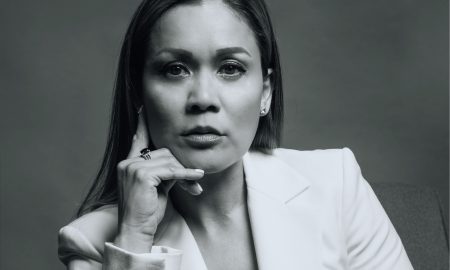
Today we’d like to introduce you to Doris Bittar.
Doris, please share your story with us. How did you get to where you are today?
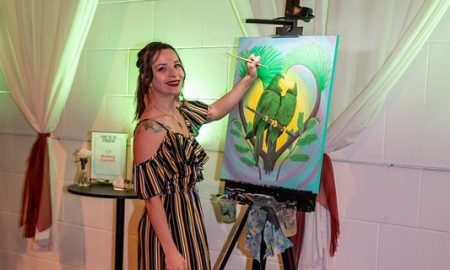
I am an interdisciplinary visual artist. I teach painting, drawing and design at California State University, San Marcos. I am an immigrant, and came to the United States from Lebanon just ahead of the 17-year civil war, as a child. Reading quickly became a refuge for me when trying to fit into American culture. I had strange lunches. Pita bread was not a known entity in the late 1960’s. I was socially awkward yet drawn to the American dream of freedom and liberty.
By the fourth grade, I was a voracious reader and lived a rich life through books and poetry. Reading enriches us by connecting us to the world when we cannot create a real world of connection. I have been a community organizer my entire adult life. My husband and I organized Jewish-Palestinian Dialogue for six years, supported charities to war victims, and strengthened the local Arabic community in San Diego to push back against racism by educating Americans about our culture. As part of my role as president of the American Arab Anti-Discrimination Committee-ADC for the San Diego chapter, we responded to Syrian Americans who came to our monthly meetings and stressed the urgency of teaching the new Syrian refugees English so they can succeed.
They wanted us to come up with a serious and workable plan. I thought about it and discussed it with others for two months before we began. Along with the support of ADC members, I formed Teach and Learn Literacy – TaLL to deliver a survival literacy program to Syrian refugees in their homes. The principle that anchors our organization is that no one should do anything alone. From that concept, we formed teams of two to three people to teach and support the adult, usually a mom or dad or young adult teen who fell through the cracks and is working toward an equivalency degree. Typically, we are helping parents, grandparents and some young adults.
After a year, they are getting trained for solar installation, janitorial work, car body shop work, window washing, plaster and painting, construction, food catering or going to college. Our goal was to help them learn the language, manage the medical care of their children, and find jobs or learn how to create work with small businesses.
Great, so let’s dig a little deeper into the story – has it been an easy path overall and if not, what were the challenges you’ve had to overcome?
Forming teams sounds simple, but it works best when we engage for some hours or a few days in a row to make the proper phone calls and follow up over a three-day period. That means engaging with about 7-8 people who have indicated an interest. The work that TaLL does behind the scenes is a full-time job, way past the 5-10 hours a week that a volunteer I put in. We are raising funds for two part time positions to speed up the work we do and keep it consistently organized and thriving. I dream about expansion to other communities.
Literacy is an issue for many Americans who are not refugees, some adults slipped through the cracks from the age range of 40 into elderly years who never learned to read, are functionally illiterate, but were able to hide it. Think about the gratification at any age, to be able to comfort yourself through reading. Reading calms you, gives you knowledge, emotional knowledge as well as quantifiable knowledge, and most importantly makes you feel a part of the world.
Though reading is a solitary activity, it is also a social activity. In the room with you are all the characters and places you read about. Why not have this hidden burden in our society become an asset, a team building experience that erases bigotry and ignorance and breaks down social, cultural, economic and political barriers to help people communicate. We take care of literacy needs, but I’m most proud of our holistic embrace.
Teach and Learn Literacy – TaLL – what should we know? What do you guys do best? What sets you apart from the competition?
Teach and Learn Literacy (TaLL) is a volunteer literacy program providing quality English language instruction to new Americans who cannot consistently attend traditional adult learning centers because of disabled or young children. Our teams include certified English as a Second Language (ESL) instructors, native language facilitators, and trainee teachers. We offer free, ongoing training and workshops for all volunteers.
San Diego has one of the largest refugee populations in the United States. The new arrivals are Syrians with special needs. Although we expect to expand our focus to other populations, our pilot program primarily engages with Syrian refugee families. Our pupils gain confidence in interacting with their neighbors, helping their children with homework, preparing for equivalency degrees, and finding jobs. We offer a broad range of guidance, including career counseling.
Teach and Learn Literacy is almost 18 months old and is a non-profit under the fiscal sponsorship of the Syrian Community Network. It was launched on January 1, 2017, where the first five teams formed to serve about nine adults. I like to call these adults – mostly mothers and some fathers – “families,” because we work within the context of the home and take in the focused aspects of their lives. TaLL has served 30 families thus far – 30 Adults. An uptick of volunteers came since the UT wrote an article on our program a couple of weeks ago and our hope for this year is to reach 50 more families.
TaLL’s goals are simple. We want the students to acquire jobs, help their children with homework, navigate the medical issues in their lives, and acclimate. We are a guiding force that does not let fear paralyze them. The Syrian, like most refugees in San Diego, love their homes of origin. Yet they have lived through extreme repression, and fear, eventually forcing them to run for their lives. Most have lived in refugee camps for 2-4 years before coming to America.
San Diego has long been a city of refugees. We have the largest number of refugees in the nation. What is different about this subset of refugees is that almost all, to a family, have disabled children and adults. Each family needs a team to get them through the early years in the US. The reason is that the Obama administration extensively vetted these Syrian families but focused on letting in the most vulnerable. An unprecedented number, a vast majority of the Syrian refugees in San Diego have children with autism, cerebral palsy, skin conditions, blindness, or needing a series of operations for bone, muscle and capillary circulation conditions.
Not to mention most are suffering of post-traumatic stress disorder from the effects of war. Most of these new Americans were running for their lives. Most have lived in a refugee camp in Egypt and Jordan for about two to four years. They are lucky to have arrived on our Western shore and be guided by the most generous people on the planet – Americans of all stripes. I do not want to sugar coat. Life in the US is hard, even for Americans who have been here many generations. Low paying jobs and high rents eat away at progress for everyone, and Syrian refugees are not an exception.
What moment in your career do you look back most fondly on?
After over 35 years of community organizing, I finally have the wherewithal, insight, and foresight to structure a plan that is nearly airtight in addressing and solving this community need for literacy. I identified what tools are needed, what components must be part of developing it, and who to contact to get the ball rolling. Fifteen months later it works and is now ready to grow. Grow TaLL is our mantra for this year and next. We now have the capacity to grow, thanks to our evolution and work behind the scenes.
Our volunteers include English as a Second Language experienced professionals, Arabic translators, and many interested in learning how to teach ESL. Offer free in-house training tailored to our needs, and guide teachers to centers where the Laubach method of learning English is offered for free about four times a year. These adults are learning survival English that is focused on functional skills. They are finding low paying jobs, but some are finding skilled work and better income through a small business such as catering, construction work, solar panel installation, medical assistantships, window washing, and conducting cooking lessons. I did not anticipate two outcomes after the first six months: One is that most of the teams would bond with each other so quickly.
They became a support network for one another, and at the same time bonded to the family – usually, a mom or dad entrenched in taking care of their families. Though most of our students are mothers and some fathers, we view them as a family because of the context they live in. The parents are very much engrossed in their kids’ lives like all parents are. They are in the thick of it: work, kids, time management, health, and acclimating to a very different culture. We are in their homes and can see the children, the grandparents, the space limitations, and their children’s needs. All of our students have handicapped children, no consistent jobs, and very little space.
Recently, our teams helped a young mother deliver her baby. There are three volunteers on this team, and they took her to the hospital, filled out paperwork, stayed with her till the baby was born, traded off to take care of children at home, and were there when she was discharged. Another example, Shamsa, a 50-year-old Syrian woman from Damascus, was often silent at the lessons with her husband. He was engaged, but she was quiet. The team decided to find out why she was so passive. The team discovered that she cannot read – not even Arabic. The team took her to have her eyes checked and it turned out that she needed glasses.
Then they began to teach her the most basic visualizations of letter writing with phonetic instructions. Today, at 51 English is her first literate language. She can read a calendar and follow her teen-aged boys’ schedules. She reads simple words and can speak in phrases when she goes shopping or to the doctor. The team celebrated her birthday just a week ago. The team and this woman’s family are now an extended family. Another unexpectedly positive impact of the program is that it’s the most profound community building I have ever witnessed in my 35 years of community organizing. TaLL is breaking down cultural, language, societal, and economic barriers.
As the head of an Arab civil rights organization educating non-Middle Eastern Americans is a goal, I hoped for this but did not expect it to happen so soon. Our volunteer Lead Teachers are not Middle Eastern. They put in about 4-6 hours a week and do not suffer from burn out because they support each other. The challenges are large, but we measure progress incrementally.
Pricing:
- Guiding Funder: $1000 or more.
- Inspirational Funder: $500
- Sustaining Funder: $300
- Friends: $150
- Goodwill Funders: $75
- Basic Funder: $30
Contact Info:
- Website: http://www.teachandlearnliteracy.org
- Phone: (619) 787-8505
- Email: doris.bittar@gmail.com


 Image Credit:
Maggi Baker, Ed Sweed
Getting in touch: SDVoyager is built on recommendations from the community; it’s how we uncover hidden gems, so if you know someone who deserves recognition please let us know here.