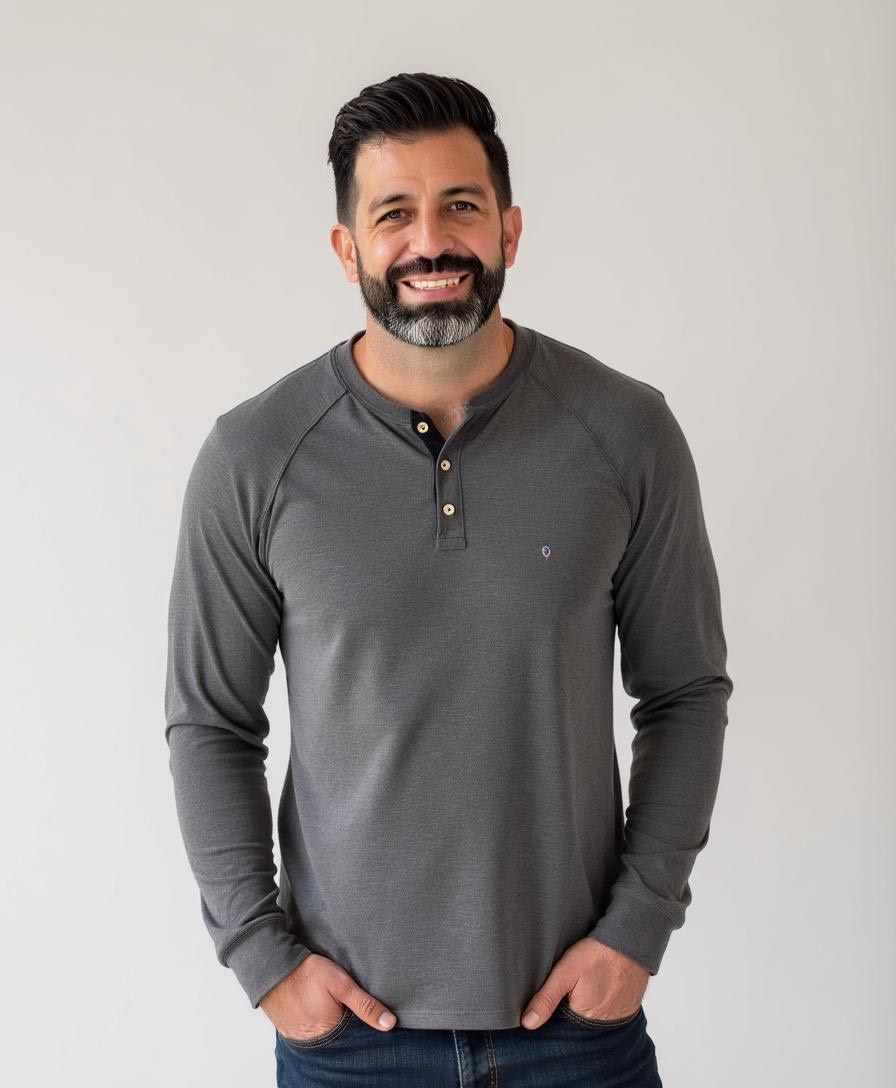
We’re looking forward to introducing you to Daniel Altenburg. Check out our conversation below.
Good morning Daniel, we’re so happy to have you here with us and we’d love to explore your story and how you think about life and legacy and so much more. So let’s start with a question we often ask: What do the first 90 minutes of your day look like?
My mornings start the night before. I put my phone in airplane mode before bed, and it stays that way until the kids are at school. It helps me wake up without noise or distraction. My alarm is set for 6:40, but my internal clock wakes me up around 6:15 every day. My wife is the early riser, so she’s usually already downstairs with her coffee and a podcast. I take ten or fifteen minutes to just lie there, wake up slowly, and ease into the day.
By 6:30 I’m up. I start with a cold glass of water because I heard it kick-starts your metabolism. Then I make my morning coffee with Laird Superfood Creamer, adaptogens, and a splash of oat milk. After that I blend a quick morning shake with oat milk, greens, fiber, collagen protein, and some fruit. The second the blender turns on, my two boys, who are seven and five, usually come down the stairs.
That part of the morning is all about them. I make their breakfast. It might be cereal with fruit, mini pancakes from Costco, or a breakfast quesadilla with guacamole. We hang out, talk, and if my seven-year-old has homework, we knock it out together. My phone is still on airplane mode so I can stay present.
Then it’s time to get dressed, pack lunches, and ride to school. One of the perks of living in Claremont is that the boys’ school is right down the street, so they ride their bikes and I follow along on my skateboard. We drop them off, and I skate back home.
Once I’m home, I have a standing morning challenge with a friend that we’ve kept up for three years: 50 push-ups, 50 sit-ups, 50 air squats, 50 jump ropes, and 50 curls. After that I read a page of The Daily Stoic and The Daily Dad. Then I shower, get ready, and check in with my executive assistant, who sends me a rundown of the entire day. Meetings, appointments, context on who I’m meeting with, and anything in my inbox that needs immediate attention.
From there I review my to-do list, look at anything left from the day before, and then I start working in 30-minute Pomodoro blocks. That structure helps me stay focused and keep momentum through the rest of the morning.
So the first 90 minutes are a mix of family time, simple routines, movement, and setting up my mind for the rest of the day. It’s become a rhythm that grounds me and keeps me connected to what matters.
Can you briefly introduce yourself and share what makes you or your brand unique?
My name is Daniel Altenburg, and I’m the co-founder of Zipdev, a nearshore staffing company based in San Diego. We started the firm ten years ago with a simple idea. There is incredible talent in Latin America and companies in the US and Canada need reliable, aligned, cost-effective remote teams they can trust. Today we have more than two hundred professionals on assignment with clients across North America. Our people cover everything from software engineering, DevOps, QA, and UX/UI to marketing assistants, customer support reps, technical support engineers, and virtual assistants.
What sets Zipdev apart is the combination of quality, alignment, and care. We recruit top talent across Latin America, we move fast, and we handle all the backend work so our clients can focus on growth. Our people work in the same time zones, communicate clearly, and understand North American business culture. We also support every hire with a full HR and retention team, which means our clients get stability and long-term performance. That blend of talent, cultural fit, and white-glove support is a big reason we have become Southern California’s largest nearshore provider.
On the personal side, I am a Southern California kid who now runs a business, volunteers in my community, and tries to make meaningful memories along the way. I am deeply involved in the Entrepreneurs Organization here in San Diego. I have served on the board for several years and will be President for the 2026 to 2027 term. I am also part of ProVisors. Surfing, snowboarding, and SDFC games all have a special place in my life. When winter hits, I do everything I can to get back on a snowboard.
At my core, I am a connector. I love meeting people, hearing what they are building, learning what books they are into, swapping ideas, and finding ways to help. Sitting in the revenue seat at Zipdev fits me perfectly because the job is really about relationships. When you care about people, listen well, and stay curious, you naturally create trust. And that trust is what drives everything we do at Zipdev.
Thanks for sharing that. Would love to go back in time and hear about how your past might have impacted who you are today. Who saw you clearly before you could see yourself?
The person who saw me clearly before I could see myself was my wife, Justine. We met back in 2008, and we have been together ever since. Married for almost ten years now. When I look back at who I was in my late twenties, I felt like a kid trying to figure life out. She had a solid career and a clear sense of direction. I had just moved back from Peru and was pursuing her while trying to understand what the next chapter of my life would look like.
But she saw something in me long before I saw it in myself. She saw potential, a future, a bigger version of who I could grow into. And she believed in that version of me even when I didn’t fully believe in it yet. She took a chance on me, trusted me, and kept encouraging me to aim higher and go further.
A lot of what I have achieved is because she held a higher vision of me than I held for myself. She pushed me to break past the limits I thought were fixed. Together we have built an incredible life, and her belief has been one of the most powerful forces behind it.
So when someone asks who saw me clearly before I could see myself, the answer is easy. It’s Justine.
What fear has held you back the most in your life?
The fear that has held me back the most shows up in two different ways. The first was this belief that success was mostly about luck. For a long time I thought you needed the stars to line up, that opportunity had to magically hit at the perfect moment. Any time something good happened in my life, whether it was my marriage, my career, or buying our home, my default response was, “Yeah, I got lucky.”
It took a lot of internal work to realize that mindset was limiting. It made me play small, like I was waiting for lightning to strike instead of trusting my own effort. Through therapy and real self-reflection, I learned that most of what I have didn’t come from luck. It came from consistency, work, and actually caring about the people around me. Letting go of “luck” and replacing it with gratitude and ownership has opened up a lot for me.
The second fear is the fear of self-sabotage. When things are going really well, there’s a voice that says I’m going to mess it up. That maybe I don’t deserve the good things I have. That fear used to pull me back from pursuing bigger opportunities because it felt safer to not try than to risk ruining something.
The shift for me has been awareness. Seeing that pattern for what it is. Understanding that the fear is old, but I’m not. When I stay present and grounded, I don’t have to let that story run my life.
Those two fears used to hold me back. Today they’re signals. They remind me to stay grateful, stay aware, and keep choosing the version of myself I’ve worked hard to grow into.
Alright, so if you are open to it, let’s explore some philosophical questions that touch on your values and worldview. Is the public version of you the real you?
If you had asked me this question fifteen years ago, or even ten, the answer would have been very different. Back then I felt like I had to be two versions of myself. There was the work version, the guy who showed up with a tie and tried to look the part. And then there was the version of me my friends saw, the twenty-something staying out late and trying to figure life out. At that age, it felt normal to separate the two.
Now, stepping into my forties as a husband, a father, and a business owner, the gap has closed. The public version of me is the real me. I’ve learned that authenticity sells because authenticity connects. And running Zipdev has made me realize that who I am is part of the brand. My values show up in how I lead, how I build relationships, and how I show up for my team and my clients. Growth, honesty, adventure, showing up as a good person, leaning into meaningful connection. Those things aren’t roles, they are who I am.
Trying to manage two versions of yourself is exhausting. It drains your energy, creates pressure, and forces you to constantly switch masks. I don’t want to live like that, and I don’t need to. At this stage of life, I’m focused on alignment. One version of me everywhere I go. Same person with my team, my friends, my community, and my family. Obviously there are things I keep private because that’s part of having a healthy relationship and healthy boundaries, but the core of who I am stays the same.
So as of today, yeah, the public version of me is the real me. And it feels good to finally say that without hesitation.
Okay, we’ve made it essentially to the end. One last question before you go. What is the story you hope people tell about you when you’re gone?
There’s a quote by Hunter S. Thompson that I’ve always loved. “Life should not be a journey to the grave with the intention of arriving safely in a pretty and well-preserved body, but rather to skid in broadside in a cloud of smoke, thoroughly used up, totally worn out, and proclaiming, Wow, what a ride.” That line has always captured how I want to live and how I hope people remember me.
If there is a story people tell about me when I’m gone, I hope it’s that I lived life to the fullest. That I chased adventure, embraced challenge, and kept a smile on my face the whole way through. I hope people say I was a guy who showed up for the people who mattered. That I stayed connected to my wife, my kids, my family, and my closest friends. That I was fun to be around, that I made people feel alive, that I inspired and motivated my team.
More than anything, I hope the story is that I was a huge fan of the life I was given. I want people to remember me as someone who soaked in the moments. All of them. The early dating days with my wife, the engagement, the wedding, the newborn phase with our boys, the chaos of toddlers, the magic of watching them grow into their own lives. The phases of life matter and I want to be the guy who appreciated all of it.
I hope they say I was someone who loved connection, who loved being outside, who never turned down a cold Modelo, who was always down for an adventure, and who could sit in the San Diego sunshine, look west at the water, and feel lucky every single day.
Because the flip side is heartbreaking. The idea of ruining your relationships and leaving this world with nobody who cares enough to tell your story. That scares me. It motivates me. It reminds me what matters.
So if the story is that I lived hard, loved deeply, chased joy, and stayed connected to the people who meant everything to me, then my life will have been epic.
Contact Info:
- Website: https://www.zipdev.com
- Linkedin: https://www.linkedin.com/in/danielaltenburg


Image Credits
RWB Multimedia