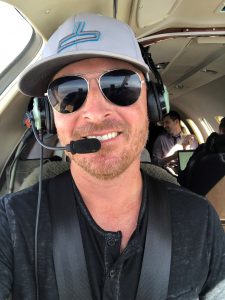
Today we’d like to introduce you to Josh Olson.
Hi Josh, we’re thrilled to have a chance to learn your story today. So, before we get into specifics, maybe you can briefly walk us through how you got to where you are today.
I started out as a volunteer with Angel Flight West (AFW). Before this, I worked with an advertising agency with Angel Flight South Central, a fellow volunteer pilot organization based in Dallas, TX. I fell in love with the mission. My father and grandfather were both in the Air Force, so I have always loved aviation and was drawn to it at a young age. When I found out the organization was built around volunteer pilots, I fell in love. At the advertising agency, we helped Angel Flight South Central rebrand through pro bono work.
After getting married, my wife Erin wanted to work in the nonprofit industry. We found out AFW was hiring in LA, and my wife was hired as the Mission Coordinator. I was working a lot of nights and weekends in the entertainment industry while volunteering at AFW during the day. When we were pregnant with our first child, it was a high-risk pregnancy. Our daughter Avery was in the NICU in Santa Monica. While Erin was on maternity leave, Angel Flight West hired me to fill in as Mission Coordinator.
While I was filling in, I got a call from a guy — another Josh — in Montana. His daughter was diagnosed with leukemia. His wife and daughter were seeking treatment at Seattle Children’s Hospital while staying at the Ronald McDonald House. Josh called to ask if we could get him to his wife and daughter. Traveling is difficult; sometimes the mountain roads were closed due to the weather. Sometimes contracting deals needed to be completed so he could continue to provide financially for his family. Then it hit me — what if Erin and Avery were at Seattle Children’s Hospital and I had difficulties getting to them? It was a very emotional situation for me. We were both in tears at the end of the call. This was my ‘aha’ moment. This was when I knew Angel Flight West was what I was supposed to be doing. I no longer wanted to do commercial acting and writing. My skills were better suited to help other people than to glorify myself. I went to the hospital that night and told Erin and she said she knew that already. AFW brought me on board and that was 14 years ago.
As a kid, I moved around a lot. When moving back to the Midwest, I landed a role in a school production and started to be known as that character rather than myself. I always felt like I had to be someone else for approval, but AFW flipped that. It’s not about me — it’s about other people. I am gifted with the ability to relate to and connect with others. As a performer, I connected with the audience and other actors. In my role at AFW, I am able to use that skill set to connect with passengers, donors, and volunteers. I can better understand and empathize with others. It’s way more rewarding to build people up and help others than to use these skills for my own affirmation.
Can you talk to us a bit about the challenges and lessons you’ve learned along the way? Looking back would you say it’s been easy or smooth in retrospect?
For AFW, it’s sometimes not about quantity as much as it’s about quality. We’ve been in a growth phase for so long to serve more people. When you have a global pandemic, it threatens the lives of those served if they come into contact with a COVID-19 case with their immune systems often being compromised. We never had to suspend AFW completely. We were able to fly PPE to various locations and we flew nurses to areas with high COVID-19 rates. We listened to healthcare partners and experts to mitigate risk as much as possible. Our method of transportation had less risk with passengers being relatively isolated in a small plane, but we still didn’t fly as many flights given the state of the pandemic. Our volunteers didn’t want to fly until being vaccinated as they didn’t want to spread illness to a passenger. We had to slow down and say, “We’re meeting a critical need for people who are at the most risk by getting them life-saving health care. We’re providing an incredibly safe option for passengers to travel.” It was an important and gratifying lesson to learn. We reset our strategy by making sure we were there for the most vulnerable first.
Great, so let’s talk business. Can you tell our readers more about what you do and what you think sets you apart from others?
Before joining Angel Flight West as their Executive Director, I was previously an account executive at a Dallas advertising firm that represented Angel Flight South Central as a pro-bono client. Since joining Angel Flight West in 2004, I have served in a variety of positions, most recently as Director of Mission Operations, and was named executive director in May 2014. I hold a bachelor’s degree in Communications from Taylor University and an MBA with a non-profit emphasis from Marylhurst University and am currently a student pilot.
As for our nonprofit, Angel Flight West is a nonprofit, volunteer-driven organization that arranges no-cost, non-emergency air travel for children and adults with serious medical conditions and other compelling needs. With a network of 1,600+ pilots throughout the 12 western states, pilots donate their aircraft, piloting skills, and all flying costs to help families in need, enabling them to receive vital treatment that might otherwise be inaccessible. Financial, medical, and/or geographical limitations all play a pertinent role in patients receiving the healthcare attention they need, making Angel Flight West’s efforts to recruit volunteer pilots and serve more passengers just as worthy today as ever before.
Every day, Angel Flight West’s volunteer pilots fly people to their medical appointments at no cost to the passenger. Angel Flight West has spent nearly four decades — and provided more than 95,000 flights — creating pathways to healthcare across the Western United States, arranging donated flights to people in need, and providing them safe passage to and from medical care.
Our vision is that transportation as a barrier to healthcare would be completely removed and that no one would have a barrier to accessing the healthcare they need. We strive for this goal through volunteer pilots, volunteer drivers, and partnerships with commercial airlines. I have stayed with AFW because helping people feels good and helping other people help people feels twice as good. We have an army of volunteers that are amazing people. They want to do something they love to help others. Making that possible in spades makes it feel like you’ve helped someone use their passion to help someone else. Plus, you’re helping patients in need of health care. Everyone wins and benefits from it.
We all have a different way of looking at and defining success. How do you define success?
First, a strong work ethic determined much of my success. In relation to Angel Flight West (AFW), I was a young dad. I was identified by the AFW board as a leadership candidate. At the time, they felt I didn’t have enough experience to take over as Executive Director yet, however, they matched funds to put me through MBA school. I was working full time, I had two toddlers, and I had to work hard during the day, to then come home and stay up for grad projects due at 11:59 p.m. I sacrificed a lot of sleep. I thought, for 18 months, I’m just not going to sleep.’ I worked a lot of 20-hour days for AFW, for my family, and for my MBA degree.
Secondly, the ability to set goals and measure performance and outcomes has been vital to my growth. Personally, and professionally, if you have nothing to aspire to, you won’t reach it. I needed to be tactful enough to measure and readjust goals as needed.
Lastly, leaders need to build others up. I’ve focused on enabling our team to achieve success. The same idea translates to vendors and clients. Coming in as Executive Director, we had a lot of challenges to overcome. Missions were in a state of decline. My instinct was, ‘If I work harder and do all the tasks I know how to do, we’ll be successful.’ That’s exhausting and doesn’t equate to long-term success. You need a team and infrastructure. Achieving some short-term success was helpful in fundraising but we needed a strong development team, and that was a real learning opportunity for me. I had a few failures before I learned how to put the right expectations in place. I learned to give others ownership and autonomy. I learned to let others fail and adjust. These were important practices to learn in my first couple of years as Executive Director.
Contact Info:
- Website: www.angelflightwest.org
- Instagram: www.instagram.com/angelflightwest
- Facebook: www.facebook.com/angelflightwest
- Twitter: twitter.com/angelflightwest
- Youtube: youtube.com/angelflightwest