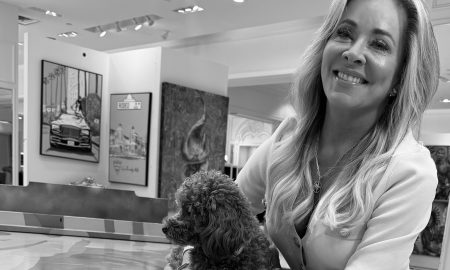
Today we’d like to introduce you to Christine Garde Denning.
Christine Garde is a native New Yorker and the Founder & CEO of the non-profit organization, CouldYou?
Christine has devoted her life to caring for the poor and trying to make the world a better place. After receiving an International Business degree from Pace University in NYC, she began her career by approaching Housing and Urban Development (HUD), suggesting that she become a community police officer, living in their public housing in order to address gang activity on their property. Christine spent ten years living at the San Diego/Tijuana border area. Her efforts resulted in significant decreases in gang tagging and violence on property while investing in the lives of hundreds of teens and families. During this time, Christine raised a little girl from the neighborhood from birth. Today she is 21.
Christine worked with Young Life and Steadfast Properties, envisioning and overseeing multiple learning centers across California that served thousands of low-income families. As a precursor to CouldYou?, Christine adapted and implemented an experience-based program called NYC Urban Plunge, which gave college students an immersion experience of life in the South Bronx, encouraging students to look at broken systems and social justice, helping students envision how they could become agents for change.
In 2007 Christine founded CouldYou? Since its inception, CouldYou? has established itself as a respected non-profit organization that connects, consults and offers transformational travel to Africa to enable people of integrity and influence from the West to partner with African leaders of integrity to address serious challenges. We believe that the line between the giver and receiver dissolves when relationship and authentic experience are desired. Their mission is to work with African leaders and organizations to develop African solutions to African problems while helping individuals to find their own unique contribution to impact poverty.
CY is committed to creating holistic solutions, building a better world for future generations, and doing business/charity with integrity. We believe it is an honor to be part of shaping the future of the continent and treat this opportunity with the respect and moral obligation that it deserves. Christine has established key partnerships in Africa, with the Arch Bishop Desmond Tutu Fellows as well as with the former president of Mozambique, Joaquim Chissano’s Foundation, as well as Ministries of Education, Culture, Gender, and Health in several countries, with a focus to shift the paradigm in addressing poverty. CouldYou?’s main initiative; providing menstrual health education and the CouldYou? menstrual cup is currently in nine countries (Ghana, Uganda, Nigeria, Cape Verde, Mozambique, Liberia, Mexico, South Africa, and the inner city USA). For $10, a girl can have her menstrual health needs met for 10 years!
According to Forbes magazine, in 2016 Christine was chosen as one of the forty over 40 women who are reinventing, disrupting and making an impact globally.
Has it been a smooth road?
It has not been a smooth road…but it has been a really good road! One professional struggle was when the organization ran out of money and I had to make a hard decision; to shut it’s doors or to make some real sacrifices and keep going. I choose to sublet my apartment and sleep on the floor at a friend’s house for six months to save money (as I wasn’t able to take a salary). I took money out of my retirement to cover the expenses on the ground in Mozambique and we kept going. It was not easy, but each time I thought about giving up, I would remember the lives we were impacting…and it made it all worth the sacrifice. I’m happy to say that we have had a breakthrough since then and I have a team of 20 people globally on staff.
A personal struggle/challenge I faced was my desire to “mother”. I recently got married for the first time at 48 and yet, since my late 20’s I’ve wanted to have a child and “mother”. Sometimes though, life doesn’t turn out exactly as you envisioned and you find yourself in circumstances beyond your control. I was in my late 20’s running a gang diversion program at the border of Tijuana/San Diego and so I began exploring and being open to ways I could reinvent “mothering”. A young girl in my program was pregnant and I took her to the hospital to deliver the baby and the moment I cut the umbilical cord, I fell in love and received the greatest gift of my life…to help mother that little girl. That little girl is now 21 years old.
It is difficult to put into words the bond we have as there actually isn’t a word to describe it…it transcends words and is the deepest love I’ve ever experienced. A memory that for me embodies our relationship was at her quinceanera (15-year-old birthday party). Her mom was dancing the mother-daughter dance and halfway through asked me to come out and finish the song. Mothering Leilani has been complicated and hard and at times heart-breaking and I wouldn’t trade it for the world. She is not my daughter. I don’t receive a card on Mother’s Day but I get to love her, mother her and treasure each day with her as she grows into an incredible young woman. I’m glad I didn’t miss this opportunity to “mother” simply because it wasn’t what I had imagined…sometimes the unimaginable is even better.
We’d love to hear more about your organization.
One of our main initiatives is a global effort to assist girls/women in reaching their economic potential to drive economic and social change in their communities through educational opportunities.
When women have control over their income, they invest in the health, education and well-being of their families. They also tend to reach out to propel other women forward, creating a powerful multiplier effect that benefits all of society. In order for this to happen, they MUST finish their education. CouldYou? is working to ensure that no girl will miss school because of menstruation.
Our solution? The menstrual cup. Menstruation is heavily stigmatized due to a lack of education and cultural beliefs, which can limit girls’ access to hygiene and interaction with their community. Facilities such as separate women’s or private bathrooms—or those with running water and soap—often do not exist, making it challenging for girls to change sanitary products and wash. Girls also have limited options for feminine hygiene products and may have to use “traditional” methods such as cloths, papers or leaves, which can be uncomfortable and allow leakage onto clothes. Where options such as pads do exist, they are often cost-prohibitive. Over 80% of the population lives on less than $2 a day and approximately 60% of the population lives in severe poverty, so families prioritize their spending on food and other essentials.
These challenges lead to more serious issues such as reproductive diseases caused by poor menstrual hygiene and contribute to school absenteeism. According to the United Nations Children’s Fund, one in ten African girls does not attend school during menstruation. In addition, girls may refrain from participating in physical activities and have a lower level of confidence.
The Solution
The menstrual cup has been used in America since the 1930’s, is certified safe by the United States Food and Drug Administration (FDA) and is environmentally responsible since one cup can be used for up to 15 years. Benefits of the menstrual cup include:
COST EFFECTIVE
Our menstrual cup costs US$10 and it lasts 10 years! CY will further subsidize the price to be an affordable option.
CY also provides health education to girls on the topics of menstruation and use of the cup
BETTER FOR GIRLS’ HEALTH
The menstrual cup does not absorb the body’s natural defense mechanisms, rather it allows the body to continue its essential cleansing and protective functions.
The medical-grade silicone menstrual cups contain no bleaches, deodorizers, absorbency gels or pesticides. They do not cause irritation and are perfectly suitable for women with sensitive skin or allergies.
Our menstrual cup is medical grade silicone and virtually eliminates the risk of toxic shock syndrome Menstrual cups are comfortable, odorless and leak-proof, and do not have to be removed when using the bathroom. Girls can safely wear them for up to 12 hours without having to change them.
In rural Africa, the girls do not need water to rinse the cup. As long as they have clean hands, they can insert then remove and empty and reinsert. After their cycle, they simply boil the cup for five minutes and store it in a cotton carrying bag.
BETTER FOR THE ENVIRONMENT
The average woman throws away around 240 tampons per year. Unlike pads and tampons, menstrual cups are reusable, eliminating ALL waste and the need to carry bulky spares.
We will also serve the girls and boys in the community through the provision of educational materials, which include a menstrual health comic book; illustrated by a Mozambican illustrator, girl’s life skills and health classes, and an instructional brochure and videos. It is important that boys be included in some interventions, to help identify strategies for male awareness on the topic girls’ menstruations. We also hire marginalized women in each country to make our cotton carrying bags and find economic freedom.
Let’s touch on your thoughts about our city – what do you like the most and least?
I love being in Carlsbad/Oceanside; close to the ocean that we can enjoy 12 months a year!
Pricing:
- $10 keeps a girl in school for 10 years (through the menstrual cup)
Contact Info:
- Address: 3232 San Helena Drive
Oceanside, CA 92056 - Website: www.couldyou.org
- Phone: 9177961961
- Email: christine@couldyou.org
- Instagram: couldyoucup
- Facebook: http://www.facebook.com/couldyoucup/
- Twitter: https://twitter.com/@couldyouafrica


Suggest a story: SDVoyager is built on recommendations from the community; it’s how we uncover hidden gems, so if you or someone you know deserves recognition please let us know here.
Popular
-

Hidden Gems: Local Businesses & Creatives You Should Know
-

San Diego’s Most Inspiring Stories
-

Maren Hoflund Is Expanding Holistic Healing Beyond the Treatment Room Through Education, Community, and Accessible Wellness
-

How Casey Cantwell Turned a Viral Event Trend Into a Business Built on Celebration and Service