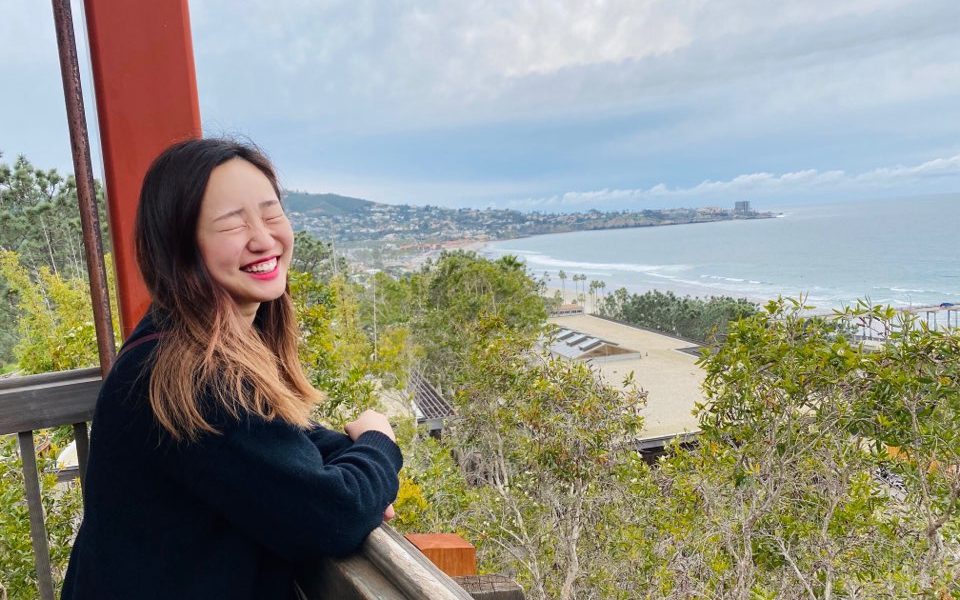
Today we’d like to introduce you to Minjoo Kim.
Minjoo Kim is a lighting designer who is on a never-ending quest of understanding the fascinating facets of light. Her lighting design credits include The Great Leap(Cygnet Theatre), Sensoria(New Renaissance Performing Art Company), Quiet No More(San Diego Women’s Chorus), Qulili(The Blind Spot), IDEAS-Cetacea(Calit2 Theater, Atkinson Hall), Crimson Girl(Dongsoong Art Center), Die or Not(Seoul Art Space Mullae), Mask on/off(Shanghai Dramatic Arts Centre).
Her work Othello, directed by Dylan Key, got selected in the Emerging Artist/Imagination Exhibit from the USA at Prague Quadrennial in 2019.
She received her MFA in theatrical lighting design from UC, San Diego, and a BA in Theatre and Film Design from Chung-Ang University in Seoul, Korea.
Minjoo, can you briefly walk us through your story – how you started and how you got to where you are today.
To talk about my story, I have to recall my memory back to 17. My days as a teenager were quite ordinary as I spent many sleepless nights tossing and turning concerned about my future. I was very indifferent to everything as even famous proverbs and sayings failed to really capture my heart, at least until my music teacher made us watch the musical “Aida”. This film rendition of the play, brightly projected in the dark classroom, was fascinating to the point where my eyes and ears were captivated. As I became overwhelmed by its grand scale, blasting sound of memorable songs and brilliant lightings in various colors, every sense, and organ of my body began to wiggle, along with the play. It was not until after the very last light had dimmed that I was able to draw my breath back, as I had watched the entire play in a state of awe. As the darkened classroom returned to a state of brightened normalcy, I felt a bright light shining down in the corner of my heart that had, for so long, been colorless.
I became fascinated by light in the sense that it could not only fill space, and express atmosphere, but also how it could express many other things, even in an empty space, through color, texture, and angle. Designing shows in other countries gave me the opportunity to respect others regardless of who they are or where they belong, and I appreciate the chance of working with them. Also, by having various projects with good people, I was able to break my shell and further expand my imagination as a lighting designer and artist.
Overall, has it been relatively smooth? If not, what were some of the struggles along the way?
I’ve always been lucky as I’ve met good people. I appreciate the opportunities that I have had with experienced artists, directors, and artists.
Since theaters have been shut down due to Covid-19, theater artists have had to face the fact of how vulnerable we are. But, I truly believe that the theater community will get through this.
Additionally, there are certainly unexpected obstacles in the US as a foreign designer. My experiences interacting with Americans and non-Americans have led me to realize how I as a foreign designer, in particular, have a challenging time. Having an open mind has helped me overcome these difficulties. I have a desire to dedicate myself to bridging Asian culture and American theater. I believe it would produce a wealthy multi-culture in our world.
We’d love to hear more about your work. What is the most proud moment/ work of you?
I’ve been working for diverse productions as a lighting designer. All of them are significant for me, but I want to mention a performance “Qulili” co-created and directed by Blake McCarty and Catherine Hanna Schrock from Blindspot Collective. It is a documentary play based on interviews with local refugees and immigrants.
This production relied on lighting design to enhance the storytelling and elevate the refugees’ experiences. With minimal costumes or physical sets, lighting was the primary means of differentiating locations and emotional qualities. Director and I diligently collaborated and I brought innovative new ideas to the process with supporting his vision.
As a lighting designer from South Korea, being part of this project was meaningful. The show couldn’t explore all the complexities of these issues, but we tried to intensify the visibility and understanding of the community in cultural blindspots. We wanted this production to inspire the audience while at the same time enhancing the senses of shared humanity.
Any shoutouts? Who else deserves credit in this story – who has played a meaningful role?
It’s hard to name just one since there are many people who believe and support me. But I want to say thank you to Chris Lewton. Chris is a master electrician with more than three decades of professional experience. Currently, he is responsible for managing all aspects of lighting department operations at Arena Stage at the Mead Center for American Theater, which is a nationally recognized, award-winning theater in Washington D.C. I’ve learned a lot of priceless knowledge. He has supported and cared for me to get through this journey.
Contact Info:
- Website: minjoo-design.com
- Email: alswn6360@gmail.com
- Instagram: https://www.instagram.com/media_joo/


 Image Credit:
Image 2 – Sean Fanning
Image 3&4 – Manuel Rotenberg
Image 5 – Mattew Herman
Suggest a story: SDVoyager is built on recommendations from the community; it’s how we uncover hidden gems, so if you or someone you know deserves recognition please let us know here.