Today we’d like to introduce you to Christine Ott.
Hi Christine, it’s an honor to have you on the platform. Thanks for taking the time to share your story with us – to start maybe you can share some of your backstories with our readers.
I have always been interested in art and the creative process. My Mom taught me how to crochet and embroider, I tried needlepoint and quilling, sketching, and painting – adult coloring was my craze for a time. but I never really hung my hat on one particular art form or craft. When we were in high school, my sister bought me a small spiral-bound origami book from a trip she took to a museum. I kept it and it was in a memory box that I would open and sort through every couple of years. I tried origami when I first got the book but wasn’t really interested. About 6 years ago, I tried it again and haven’t stopped folding since. I started with the Origami Crane – and then started looking online for more about Origami there are the most amazing tutorials online, so I branched out and started challenging myself to fold more difficult pieces,
Origami is appealing to me in so many ways, the history of the art, the meaning behind the crane. I was folding on my own, just enjoying the process and the peace it brings to me when I am just folding but my sister encouraged me to start an Instagram page and I’m so glad she did. It’s a wonderful way to be able to share what you are folding and to see what other artists are making. You have the opportunity to see their work, to learn about origami designers, and to try even more difficult pieces.
The papers that, beautiful on their own, can be turned into origami works of art. I did an origami fashion project with a paper company and that was a wonderful experience – it helped me see other ways to use modules that, when folded on their own, become Kusudama, but that can also be folded and used in other ways.
I got a degree in English and Education but did not end up pursuing my wish to become a teacher. But now I have had the pleasure of being able to teach origami, participate in an art festival, fold at events and share my love of both teaching and origami.
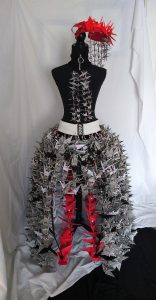
My latest project was the folding of 1000 cranes to create an origami dress. This project allowed me to combine origami fashion and the meaning of the crane into a dress that can be worn and, hopefully, help bring awareness to issues that children are facing.
If an art form can also give you a platform for raising awareness of issues important to you, if it can be shared through teaching and you can help others appreciate and experience the joy and meditative nature of the art of origami, then it will continue to be a passion for me.
Alright, so let’s dig a little deeper into the story – has it been an easy path overall, and if not, what were the challenges you’ve had to overcome?
I started folding origami because I liked to fold. But I was pushed to make money with origami. Why would you do it if you can’t make money doing it was the message. So, I tried. I folded hundreds of pairs of earrings and went to a craft show and did not have success. The message was “QUIT” – quit folding. Then I was pushed to turn the folding into an actual business and that was just messy – so much pressure and being told what to fold, how to do it, how to market it, spending money on expensive paper, on being in business. It was a fight to just be able to do something because I love to do it. I was told almost daily to stop. Give it up. Quit folding. But you don’t stop something you love to do. The ideal scenario for me, for who I am and who I want to be, would be to find more ways to share origami. To teach, to participate in festivals, to create for installations but to have this be driven by my wish to share with others the art form that I love, that gives me so much enjoyment and keeps me excited to go on to the next project.
As you know, we’re big fans of you and your work. For our readers who might not be as familiar what can you tell them about what you do?
I fold paper. And I try to do it with precision. Never rushed and always trying to do it well and to enjoy the process.
Something that sets me apart is that I am always looking at ways to use paper, color, modules and to make something that may not have been the original intention of the design. To create something people can enjoy and that may inspire others to try this art form.
I write Haiku as well and look at paper as a means of expression. Continuously looking at nature, color, trying to find ways to capture a feeling, a message, in both Haiku and Origami.
I am most proud of the origami fashion pieces I have created. It would be impossible to say that the many fantastic artists out there haven’t inspired me in some way or sparked something that led to my take on an art form. But I put a lot of thought into how to make something that is more than it would be on its own.
My 1000 crane/Senbazuru dress is the latest piece I folded, and one I am very proud of. I want this piece to help bring awareness to issues children face. Because of the story of Sasaki Sadako and also because of the many meanings behind both origami and the crane, this dress is my wish for the health and long life of children who are suffering.
HAIKU
A Senzbazuru
Recovery and Long Life
My Wish for Children
Senbazuru literally means 1,000 cranes. I chose the colors to match the red-crowned crane which is an iconic bird in Japan. The crane is a symbol of loyalty and permanence, and the mythological crane is said to live for 1,000 years.
The challenge of completing a lei of one thousand folded paper cranes is said to be rewarded with a wish.
And the folding of 1,000 cranes was more widely popularized in the story of Sasaki Sadako.
This tale relates how she was exposed to dangerous levels of radiation during the bombing of Hiroshima in 1945. She survived, but only to contract leukemia a few years later.
She was inspired by the legend of the senbazuru and so began folding cranes, She, sadly, did not succeed in her wish, however, her inspiration leads many to fold colorful paper cranes and donate them in leis at shrines across Japan, most frequently at the Peace Memorial in Hiroshima.
I want to continue to find ways to bring origami to as many people as possible
What do you like and dislike about the city?
I live outside of San Diego but can say that I love living in this area. I love the museums, restaurants, history, beauty of San Diego. The beaches are amazing, there are so many places to hike, so many events, and different areas of both the city and surrounding areas to enjoy. The traffic can be daunting if you are out at the wrong time of day, and we live in an area that gets very little rain so the dry season can be a little scary due to fire danger. But I love going to the wineries, heading to Old Town to spend the day, checking out the Embarcadero, Balboa Park, and getting a great meal at the many, many great restaurants in the city.
Contact Info:
- Instagram: https://www.instagram.com/oco_origami/