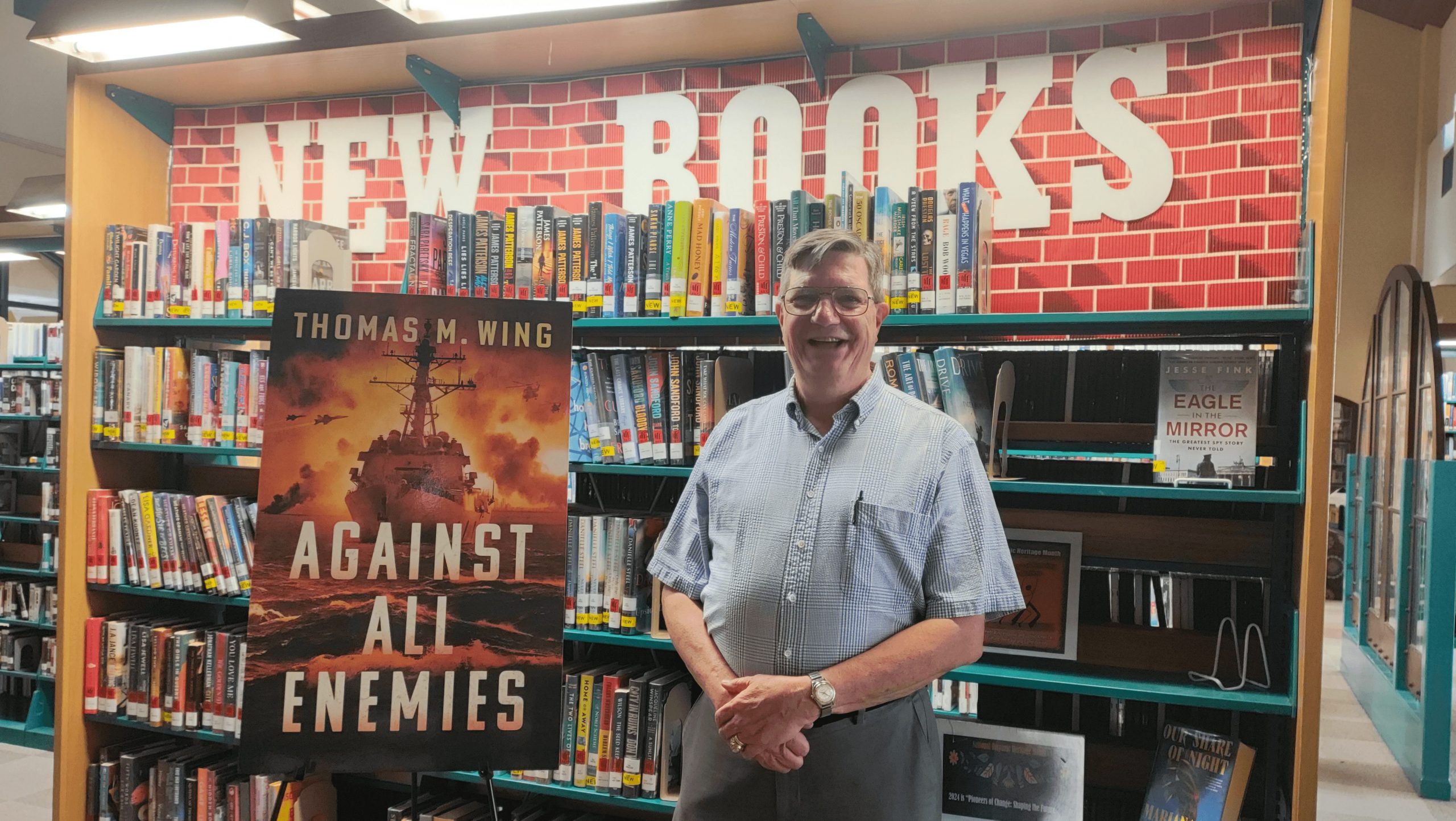
Today we’d like to introduce you to Tom Wing
Hi Tom, so excited to have you with us today. What can you tell us about your story?
I started writing in grade school, perhaps sixth or seventh grade. Mostly really dumb poetry, and a few very short stories. But I’d always made up stories in my head. I began writing them down more often in the latter part of high school, and a little bit at the Naval Academy, but I didn’t get serious until after commissioning, but before I reported to my first ship in Pearl Harbor. Being stationed there, however, really gave me the opportunity to develop more story ideas. But I didn’t have the time to flesh them out, so they became pieces of paper with concepts that floated in a file folder at home. It was no better on the second ship. However, when I was assigned to shore duty, I finally began exploring some of those concepts. I sold a short science fiction story to a newsletter here in San Diego, the Omega Chronicles, in 1991. That was when I told my wife about my “writing problem,” though we’d been married three years at that point!
I remained in the Navy on active duty for another six years, and while I found some time to write, I didn’t complete anything. I took a children’s literature correspondence course in 1995, which whetted my appetite for longer fiction, as well as giving me a huge confidence boost. I suffer terribly from imposter syndrome, even now. I read extensively as a young person, and while I loved making up stories, the thought that I might publish, when I compared myself to writers like C. S. Forester, Herman Wouk, etc….I didn’t fare well in that comparison!
I also started my first novel attempt in 1995. We were stationed in Norfolk, Virginia, at the time, and the history of the place caught my imagination. I envisioned a merchant captain swept up in the chaos of impending revolution. I outlined in detail. I began writing. By Chapter Three, I was so far off the outline, I couldn’t believe it. I went back and edited constantly, spending so much time that I didn’t actually set down much new writing. (That book is finally coming out, after MANY revisions, in April of this year, thirty years after I started it.)
I continued to dabble in writing, starting several new novels, during the late 90’s and early 2000’s. I was also deploying constantly as a Navy Reservist, so I also began writing a memoir about Citizen Sailors in the wars in Afghanistan and Iraq. Still unfinished.
In 2007, I finally worked up the courage to show someone else, besides my wife, my writing. A cousin had married a writer, Richard Keith Taylor. He’d married working as head of security at Paramount Studios with script and novel writing. By that point, he’d had two scripts bought and turned into movies, and had self-published several books. Boy, talk about hesitant! But my wife talked me into letting him look at the novel.
Richard told me later he was completely prepared to break it to me gently that I sucked. But he said as he read the story, that I had a talent. I needed to learn some craft, and hone it. But he said the structure was there, and the story “had legs.”
That gave me the confidence to keep writing, to start showing it to others, and get feedback. In 2017, I attended my first writers conference, and met my new community. I found a couple of editors who wanted to work with me. (Sadly, we lost one to stomach cancer about two years later.) I still work with one of them, Laura Taylor (not related to my late writing mentor, Richard Taylor.)
In 2018, I began querying agents for a novel I’d finished in 2016. I’d spent 2017 and 18 revising it, improving it, all while taking a creative writing certificate at UCSD. I sent it off to 34 agents, most of whom ignored it. I got five requests for a full manuscript, which is great. But three ended up sending form rejections. Another gave me some excellent feedback and a personal note. The fifth told me he’d like to work with me, but I had to cut it from 125,000 to 90,000 words. I just wasn’t able to do that in the six months he gave me.
In 2022, I showed it to Acorn Publishing co-owner, Holly Kammier. She said they’d like to work with me, if I submitted it to their editor, Laura Taylor. I’d already been getting feedback from her on my work during Read and Critique sessions, so it was easy to formalize our relationship. The book, Against All Enemies, was published in October 2023. Set in the modern day, it follows a Navy destroyer captain who must fight back, alone and unafraid, after a devastation attack on America by China.
After spending another several months revising the first novel I’d finished, I submitted that to Acorn, and again got their buy-in. After a round of editing with Laura, it entered the Acorn process in August of last year. Final release for In Harm’s Way is on 10 April this year.
I’m now working on the follow on to In Harm’s Way, titled The Sea Hawkes, which is the second in a trilogy that follows that colonial sea captain during the Revolution. I am also about one fourth of the way through another novel, set during World War II, and very loosely based on my father’s and two uncles’ service in that conflict. that one is set aside, for now, until I complete the entire Revolutionary War trilogy.
Would you say it’s been a smooth road, and if not what are some of the biggest challenges you’ve faced along the way?
It could have been a much smoother road if I had done one thing differently. Okay, two things.
The first is I should have shown my writing to others, especially other writers, MUCH sooner. Had I found a writing community and shared my work thirty years ago, I’d be a much better writer now, and have more books published. By delaying, and by not writing as much, I stunted my own growth. Once I began soliciting feedback from fellow writers, and from publishing professionals, my ability to craft my stories in more complex and meaningful ways grew substantially.
The second thing I wish I’d done was keep journals. I started one on my first ship, but destroyed it before I transferred, worried that I had classified information in my musings. In retrospect, it’s highly unlikely that I had anything to worry about. Those notes would have helped me with a future memoir, and more importantly, would have contributed to improving my writing craft.
The only other complications along the way have been the shrinking of the traditional publishing industry over the past thirty years, though I was oblivious to it until about eight years ago. It has made it harder for debut novelists, and even those who’ve already got a pretty large following, with several titles in print, to get traditional publishing deals. The massive growth of self-, hybrid-, and small press publishing has enabled thousands to get their stories out in the world, some of whom might not have gotten published. That part of the changing industry is a good thing. What is not good is that a minority of those stories would benefit from a more professional approach. There are enormous numbers of excellent self-published authors. But their product is associated with those who do not do the work to self-publish high quality works. The same goes for hybrid- and small press offerings. Most companies do excellent work. But their reputation is sullied by the small numbers who are either taking advantage of authors, or put out poor quality products.
Alright, so let’s switch gears a bit and talk business. What should we know about your work?
I’ve been working with an excellent web site and brand developer, Intrinsic Maven, who helped me identify my brand. My goal has always been to write stories about people who were not super-heroes, who were instead average people who rise to the occasion when faced with extraordinary circumstances. I’ve also always been a history buff, especially maritime history. So I combine the two. I write stories about men and women faced with historical events and dilemmas, who must find a way to achieve their own goals.
I also deeply respect history, accurate history. So I don’t take liberties with historical events. I put my characters into the events as they actually happened. My fear would be I get the history wrong, and someone reads it and believes something happened in a way that is completely wrong.
Finally, I want to be authentic. If I’m writing about what happens in the Combat Information Center of a destroyer, I want to describe that space accurately, and the events authentically. So I portray the flow of orders, the dialogue, and the myriad tasks that must be done to, for example, fire weapons to defend the ship, authentically. I am most proud of the reviews I’ve gotten from retired destroyer sailors. Several have said they felt like they were back aboard ship, smelling the coffee and “the fear.” There are many authors who write military thrillers, or historical novels. Not all take time to ensure that they use modern technology accurately or authentically, or portray historical events the way they actually happened.
Lastly, I’m very interested in eras and events that have been largely ignored by fiction writers. There are, for example, not very many novels set in North Africa and Italy during World War II. So one of my characters in my World War II novel will serve there, from the landings of Operation TORCH, through the invasions of Sicily and southern Italy, until the end of the war. There is also little about those who survived the Japanese prisoner of war camps or the Hell Ships. My uncle did. So another character in my WWII novel will experience capture in the Philippines, survive the Bataan Death March (again, as did my uncle), and more than three years as a POW.
What does success mean to you?
I’m not in this to make money, which is good because modern authors do not as a rule make a living from writing, unless they are VERY prolific. For me, success is when I get a review that says I made the reader feel what my main character felt, or they learned something. Honestly, success boils down to someone read my story and liked it.
Contact Info:
- Website: https://www.thomasmwing.com
- Instagram: https://www.instagram.com/thomas.m.wing.writer/
- Facebook: https://www.facebook.com/ThomasMWingWriter/
- LinkedIn: https://www.linkedin.com/in/thomasmwingwriter/
- Twitter: https://twitter.com/ThomasMWing1
Image Credits
Photo at Scripps Ranch Library by Michelle Sund