We recently had the chance to connect with Sofia Zaragoza and have shared our conversation below.
Hi Sofia, thank you for taking the time to reflect back on your journey with us. I think our readers are in for a real treat. There is so much we can all learn from each other and so thank you again for opening up with us. Let’s get into it: What makes you lose track of time—and find yourself again?
Something that makes me lose track of time is writing spoken word poetry. I often begin writing with no clear theme or topic in mind, but with a feeling I want to express. When I have a feeling that can’t be contained – be it joy, uncertainty, excitement, anger, whatever – writing it down on paper helps me to understand it more. It’s a way of processing my emotions that has a creative output, although it usually takes a lot longer than I expect. It can take 3 minutes or 5 hours to finish writing. Part of finding myself again is the reflection on writing when it’s finished, but also the opportunity to speak the poem out loud. When I finally perform it for someone and they are able to connect to my experience, I am able to reflect on my own situation and emotions.
Can you briefly introduce yourself and share what makes you or your brand unique?
I’m Sofia and I am a theatre artist, activist, and storyteller – based between San Diego and London. I am born and raised in San Diego, growing up in a First-Generation Mexican household in East County. While I never thought that theatre was going to be a career path for me growing up, I have now worked as a Freelance Theatre Artist for the past 11 years. I am really interested in creating new performance art that is relevant in the current social and political landscape, by sharing important messages based on social justice issues and real stories. My background of training in Theatre of The Oppressed has empowered me to tell contemporary stories which reflect the diversity in the communities around me. My skills include performing, directing, producing, teaching, and stage managing – although I’ve tried just about every job in the theatre at this point! After completing my B.A in Theatre Arts with Honors in Directing at UCSD, I went on to work for theatre’s in San Diego such as the La Jolla Playhouse, Diversionary Theatre, Blindspot Collective, TuYo Theatre, and Imagine Brave Spaces.
In 2021 I moved to London to pursue an MFA in Theatre Directing at the University of East London. In London, I have continued to build an international artistic community and explore my practice deeper. In addition to working for several theatre companies here primarily as a director and teaching artist, I have also started my own project: Off the Beat Productions. Off the Beat Productions is a collective of artists, founded in 2023 by myself and Turkish-Cypriot artivist Alara Koroglu. Off the Beat is interested in developing new work at the intersection of Theatre for Social Justice, Site-Specific, and Immersive Theatre. We look at real stories of injustice that happen around the world, and contextualize them in London as global issues which still affect our local community. Additionally, we are interested in breaking down the barriers of what spaces should be occupied for storytelling, whose stories get to be told, and elevating artists who may be in marginalized communities. Our recent work has been tackling issues of feminism, immigration, and environmental justice.
Since moving to London I’ve spent a portion of each year traveling back to San Diego to continue my work there. Most recently have been collaborating with Imagine Brave Spaces, and this Spring 2025 I was a part of a tour of the play Zion’s Story by Catherine Hanna Schrock, which is a creative and interactive human trafficking prevention and awareness program for middle and high school youth, families, and communities. I was additionally facilitating theatre workshops in schools and Short Term Residential Therapeutic Programs (STRTP’s) across San Diego and San Marcos.
With Off the Beat Productions, I am currently working on co-producing and directing the production ‘Your Favo(u)rite American Woman’ by Ciarlene Coleman (fellow San Diegan who I have known from my UCSD days), which will be presented in The Lambeth Fringe Festival. I’m also gearing up towards releasing an EP from a new musical our company has been developing, the Silent Screams EP. It will be available on Bandcamp from October 3rd 2025, for all who would like to support! The Silent Screams EP features music from the full – length musical, ‘Déjà Vu’ written by Alara Koroglu and composed by Cyrus Atkinson. We hope to re-mount this project in late 2026.
On top of those, I’m currently Stage Managing with Intermission Youth Theatre and facilitating Theatre of the Oppressed workshops with Kin Structures. I’m looking to return to San Diego for a project in 2026, as I have still been working between both cities over the past four years!
Okay, so here’s a deep one: What did you believe about yourself as a child that you no longer believe?
When I was a child, I believed that I was shy. I believed I was incredibly shy and introverted, because that’s what “good”, studious, well behaved girls acted like. In fact, I personally identified as an introvert until I left high school! When I was younger I felt very “othered” for various reasons, and maybe I had a fear of rejection if I explored connecting with others around me. Now I attribute my “shyness” to misunderstood mental health at the time.
Anyone who knows me now, knows I’m quite the opposite. I may even be the most extroverted extrovert, to ever extrovert! I love being around people all the time, recharging by spending quality time with the people I love.
Do you remember a time someone truly listened to you?
In the early days of my career, I worked as an Assistant Teaching Artist with the La Jolla Playhouse (LJP) on a program called ‘Empowerment Theatre’. Empowerment Theatre was a joint program between LJP and Girl Scouts San Diego, aimed at empowering young women through theatre. This year, we were specifically looking at themes of discrimination using Playback Theatre, a form of improvisational theatre in which someone tells a real story from their life and watches it enacted back to them on the spot. The topic of our particular playback was to “tell a story of injustice” which happened to you, or which you saw happen to someone else.
I told the story of a time I experienced discrimination when I was young, which I had never really processed at the time. The story took place when I was in 2nd grade, around 7 years old. The other students and I were lined up to go to class, and I noticed a girl in front of me had really cute rainbow tights on which I absolutely loved. I told her, “I like your medias,” to which she responded by laughing in my face and saying, “learn English, you’re in America now.” The time was impactful to me because instead of teaching my classmate that “medias” is the Spanish word for “tights”, I never spoke Spanish in school again after that.
When I told my students this story of what happened as an example of a “time of injustice”, it was the first time I had told others this story as an adult. I was so surprised and moved by just how many other people in the room had experienced something similar, and wanted to reflect on it. As part of the Playback Theatre practice, three of my students cast themselves in this scenario in this as myself, the student I talked to, and the teacher. They then improvised the scene of exactly what happened, playing back the scenario for me to witness from the outside. I felt incredibly listened to, heard, and taken into consideration. To see these young people listen to my story and to share it back to me was such a gift to reflect on. Having my story listened to in this moment was a reminder to me that using real stories in theatre is more than just for entertainment, but can be used for connection and community healing.
Sure, so let’s go deeper into your values and how you think. What’s a cultural value you protect at all costs?
The cultural value I am committed to protecting at all costs is equity. This comes into play in various leadership positions I have been in, primarily as a director, producer, and teaching artist. There are so many systemic and institutionalized inequalities in the theatre industry in terms of access, training, and opportunities. It is so important to keep these injustices in mind when building a team, and when conflict managing situations. For example, we live in a multicultural and diverse community which has denied people of color opportunities in the theatre industry for so long, specifically in acting and leadership positions. As someone now in leadership positions it is important to interrogate why this has been the case, and what we can do to make opportunities more accessible to everyone. I think the biggest part of equity is to be fair and impartial to everyone, while taking into account each person’s unique story and humanity.
Before we go, we’d love to hear your thoughts on some longer-run, legacy type questions. What do you understand deeply that most people don’t?
One thing that I understand deeply and try to put into practice, is “radical love”. Radical love is a practice and a philosophy emphasizing unconditional love despite social, cultural, and emotional barriers. Radical love is about universal connection, and can encompass activism, environmentalism, and transformation of oppression. It is understanding that unfortunately in the world we live in (and in the entertainment/ theatre industry highly), love is often seen as transactional, where only certain people are worthy of love. In a lot of theatre spaces you’re only worthy of love if you’re talented enough, or pretty enough, or have connections. On a larger scale, society tells us that people are only worthy of love if they have certain political views which align with ours, if they have a home to sleep in and smell like they showered, or if they are from a certain places and speak the same language as us.
Radical love requires deep courage to look past differences and vulnerability to acknowledge your own bias’, in order to extend love to everyone, even people who may be considered “difficult” to love. It is not giving people a pass to get away with hurting themselves or others, but that we must do ongoing active work with love to support those who are struggling in transforming into a more kind, respectful, and connected people.
Since so much of my work is community and education based, I use radical love to create spaces with collective responsibility and empathy. In my career I work with so many people – mentors, professionals, students, audience members, and peers. It took many years of “unlearning” my internal biases and deciding to not judge a person based on a first impression. Because you are human and because you are in my community, I’m going to learn to extend love to you. By demanding radical love be a basis for my relationships in life, I hope that the bit of kindness and compassion I extend can help to create a more just world.
Contact Info:
- Website: https://www.sofiazaragoza.com
- Instagram: @offthebeatproductions
- Soundcloud: https://offthebeatproductions0.bandcamp.com/
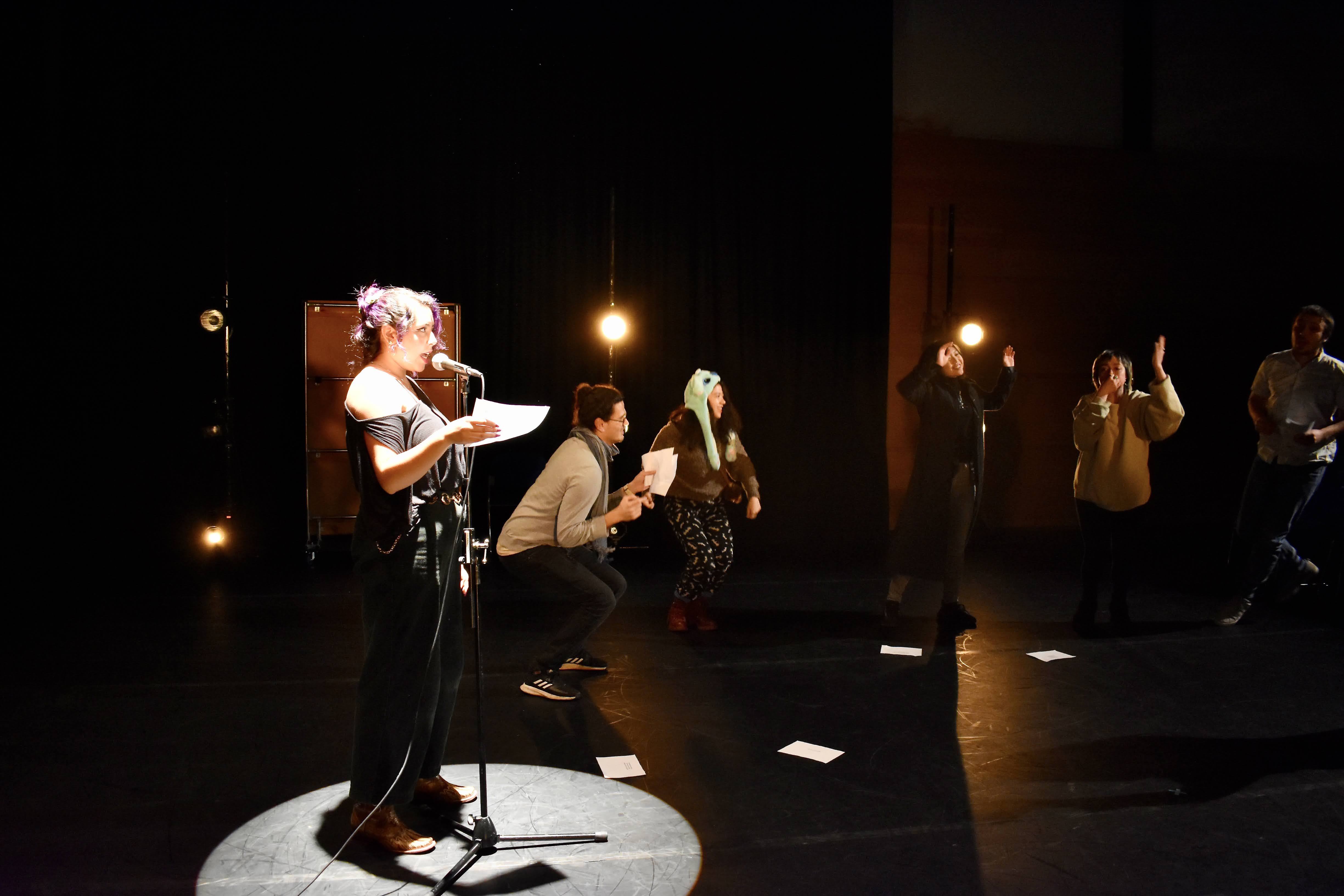
Image Credits
Daniaal Khalid