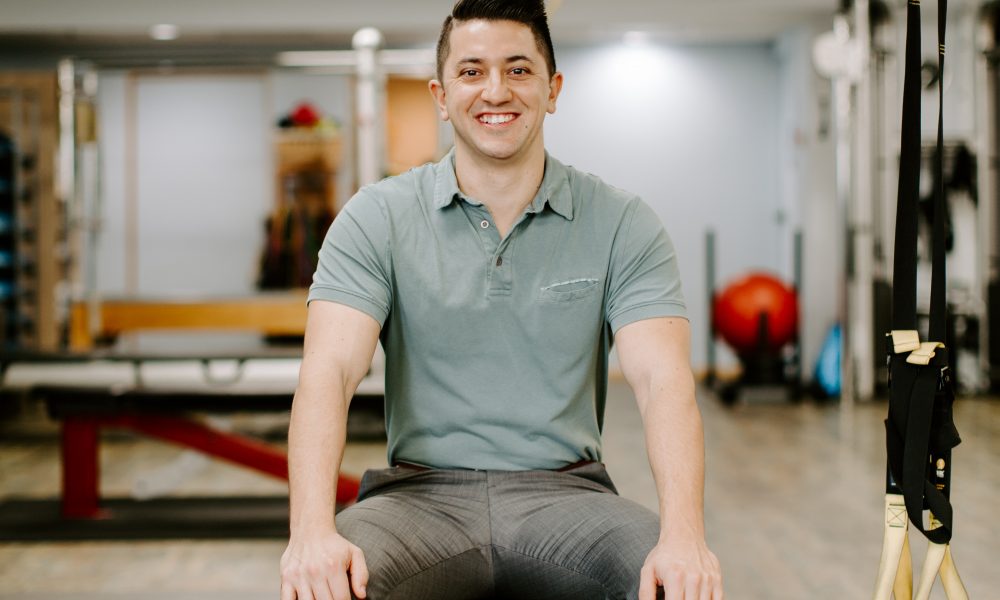
Today we’d like to introduce you to Dr. Carlos Rocha.
Dr. Rocha, please share your story with us. How did you get to where you are today?
Building a love for a career in physical therapy and fitness began with a passion I’ve always had to help others become better versions of themselves. I’m originally a native of Newark, NJ, an inner city community known more for being the auto theft hub of America than a community known for raising kids. That said, I wouldn’t have traded my youth for anything. I was lucky enough to have extremely supportive and loving parents who endured countless sacrifices to provide me and my two sisters with the opportunity to learn at private schools. This unique scenario gave me the privilege of being exposed to a modest yet diverse community that had its challenges but taught me the value of family, friendship, respect, and knowledge. As I grew older, I also learned how perspective and point of view truly affect how people experience life, and how lack of perspective can limit an individual’s experience. I am able to use that lesson today with individuals who seek help from chronic pain by teaching them that, while they may be having a prolonged uncomfortable experience, having a painful life is something they can control.
My interest in health and wellness began as a youth athlete competing in ice hockey, track, and field, basketball. I had to work hard to excel but was able to build my skillsets and compete at the state interscholastic playoffs for ice hockey and sprinting for a track. While pursuing my bachelor’s degree at Boston University, I played club ice hockey and worked as a strength and conditioning coach for pre-collegiate and collegiate D1, D2, and D3 athletes at the Athletic Enhancement Center. I learned the value that education and direction play in developing a well-rounded athlete and individual. After graduating with my bachelor’s in biology and deciding not to pursue medical school, which was my original intention, I faced a crossroads in my life.
I decided to move to San Diego in the fall of 2008 with nothing more than two suitcases, $1,500, and a promise of a personal training job in Pacific Beach. I had nothing to lose, and everything to gain. I promised my mother that, I would come out for two years and move back to New Jersey. I quickly found success in personal training and was lucky enough to build a career with a major corporate gym by moving into various managerial roles around San Diego. However, despite my professional success, I felt like something was still missing from what I could provide my clients. Often times, while working with an individual performing a movement that was seemingly innocuous and within their capacity, there would either be limitations in their range of motion or some other explainable pain.
This pattern consistently frustrated me and restrained my clients from meeting their goals until a friend of mine, who happened to be a physical therapy assistant, asked me if I had ever thought about physical therapy as an approach. Until then, my perception of physical therapy was limited to thinking “they only work with elderly people,” or “help people in hospitals.” But my friend, who also coached with me at the Olympic Training Facility, assured me there was much more than that to PT. I took it upon myself to volunteer at his clinic and immediately fell in love with the profession. I witnessed the PT’s working with individuals of all ages, capacities, and levels of fitness to move better and improve their quality of life. They had the ability to use their hands to help people achieve what previously scared a person or elicited debilitating pain. This was the bridge between the two worlds I lived in that I had been searching for. From that moment on, I knew I wanted to be a physical therapist.
Overall, has it been relatively smooth? If not, what were some of the struggles along the way?
Very little of my journey would be considered smooth to most people. Beginning with my childhood living in the inner city, it was difficult to see so many friends I had grown up with choose paths that would, unfortunately, lead to detrimental and dangerous lifestyles. Luckily, I had the unrelenting support of my family to keep me focused on my course. I was the first person in my family to ever graduate college and finish a professional graduate degree as well, so figuring out how to navigate the scholastic world was a new lesson for me.
The first time I applied to a physical therapy program, I was rejected. When I reached out to the admissions office to inquire what it would take for me to get in, the response was to give up and the amount of work I’d need to do to become eligible wasn’t worth my time and money. No words ever said to me had ever been more motivating. I immediately built out a plan of which courses I would need to take, what research I needed to complete and under what disciplines I needed to study to build myself as the ideal applicant for PT school. It took me three years from that conversation before I was accepted into a program, and it was worth it.
Obviously, going to PT school provided its own challenges, as it does for every student. However, my experience was compounded with the fact that I couldn’t get approved for enough financial aid to attend my first semester since I still had outstanding student loans from my bachelor program. There I was, after three years of struggling just to get accepted facing the reality that school could be out of my grasp simply because of finances. Luckily, my school had a part-time program, one of only two in the country at the time. The program required me to attending eight hours worth of lab every other weekend with my lecture material being completed largely online. This allowed me to work full-time and save money on loans I’d have needed for living expenses such as rent, gas, and food. I was also able to pay off a portion of my tuition out of pocket limiting my total debt accrued by the end of my program. The program was almost twice as long as the resident program but, with relentless hard work and support from my family and my fiance, I was finally able to pursue my dream. At the end of the program, I accrued only about half of the debt resident students do but was able to develop up my own private fitness business at the same time which transitioned to include physical therapy services after graduating.
Please tell us more about your work, what you are currently focused on and most proud of.
I am the owner of a physiotherapy and fitness business that specializes in the individualized evaluation and treatment of sport, work, and repetitive injuries. We also work closely with people suffering from neurological conditions such as Parkinson’s disease, Alzheimer’s disease, stroke, and concussion. Essentially, I help people with barriers to achieve their physical, functional, and fitness goals by teaching them how to move better and how to treat themselves. Our clients range from as young as six, to as old as 96 years with the philosophy that everyone should be able to walk, push, pull, carry, hinge, and squat. My business uses a combination of movement education, hands-on techniques, instrument-assisted techniques, and strength, agility, and power training to help my clients build confidence in movement, which gradually leads to competence with movement. I dictate the success of my business on how well individuals can identify their problems and self-correct because I believe in empowering my clients rather than making them dependent on me to feel better.
As a client-based business, we’re lucky enough to spend a full hour with each person, in contrast to most insurance-based clinics where you see you doctor for perhaps 20 minutes before being pushed off to an aide for exercises. To achieve lasting change, it is essential that each client understand the specifics of each movement and how the reaction to movement drives success or failure. I am proud that we’re able to give each client the one-on-one treatment they need and deserve and build a lasting relationship that all healthcare practitioners should strive to have.
Dr. Rocha’s Physiotherapy and Fitness also work closely with youth and NCAA collegiate athletes, as well as weekend warriors, to improve their performance, prevent injury, and assist with returning to sport following a setback. I’ve been fortunate to have coached and trained athletes competing in soccer, golf, basketball, baseball, ice hockey, tennis. football, and track and field. Needless to say, we’re not your traditional physical therapy clinic, as our focus is always centered around improving function through strength and movement relative to the specific goals of our clients.
If you had to go back in time and start over, would you have done anything differently?
Nothing, I’m a big believer that every mistake made is a lesson learned. Our history molds each of us into the people we are today, regardless of the history. I feel lucky to have learned from my struggles and better for it.
Contact Info:
- Address: 7777 Faye Ave Unit G-2
La Jolla, CA 92037 - Website: https://www.lajollafit.com/
- Phone: 9732226070
- Email: crocha973@gmail.com
- Instagram: https://www.instagram.com/l0sr0c/
- Yelp: https://www.yelp.com/biz/carlos-rocha-san-diego?osq=carlos+rocha


 Image Credit:
Victoria Perez Instagram: @itsvickyphotos
Getting in touch: SDVoyager is built on recommendations from the community; it’s how we uncover hidden gems, so if you know someone who deserves recognition please let us know here.
Popular
-

Hidden Gems: Local Businesses & Creatives You Should Know
-

San Diego’s Most Inspiring Stories
-

Helen Liang on Bringing North Coastal Floral Design to Life Through a More Personal, Community-Driven Retail Experience
-

Ryan Grow on Turning Personal Struggle into Atmosphere, Memory, and Meaning in The Water Remembers