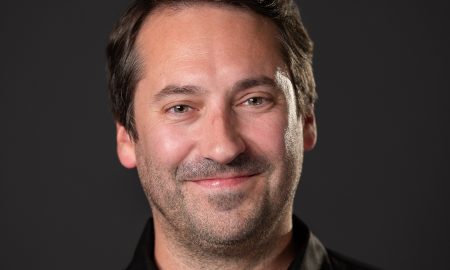
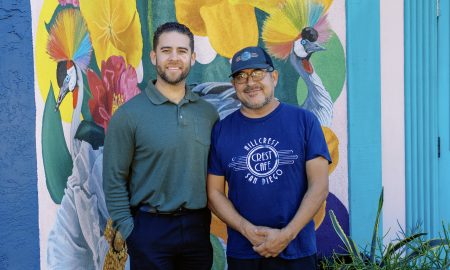
Today we’d like to introduce you to Perry Vasquez
Can you briefly walk us through your story – how you started and how you got to where you are today?
First of all, thank you for inviting me to tell my story! My name is Perry Vasquez. My father was born in East Chicago, Indiana, the son of Mexican migrant workers. My mother is a coal miner’s daughter from West Virginia. They met in Los Angeles where I was born. To say I come from a humble background would be accurate. My parents divorced when I turned 7 years old and my mother took my brother and me to live with my granny in North Carolina. I received an evangelical religious education there and while I no longer follow that faith, I’m grateful to the church ladies who taught me Biblical exegesis! That love of learning stayed with me and I went on to earn a degree in Political Science and Painting from Stanford University and an MFA in Painting from UC San Diego.
Today, I’m a faculty member at Southwestern College in Chula Vista where I teach students how to draw by imitating animals. My teaching is inspired by the Shaolin Five Animals system of gong fu. Around 600 A.D. Taoist monks at Shaolin Monastery created a system of martial arts by observing animal behaviors and translating them into gestures and movements. Drawings are made by gesture and movement as well. So anyone can draw like a tiger in the same way anyone can move or strike like a tiger – with a certain kind of a powerful gesture.
Why did you come up with this approach to drawing?
People understand animals intuitively. I wanted to harness that understanding and link it to a creative methodology for drawing. Hence the five animals – the tiger, crane, snake, praying mantis and dragon. Tigers possess grace and power, cranes possess balance and self-control, snakes use supple strength and repetitive endurance, a praying mantis teaches patience and fragile beauty and dragons ride the wind with fiery emotion.
An important Taoist principle is that a work of art, like life, is a never ending process of balancing opposite and complementary forces. This can be a useful frame through which to look at art. Take “The Scream” by Edvard Munch, the famous painting he made after experiencing an anxiety attack while walking with friends. It must’ve been intense. The Screamer in the painting seems more alien than human. We see him in a state of becoming totally unbalanced. Surprise! He does this by balancing several opposite and complementary formal relationships in the composition. For instance, the contrast between the curving lines of the Screamer and the straight, rigid lines of his buddies helps communicate the artist’s feeling of alienation from them. A straight line next to a curved line can signify many things but in this case it helps to emphasize the Screamer’s emotional isolation and instability.
Which animal do you identify with the most?
I’m a praying mantis. The paintings I make require patience. Sometimes though, I just want to be like Jackson Pollock who painted like a dragon – gracefully flinging paint while riding the wind and smoking a ciggy! Having said that, it’s important to note that the boundaries between these animal categories are fluid. It’s helpful to think of them as metaphors. Each animal represents a cognitive mode and each mode can be used to complement and support all the others.
Who or what influenced you as a young artist?
When I first began to draw I was happy to focus on copying from books. Then I started going on barn sketching expeditions in the countryside with the nice church ladies who wanted to encourage me. That’s when I realized you had to draw from nature to improve. I began to think there must be something beyond technique, though. At age 20, I read The Use of Lateral Thinking by Edward de Bono. The premise of the book is that conventional or vertical thinking is like a chain in which one thought logically follows another. By contrast, lateral thinking proceeds by moving along parallel paths that often leap over “logical” steps to reach the next level of insight. For me, it was a eureka moment. I thought, this is how artist’s think! – by using a cognitive process guided by insight rather than solely by rational calculation. People from the hard sciences call this “fuzzy” thinking. I know it sounds cute but it’s not supposed to be a compliment! However, there are some scientists who use lateral thinking. Terrence Deacon is an evolutionary biologist who wrote a book called Incomplete Nature in which he basically uses a doughnut theory to explain the development of human consciousness. In other words, what doesn’t show up in a system is just as important to its development as what does. Taking into account what isn’t there is a good example of lateral thinking.
What is the first lesson you give to students when teaching your method?
Crane-snake drawing by Norma Kascinta
The first lesson is in hybridity or mixing up categories. I ask students to consider an animal they think most represents them, second, they should choose an animal whose attributes they’d most like to develop. Next, I ask them to combine the features of those two animals into a drawing of a single animal. The results always amaze me because there’s no logical path to the final outcome. Three different students will combine a crane and a snake and each will be radically different from the others.
How do you teach technique?
Let’s say you have an idea for a picture in your head with lots of details related to mood, pattern, texture, proportion and contour. You’ve got to get it down on paper somehow so others can see it. How do you begin? I’ve created a method to capture ideas by using certain kinds of marks and gestures. I call it The Way of the Intercepting Pencil. It consists of three simple techniques and students can use them to draw many things. Martial art is relevant here in that there are three basic things it teaches: punching, kicking and blocking. If you can learn to apply these skills you can defend yourself in many situations. It’s the same with drawing. Good technique allows you to express yourself. The three techniques are:
- Grasp the Dragon’s Tail – a side to side movement of the pencil
- Cloudy Hands – a circular movement of the pencil
- Tiger’s Claw – using the pencil point to create lines and edges
Has your career in art been a smooth road? If not, what were some of the struggles along the way?
After I completed my education, I worked for eight years as a freelance illustrator before I became a teacher. They were lean years full of moments of self-doubt. What sustained me was a promise I made to myself when, as a 19 year-old, I visited Van Gogh’s grave in the village of Auvers-sur-Oise in France. The promise I made on that day was to follow the artist’s path. Over the years when I felt like quitting Van Gogh’s words always came back to me, “If there’s a voice inside your head telling you you‘re not a painter, then by all means paint, and that voice will be silenced.” Nuff said!
Can you talk about your work?
At the moment I am working on two major projects. The first is a series of oil paintings for a show at Sparks Gallery in October 2021. The subject matter is the burning palm tree. It’s a subject I’ve been drawn to for a few years now. I can’t let it go! It’s a challenging subject matter for a painter and one worthy of a Van Gogh or a Turner. It’s also emblematic of the changes the world is going through. The future of the planet hinges on so much right now. I literally can’t bear to read the latest news about climate change but somehow I find comfort in painting these canvases. I don’t know why but there’s a spirituality there. A strange mixture of beauty and violence.
The other project I’m doing is a mural for the interior of the new San Diego County Probation Office. I’ll be meeting with members of the justice involved community to learn their stories and gather ideas for the mural. I’m looking forward to this project because it will help me think about the role public art has to play in promoting the values we want to see in our communities and our democracy. I first got interested in questions about history and politics after spending a year abroad in Europe as a college student. Encountering the different nations, languages, customs and styles of government made me curious about how reality establishes itself. I came away wanting to know; Which ideas have gotten us to where we are today? What motivates us and gives us meaning as a species? To me, these are some of the most interesting questions artists can ask themselves.
Contact Info:
- Email: plvasque@gmail.com
- Website: perryvasquez.com
- Instagram: @this_is_not_a_pope
- Youtube: https://www.youtube.com/channel/UC2WOeFyxPS4IgHqfoT9fxdA
- SoundCloud: https://soundcloud.com/coconutdali

 Image Credits
Perry Vasquez, Farshid Bazmandegan