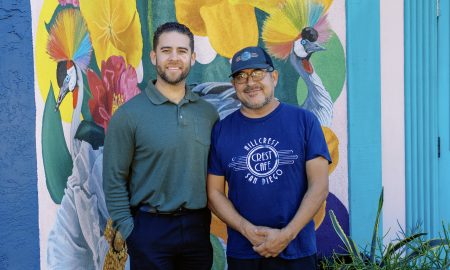
Today we’d like to introduce you to Dr. Oleg Sinyavskiy.
Dr. Sinyavskiy, can you briefly walk us through your story – how you started and how you got to where you are today.
I’ve always been interested in understanding how the brain works. That curiosity inspired me to pursue a Ph.D. in Computational Neuroscience, where I focused on understanding how to implement a method of reinforcement learning in a biologically plausible manner. While undergoing my Ph.D., I was also working on a number of robotics projects, such as robotic soccer and unmanned aerial vehicles (UAVs). During this time, what seemed completely by chance, I met Dr. Eugene Izhikevich, co-founder and CEO of Brain Corp, who told me that he was working with a newly founded startup that focused on neuroscience and robotics. I immediately applied for a job and joined Brain Corp, where over the years, I moved from a junior scientist to the Director of Research and Development. Together at Brain Corp, we worked on projects involving neuromorphic hardware for robotics with DARPA and Qualcomm. Over time, we switched our focus to a technique that applied learning by demonstration approach using deep learning. It appeared that utilizing this technique for autonomous navigation was going to be a breakthrough success. Our first successful (success meaning, scalable) application of this technique was the introduction of BrainOS powered robots into the floor care industry. This commercial application was where we found our first step into success, landing multiple contracts with high profile clients. From there we have extended the technique to other applications, such as autonomous delivery vehicles.
Great, so let’s dig a little deeper into the story – has it been an easy path overall and if not, what were the challenges you’ve had to overcome?
The journey with Brain Corp has been dynamic and exciting, to say the least. Over the course of my time with the company, we had gone through four drastic pivots trying to take extremely complex, buzzy technology and apply it to create pragmatic, scalable products. We were wary that many startups often ride the hype wave too long and end up disappearing because they don’t nail down a way to apply their technology.
Another struggle we faced was a side effect of our heavily academic background (our initial team at Brain Corp was full of Ph.D’s). It was an exercise having to juggle the balance between being a research-driven group that was trying to implement a product-driven mentality. If we fell too far into research, there was a chance we would not produce anything useful. If we only focused on short-term solutions, we would not solve the fundamental problems and beat out other competition.
Please tell us about Brain Corp.
Brain Corp is an AI company creating transformative core technology for the robotics industry. Our comprehensive solutions support the builders of today’s autonomous machines in successfully producing, deploying, and supporting commercial robots across industries and applications. Our product is BrainOS, a cloud-connected operating system for commercial autonomous robots. Wheeled form factors powered by BrainOS navigate autonomously, avoid obstacles, adapt to changing environments, manage data, generate reports, and seamlessly interact with end-users and other robots. These core capabilities are all enabled by BrainOS, empowering robot builders to focus on product differentiation and greatly streamline time to market. Since the architecture is hardware agnostic, it can be easily adapted across different form factors and drive systems: tricycles, differential drives, and other steering platforms. Each of these motorized, wheeled vehicles perform diverse, specialized functions in different environments, all while navigating their environment autonomously.
Our first successful commercial application of BrainOS was in the cleaning industry, where we applied the platform to proven manually operated floor care equipment and effectively turned those machines into self-driving robots. We currently lead the floor care market and have begun to explore other market verticals, such as the delivery space and shelf analytics. This ability to swiftly extend into new markets and applications demonstrates the strength and potential for the success of our hardware-agnostic BrainOS platform. The commercial floor care industry is just the first vertical where BrainOS can be used. There is no limit to industries where this technology can be deployed. We see opportunities in hospitals, hospitality, construction, security, and many more verticals. Beyond that, robots are able to collect vast amounts of data and convert that information into actionable insights. The ability to capture this information and serve it up in meaningful ways will also help prove the enormous value that robots will bring to the environments in which they work.
As a company, I think we ought to be most proud of our ability to scale. We truly are one of the few companies that have taken a commercial robotics technology and turned it into a useful, scalable product. We have machines equipped with state of the art navigation technology operating in a space where others have failed to deliver. There are many customer focused cleaning robots, there are safety-critical driving companies, but there are only a handful of companies that have fully autonomous, self-driving cleaning robots operating in crowded and dynamic public spaces – and that is where we are most successful, the ability to navigate in unpredictable environments.
I am personally proud of our company culture. We are an agile startup that is energized by and united behind our vision of robots everywhere, helping people.
If you had to start over, what would you have done differently?
If I could start over with all the knowledge I have now, I would focus our initial efforts on figuring out the useful product earlier (robotic navigation systems), as well as having a more sober view on often overhyped technologies like deep learning and neuroscience.

Suggest a story: SDVoyager is built on recommendations from the community; it’s how we uncover hidden gems, so if you or someone you know deserves recognition please let us know here.