


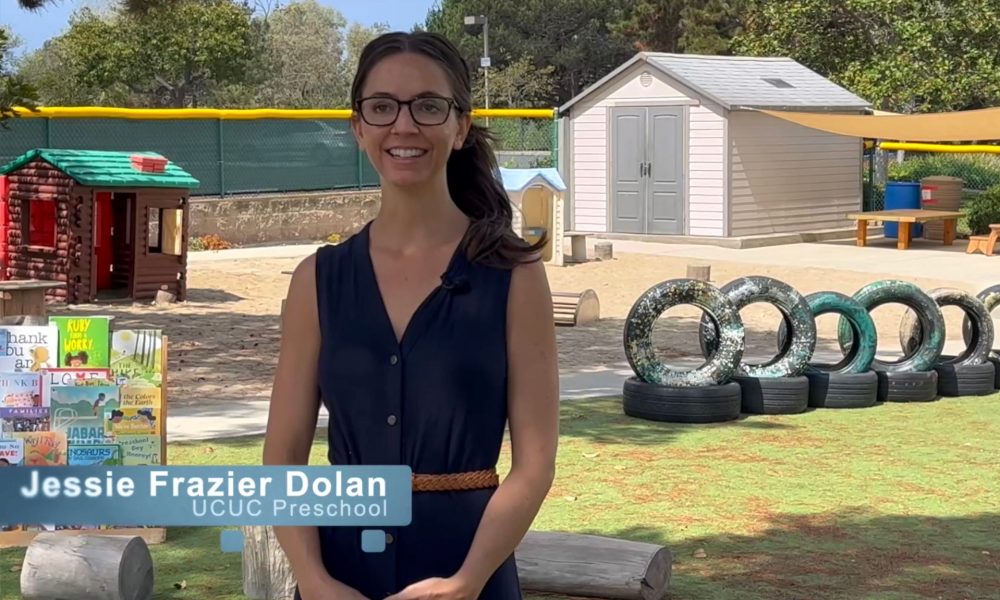
Today we’d like to introduce you to Jessica Frazier.
Hi Jessica, we’d love for you to start by introducing yourself.
My journey in Early Childhood began when I was working in a coffee shop. After I had graduated from SDSU, I knew that I wanted to work with children, but wasn’t sure in what capacity. I was working at a local coffee shop Cuppa Cuppa Coffee near SDSU when I met who would become my mentor. She came through as a customer. She was so kind that I remembered her the next time she came in. This prompted her to ask me what I wanted to do. I shared that I wanted to work with children and was drawn to the early years (preschool age). Unbeknownst to me, she was a Lead Teacher and Mentor Teacher at a local preschool. She invited me to volunteer in her classroom and my life was changed forever. The amazing staff (administration and teachers) at that school welcomed me, provided me a job, and trained me in the science of Early Childhood Education. After teaching for about 5 years, I decided to go back to school to get my Masters in Child and Family Development along with my certification as a Social Emotional Behavioral Regulation and Intervention Specialist from SDSU. I wanted to be the best teacher I could be for the children that were in my care. I continued to work during the day to save money and pay for my continued schooling. After graduating, I continued teaching and was offered a position as a Program Specialist, overseeing curriculum development and programing for the child development center.
After a few years in that position, I decided to take a leap and become a Program Director and Pedagogista for UCUC Preschool. The journey has been amazing. Together with the amazing teaching team, we transformed the school to serve as a model for emergent child-centered project-based learning. It has not been easy, especially throughout Covid. The childcare sector was hit particularly hard. Our school partners with different local organizations such as the San Diego Reggio Roundtable to help host and coordinate workshops, trainings, and continuing education for early childhood educators.
After 13 years in the field, I currently serve as the chair of the San Diego Reggio Roundtable and adjunct faculty for Grossmont Community College while still running our preschool. We have worked in collaboration with Grossmont College and Point Loma Nazarene University to provide research-based meaningful workshops and trainings rooted in best practices for educators to continue their professional development and growth.
I’m sure you wouldn’t say it’s been obstacle free, but so far would you say the journey has been a fairly smooth road?
I think everyone has struggles along their journey. The biggest challenge for me was the pandemic. Our sector operated while regular schools and many businesses were closed. We restructured our program in order to comply with the guidelines to reopen following the stay-at-home order in March 2020.
Early Childhood Education is definitely a passion career. Despite it requiring higher education, most jobs pay minimum wage and many schools do not offer benefits (i.e., health insurance) to the Early Childhood Educators. Often our field is overlooked as simply babysitting or playing with young children when the reality is so much more. There is research and science behind the intentional and purposeful environments and projects we create. While there have been conversations about the importance of Early Childhood Education on grander scale, meaningful changes to support the workers in this field have yet to happen on a large scale.
Appreciate you sharing that. What else should we know about what you do?
I work as an Early Childhood Educator. As the Program Director for UCUC Preschool, overseeing the daily operations. I also work as the Pedagogista, supporting the teacher educators in their intentional and purposeful teaching to dive deeper, look for meaning in children’s actions and words, and support, scaffold, and foster children’s development. There is a heavy focus on social-emotional development and creativity in our program. We strongly believe in creating a sense of community through meaningful connections with intentional commitments to each other. Our goal is to cultivate a wide breadth of thought and ideas as the foundation for life-derived learning. We foster social responsibility, equity, respect for nature, inquiry, and exploration through the lens of our core values. As a team, we selected 5 core values that reflect our program. These values inform our policy and practice. These values Collaboration, Creativity, Curiosity, Inclusiveness, and Kindness are what set our school apart. I am proud of the transformation our school has had and the community we have built.
This year, I am most proud of our school’s participation in an international play summit. We shared information about the importance of play in early childhood education, how to run an emergent child-centered program, and how to create a self-service atelier for children.
We’re always looking for the lessons that can be learned in any situation, including tragic ones like the Covid-19 crisis. Are there any lessons you’ve learned that you can share?
Covid-19 hit our sector extremely hard. We had stringent guidelines to follow which as times did not align with the K-12 sector. Managing the high emotions was the hardest part of the pandemic. Unfortunately, many educators bore the brunt of people’s frustrations with the ongoing pandemic. The high-stress environment did cause me as well as many of my teacher educators to question if we wanted to continue in this field. However, we continued to remind one another that we are in this profession to serve the children. We asked ourselves “what kind of world do we want to live in?” and supported one another to remember that as early childhood educators, we play a crucial role in shaping the future world. If we want to live in a world that is filled with compassion, empathy and celebrates diversity, that message first and foremost must be modeled, demonstrated, and taught to young children. Children have the most brain development during the first five years of life. Covid helped remind me that we are tasked with helping to wire the brain to support these goals. If we are able to help the children absorb these messages, then perhaps if there is a global pandemic again in the their adulthood, they will treat others with kindness, compassion, empathy, and respect.
Contact Info:
- Website: https://www.ucucpreschool.com/
- Instagram: https://www.instagram.com/ucucpreschool/?hl=en


Popular
-

Hidden Gems: Local Businesses & Creatives You Should Know
-

San Diego’s Most Inspiring Stories
-

Gina Gerrato Greenhaus on Early Intervention, Intentional Planning, and Redefining What Makes Students Stand Out
-

Desiree Borja on Reframing ADHD, Embracing Neurodivergent Strengths, and Using AI as a Tool for Equity

