


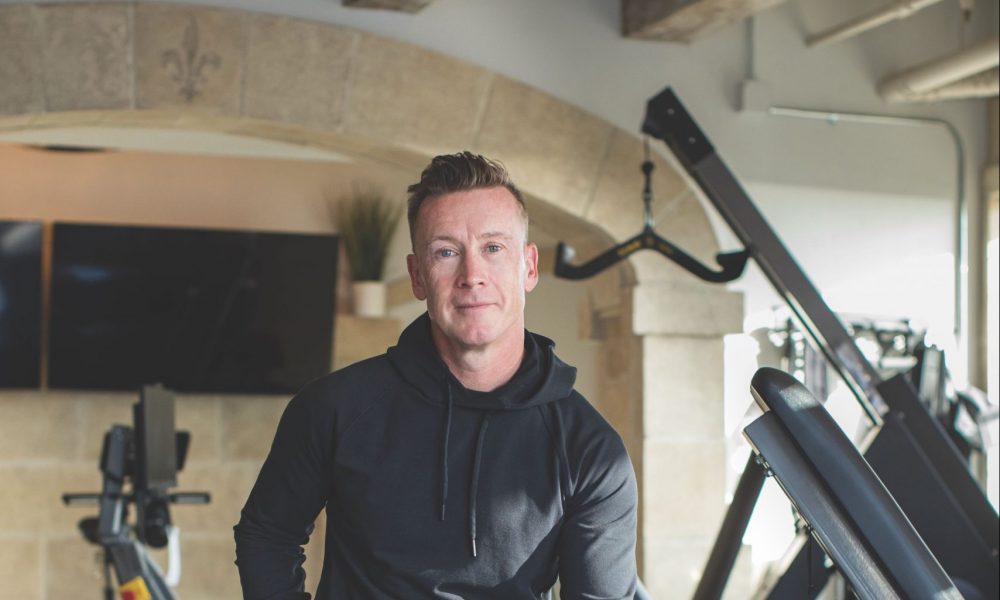
Today we’d like to introduce you to Rob Darnbrough.
Hi Rob, can you start by introducing yourself? We’d love to learn more about how you got to where you are today.
I was a competitive cyclist growing up and a traditional gym rat. I was also a serial entrepreneur who ran everything on the red line. So, I was sort of the guy who bought right into more is better–the harder you work, the more results you get…the more time you spend in the gym, the better the outcome. Until I was diagnosed with an aneurysm for over-training at age 49, and then told never to walk up a hill again by two cardiologists and never to lift anything over 30 pounds.
Having been diagnosed with that, I spent four and a half months in a deep state of depression because I went from being the fittest guy in every room to a guy who was ever allowed to work out again. So, my identity was lost, and I got really stuck in a tough position where I was trying to figure out: what do I do? I was thinking, I’m only 49. I don’t want to rupture because if I rupture, I die. I need to find a better solution. That’s when I started to look into technology and its impact on the fitness industry and trying to see if there was a better way.
That’s when I contacted Vasper and I said to them, can I use your machine, because I’m really, really intrigued by what you were doing for astronauts who are coming back from outer space with atrophy. And I thought maybe this would be a way for me to get back into shape after losing so much in just four and a half months. Because at 49 it goes fast! As you start to age, you lose it really quickly–atrophy comes in, your cardiovascular system depletes, everything. We naturally start to lose half a pound of muscle per year after age 25 and 10% of our cardiovascular system per decade. So, we’re losing a lot already, and that’s while fighting the good fight, and when you choose to stop fighting that fight like I had to, unfortunately, it goes fast.
So, I asked Vasper, can I use your equipment? And they said you’d have to go see the cardiologist who wrote paper on our equipment because we can’t tell you can for liability reasons. So, I flew to Dallas, Texas and I met with Dr. Jeffrey Gladden and he did two things with me. He first did a VO2 max on me to see how much cardiovascular system I had lost during that time. It turned out it had actually depleted to an average 54-year-old. So, at 49, I was already an average 54-year-old coming from a competitive cycling background, in which I always had a good VO2 max.
To have it go to that level was quite depressing. And seeing it going in that direction, I thought, I have to find a way out of this. He then also tested my aneurysm to see if that would cause any additional risk for a possible rupture and cleared me for that too. So, I bought the machine, and I flew back to Hawaii, where I was living, and I started working on it three times a week for 20 minutes, just using the built-in protocols. Then, three months later I flew back to Dallas and retested as VO2 max, and it had improved to that of an elite 45-year-old.
That was a light bulb moment for me that was like, wait a minute, I used to work out an hour and a half a day every day, and never did I see this kind of transformation that quickly, and now I’m working out an hour a week total. Then that got me into a deep dive of trying to figure out if there was other technology in the world of strength training and cardiovascular that was getting these kinds of results with less wear and tear and damage on the body.
So that’s how we got into it, by adding strength training and oxygen and all the other factors. I started by bringing this stuff into my house and I was working out and I was getting results. A year later, thanks to ARX, I had gained back two-thirds of the muscle (I’d lost 15 pounds of lead mass when I first got diagnosed by just atrophying). And a year later when I went to my do my VO2 max, I had an elite 30-year-old’s VO2 max–and, again, I was still just training an hour a week. So not only from a physical standpoint was I regaining my life, but also from a mental standpoint. I was actually feeling confident and feeling good about where I was and not being depressed that I was going to have to live with this horrible situation for the rest of my life.
That’s when my oldest son, Connor, came to me and said, “We’ve seen what you’ve been able to do and how you’ve come back.” Because he always knew me as this fit guy that was my world, and then watched me get hit with what I got hit with, then reversing and finding a solution out of it. He said, “Why not make this available to everyone? Would you be willing to help me start a business so I could be entrepreneurial like you were?”
So that’s how this all started. I came out of retirement and thought, I’ll help my son develop this business, but it had to be on the basis and principles that the method is what matters, not the equipment. There had to be sports science and data science supporting the convergence of these technologies. Because if it didn’t create value for people, there was no point in doing it. It wasn’t about just getting people access to a piece of equipment that was unique or different. It had to be about how do we create the most value in every situation that our members feel that they’re not compensating us enough. This is how I built my previous businesses. If you can figure that key out, then the way you get compensated is by touching more lives, not by charging more to the individual.
Then what we did is we were able to use this technology in a way that allowed people to benefit from the same principles that personal training has offered for decades, but because of technology, at a third of the price. Because if you were to go to a trainer for three sessions a week, which is what we offer, you would be in the area of about $900 a month. So, our members can come in and work out with us three times a week and they can achieve the same benefits, if not better from a health span perspective, for a third of that price and time. That’s the value proposition that we’re offering. Because, for me to come out of retirement and to help my son do this and to build this, we had to touch as many lives as possible and be able to show them what I had learned through the mistakes I had made with traditional training and what was traditionally offered through the exercise and the fitness industry.
Alright, so let’s dig a little deeper into the story – has it been an easy path overall and if not, what were the challenges you’ve had to overcome?
Well, one of the big advantages for us is that I’ve been an entrepreneur for over 30 years, and I’ve run seven different companies. So, I started with a lot of understanding of how systems and processes work, and an understanding of how to build a model that made sense. That really helped us really get the business up and running well.
At the end of the day, it was about trying to figure out how to change people’s habits. I always say goals are not beneficial. Habit-changing goals will only temporarily change your habits. In other words, if you say, I’m going to lose 10 pounds, you’ll do that, but then you’ll put 10 pounds back on. But if you invest in a method or system or process, then you’ll make changes will actually change your identity.
A good example would be if you said to somebody, would you like a cigarette? And that person says, no, I’m trying to quit. That’s a completely different identity to somebody who says, no, I’m not a smoker.
So, when you talk about changing how people see and foresee their own health and fitness, it’s about helping them develop habits that lead them to a new identity about who they are. So, they’re no longer the person trying to lose weight. They’re no longer a trying person to be fit, but they’re actually a person who identifies themselves as healthy and fit. A lot of what we’ve been building and putting time into is trying to create good habits for people and the best way to do this through better feedback loops because habits are really fed by feedback loops. That is why we quantify everything, all our data is quantified, and that’s why we’re going into 2023 with our new app, where we’re actually going to be pushing strength gains cellular age results, cardiovascular gains, body composition gains, into the app.
Because what happens is, if you want to change behavior, you have to change habits, and habits only get changed when there’s a positive response. Now, we know that good habits generally don’t give us immediate benefit, but long-term benefit; bad habits usually give us immediate gratification, but long-term damage. When you’re trying to change people’s way of perceiving health span, you have to create a positive feedback loop so that they start doing more of the things that benefit them long term. So, a lot of what we’ve been working on is how do we make you capable of skiing with your children and your grandchildren when you’re 90? Really! Not how do you get six-pack abs in six weeks.
So, now back to your question. When we look at the challenges of that we face as a business, our biggest challenge has been really making sure that we continue to manage quality over quantity, because we have 22 applications for franchising right now. So, our challenge is not expanding too quickly that we lose the ability to maintain that family experience—the feeling of being part of this facility, because it’s a big part of what we offer. It’s not just great results and access to incredible technology, but it’s also a feeling of being a part of a true community.
When you come to our flagship Cardiff location or any of our locations (La Jolla, Costa Mesa, Koloa-Kauai), you feel like you’re part of that family, and we want each of our facilities to feel like that. So that’s our challenge: how do we maintain a family feeling in our facilities while still addressing the demand that we have for expansion.
We really do want that expansion too, but we want people to feel good. Like I say, the best way to spend your days is making other people feel important. That’s the best way to live. Like I used to teach my kids growing up, the only thing you’re entitled to in this world is to go out and create value for others. There’s no other thing that you’re entitled to.
Thanks – so what else should our readers know about The Smart Fit Method?
I think the biggest thing is that we are heavily focused on health span. We are really focused on how fitness changes you at a cellular and hormonal level, which is a very different way of looking at fitness. We are also really keen on understanding: how does the body respond to the stimulus and how much stimulus is enough stimulus to get the body to respond. Because what we know is that at a certain point, once we’ve achieved enough stimulus, the body then needs time to adapt and that any additional stimulus really becomes a diminishing rate of return. So, the way we try to think out about it is that how do we give people what they need without giving them more than they need and not having them get confused by exercise effect over effective exercise. That’s our real position in the marketplace.
I always look at it this way, 8% of the population gets the minimum effective dose of exercise as recommended, which is 150 minutes of cardio and two strength training sessions a week. That’s five hours minimum in a facility–anywhere from five to seven hours, depending on how often you look at your phone while you’re working out. The reality is that when you’re 20 to 25 years of age, that’s not a difficult thing to do. Spending time in the gym every day, spending five hours a week, you get the minimum effective dose and also (and this is big) your hormones are working correctly for you. So, everything’s working in your favor. You’ve got the time and you’ve got all of the hormonal aspects necessary to receive the benefit.
But as you age, things like mortgages, family, kids, education, all these things get start to get in the way of achieving that minimal effective dose. That’s why only 8% of the population achieves it. At that later stage of life, the the challenge is that 60% of the population doesn’t even consider getting off the couch. But there’s 32% of the population who don’t necessarily have the time or the ability to get into a gym and spend five to seven hours a week. And they’re not the type of people who want to sit on their couch. So where do those people go and what do they do? What we’ve done is found a much more efficient, effective, and safer way for individuals to get the minimum effective dose of exercise, but also still maintain their lifestyle: doing the things they want to enjoy.
The next part we look at is also that the business of fitness is hyper-focused on the 20- and 30-year-old. They’re selling the sexy. They’re selling the, in the moment. Then the problem is that you’ve got a bunch of baby boomers out there who aren’t ready to throw in the towel, but they really don’t want to be in a group fitness class throwing barbells and dumbbells.
Like I always say, like, there’s a fifty-year-old guy who goes into a CrossFit, looks at the guy banging his hands together with chalk…throwing the barbell…and he’s like, that’s not me. Then he looks over at the YMCA and they’ve got a Silver Sneakers program and he goes, that’s not me. And then you’ve got the woman who’s in her fifties who goes to the group fitness class and the girl gets up on the box and goes, come on bitches…and the music’s punching…and she’s like, I don’t want to do this. And then she’s also not ready for Jazzercise. So where do they fit?
What we focus on as a business is, we look at that active ager–the busy professional, early retiree, active senior, who doesn’t belong in either of those facilities and are looking for a more efficient, a more effective way to stay healthy and not get injured.
So, before we go, how can our readers or others connect or collaborate with you? How can they support you?
Join The Smart Fit Method! Your life will change, and it will inspire others too. You know, when I came back into the fitness world to help my son develop this and support his entrepreneurial vision, a big part of this was continually building the team. Whether that be from a technology standpoint, an operational standpoint, a CFO standpoint, an infrastructure standpoint, there’s great opportunities to work with our organization to develop and change the way that people see fitness improving their health span.
Then from touching more lives perspective, we’re a franchise. So, we are heavily focused on developing and building the process and the system and the method that we need to be able to reach more members through franchisees. So, if anyone is interested in learning more about that, they can reach out to us at hello@smartfimethod.com to inquire about how they may want to bring this to their community.
Thank you for this opportunity! There is one more thing I’ve really been thinking a lot about lately: A lot of people are putting together New Year’s resolutions, and I think it’s really, really important to understand that fitness is really a mental game more than anything else. A lot of people think it’s physical, but it’s actually mental. It’s really about changing habits. It’s about how we see ourselves and how we identify with ourselves. It’s like that example I gave about the smokers.
This is the whole thing. How to reach that 32% who doesn’t identify with the 60%, and they don’t identify with the 8% who are out there working out. So how do we go about actually helping these people change the way they go about improving themselves? And my whole thing is that goals are fine, but they are temporary. Right?
If you’re going to go into the New Year and you’re going to improve your health and fitness, it’s got to be about how you establish long-term habits and that’s not about goals. It’s like this quote from the book Atomic Habits, by James Clear, “What’s the difference between systems and goals? It’s a distinction I first learned from Scott Adams (the cartoonist behind the Gilbert comics). Goals are about the results you want to achieve. Systems are about the processes that lead to the results.”
I think about that all the time when I’m thinking about what we’re trying to accomplish. How do I get people to change the way they identify with fitness? Like, I’ll say, fitness is not a punishment for what you ate or a good night out. It’s a celebration of what your humanly body’s capable of. That’s what it should be. That’s how we should think about it. Because I hear so many people saying things like, I’m going to drink this extra glass of wine, or I’m going to have this meal and then tomorrow I’ll have to run an extra mile. But if we identify with exercise of punishment, then we’re never going to have a positive relationship with how we feel as humans.
I think we have to start thinking away and one of the things this technology is it just gives us the ability to make fitness a part of our life without making our whole life about it. Because there is that joy in giving people back time and longevity and health. So, we can say, don’t come into the gym for more time or spend hours and hours on your Peloton. I want you to go enjoy nature and your friends and family. The whole point of giving you this time back is so you can get outside and do the things that this fitness is giving you the ability to go do–and with the people who matter to you. So, it’s about not just enjoying your great-grandchildren, but actually playing with them; not just sitting on a park bench watching them but being out there actually playing with them.
That’s the point, right?
Pricing:
- $299 / month for Annual Membership
- $349 / month for Monthly Membership
Contact Info:
- Website: https://www.smartfitmethod.com/
- Instagram: https://www.instagram.com/smartfitmethod
- Facebook: https://www.facebook.com/smartfitmethod


Image Credits
Tomoko Matsubayashi
Alex Clark
Popular
-

Gina Gerrato Greenhaus on Early Intervention, Intentional Planning, and Redefining What Makes Students Stand Out
-

Desiree Borja on Reframing ADHD, Embracing Neurodivergent Strengths, and Using AI as a Tool for Equity
-

San Diego’s Most Inspiring Stories
-

Hidden Gems: Local Businesses & Creatives You Should Know

